Thank you for visiting SNEWPapers!
Sign up free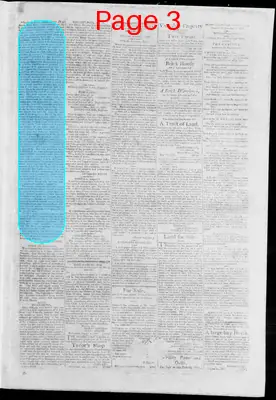
Letter to Editor
August 7, 1802
Virginia Argus
Richmond, Virginia
What is this article about?
A concerned republican responds to published accusations of Vice-President Aaron Burr's political tergiversation, particularly his alleged dealings with federalists. The writer calls for a prompt judicial investigation or a republican committee meeting to verify the claims and either exonerate Burr or condemn him, emphasizing the need for evidence over hearsay.
Clipping
OCR Quality
96%
Excellent
Full Text
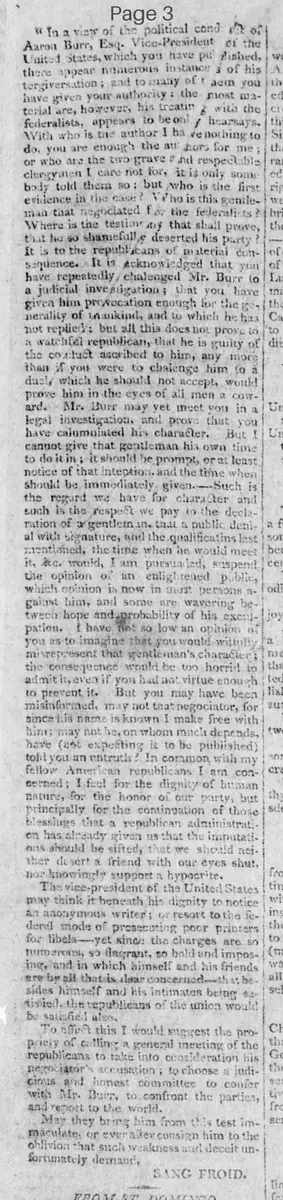
In a view of the political conduct of Aaron Burr, Esq. Vice-President of the United States, which you have published, there appear numerous instances of his tergiversation; and to many of them you have given your authority: the most material are, however, his treatment with the federalists, appears to be on hearsays. With whom is the author I have nothing to do, you are enough the authors for me; or who are the two grave and respectable clergymen I care not for, it is only somebody told them so; but who is the first evidence in the case? Who is this gentleman that negotiated for the federalists? Where is the testimony that shall prove, that he so shamefully deserted his party? It is to the republicans of material consequence. It is acknowledged that you have repeatedly challenged Mr. Burr to a judicial investigation; that you have given him provocation enough for the generality of womankind, and to which he has not replied; but all this does not prove to a watchful republican, that he is guilty of the conduct ascribed to him, any more than if you were to challenge him to a duel, which he should not accept, would prove him in the eyes of all men a coward. Mr. Burr may yet meet you in a legal investigation, and prove that you have calumniated his character. But I cannot give that gentleman his own time to do it in; it should be prompt, or at least notice of that intention, and the time when should be immediately given. Such is the regard we have for character and such is the respect we pay to the declaration of a gentleman, that a public denial with signature, and the qualifications last mentioned, the time when he would meet it, &c. would, I am persuaded, suspend the opinion of an enlightened public, which opinion is now in most persons against him, and some are wavering between hope and probability of his exculpation. I have not so low an opinion of you as to imagine that you would willfully misrepresent that gentleman's character; the consequence would be too horrid to admit it, even if you had not virtue enough to prevent it. But you may have been misinformed, may not that negotiator, or since his name is known I make free with him; may not he, on whom much depends, have (not expecting it to be published) told you an untruth? In common with my fellow American republicans I am concerned; I feel for the dignity of human nature, for the honor of our party, but principally for the continuation of those blessings that a republican administration has already given us that the imputations should be sifted, that we should neither desert a friend with our eyes shut, nor knowingly support a hypocrite. The vice-president of the United States may think it beneath his dignity to notice an anonymous writer; or resort to the federal mode of prosecuting poor printers for libels—yet since the charges are so numerous, so flagrant, so bold and imposing, and in which himself and his friends are by all that is dear concerned—besides himself and his intimates being satisfied, the republicans of the union would be satisfied also. To effect this I would suggest the propriety of calling a general meeting of the republicans to take into consideration his negotiator's accusation; to choose a judicious and honest committee to confer with Mr. Burr, to confront the parties, and report to the world. May they bring him from this test immaculate, or ever after consign him to the oblivion that such weakness and deceit unfortunately demand,
SANG FROID.
SANG FROID.
What sub-type of article is it?
Persuasive
Political
Investigative
What themes does it cover?
Politics
Morality
What keywords are associated?
Aaron Burr
Political Tergiversation
Federalists
Republicans
Judicial Investigation
Committee Meeting
Character Calumny
What entities or persons were involved?
Sang Froid.
Letter to Editor Details
Author
Sang Froid.
Main Argument
the writer demands prompt evidence and investigation into accusations of aaron burr's tergiversation with federalists, proposing a republican committee to confront parties and either clear or condemn him to protect the party's honor.
Notable Details
Analogy To Duel Challenge Not Proving Cowardice
Suggestion Of General Republican Meeting And Committee
Concern For Republican Administration's Blessings