Thank you for visiting SNEWPapers!
Sign up free
Editorial
May 24, 1843
Alexandria Gazette
Alexandria, Alexandria County, District Of Columbia
What is this article about?
An editorial from the New Hampshire Sentinel advocates for Daniel Webster, a native son, as the Whig presidential nominee for 1844, praising his statesmanship, defense against past political attacks, and role in averting war via the Treaty of Washington, while critiquing the 1841 Cabinet crisis.
Clipping
OCR Quality
98%
Excellent
Full Text
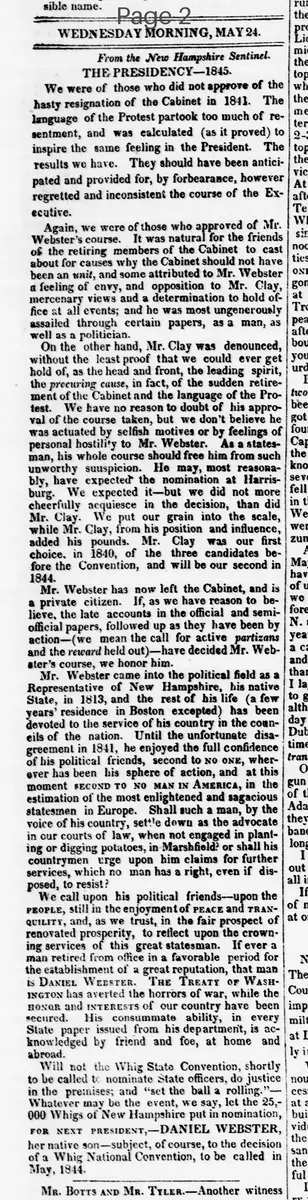
WEDNESDAY MORNING, MAY 24.
From the New Hampshire Sentinel.
THE PRESIDENCY—1845.
We were of those who did not approve of the hasty resignation of the Cabinet in 1841. The language of the Protest partook too much of resentment, and was calculated (as it proved) to inspire the same feeling in the President. The results we have. They should have been anticipated and provided for, by forbearance, however regretted and inconsistent the course of the Executive.
Again, we were of those who approved of Mr. Webster's course. It was natural for the friends of the retiring members of the Cabinet to cast about for causes why the Cabinet should not have been an unit, and some attributed to Mr. Webster a feeling of envy, and opposition to Mr. Clay, mercenary views and a determination to hold office at all events; and he was most ungenerously assailed through certain papers, as a man, as well as a politician.
On the other hand, Mr. Clay was denounced, without the least proof that we could ever get hold of, as the head and front, the leading spirit, the procuring cause, in fact, of the sudden retirement of the Cabinet and the language of the Protest. We have no reason to doubt of his approval of the course taken, but we don't believe he was actuated by selfish motives or by feelings of personal hostility to Mr. Webster. As a statesman, his whole course should free him from such unworthy suspicion. He may, most reasonably, have expected the nomination at Harrisburg. We expected it—but we did not more cheerfully acquiesce in the decision, than did Mr. Clay. We put our grain into the scale, while Mr. Clay, from his position and influence, added his pounds. Mr. Clay was our first choice, in 1840, of the three candidates before the Convention, and will be our second in 1844.
Mr. Webster has now left the Cabinet, and is a private citizen. If, as we have reason to believe, the late accounts in the official and semi-official papers, followed up as they have been by action—(we mean the call for active partisans and the reward held out)—have decided Mr. Webster's course, we honor him.
Mr. Webster came into the political field as a Representative of New Hampshire, his native State, in 1813, and the rest of his life (a few years' residence in Boston excepted) has been devoted to the service of his country in the councils of the nation. Until the unfortunate disagreement in 1841, he enjoyed the full confidence of his political friends, second to no one, wherever has been his sphere of action, and at this moment second to no man in America, in the estimation of the most enlightened and sagacious statesmen in Europe. Shall such a man, by the voice of his country, settle down as the advocate in our courts of law, when not engaged in planting or digging potatoes, in Marshfield? or shall his countrymen urge upon him claims for further services, which no man has a right, even if disposed, to resist?
We call upon his political friends—upon the PEOPLE, still in the enjoyment of PEACE and TRANQUILLITY, and, as we trust, in the fair prospect of renovated prosperity, to reflect upon the crowning services of this great statesman. If ever a man retired from office in a favorable period for the establishment of a great reputation, that man is Daniel Webster. The Treaty of Washington has averted the horrors of war, while the Honor and Interests of our country have been secured. His consummate ability, in every State paper issued from his department, is acknowledged by friend and foe, at home and abroad.
Will not the Whig State Convention, shortly to be called to nominate State officers, do justice in the premises; and "set the ball a rolling." Whatever may be the event, we say, let the 25,000 Whigs of New Hampshire put in nomination, FOR NEXT PRESIDENT,—DANIEL WEBSTER, her native son—subject, of course, to the decision of a Whig National Convention, to be called in May, 1844.
From the New Hampshire Sentinel.
THE PRESIDENCY—1845.
We were of those who did not approve of the hasty resignation of the Cabinet in 1841. The language of the Protest partook too much of resentment, and was calculated (as it proved) to inspire the same feeling in the President. The results we have. They should have been anticipated and provided for, by forbearance, however regretted and inconsistent the course of the Executive.
Again, we were of those who approved of Mr. Webster's course. It was natural for the friends of the retiring members of the Cabinet to cast about for causes why the Cabinet should not have been an unit, and some attributed to Mr. Webster a feeling of envy, and opposition to Mr. Clay, mercenary views and a determination to hold office at all events; and he was most ungenerously assailed through certain papers, as a man, as well as a politician.
On the other hand, Mr. Clay was denounced, without the least proof that we could ever get hold of, as the head and front, the leading spirit, the procuring cause, in fact, of the sudden retirement of the Cabinet and the language of the Protest. We have no reason to doubt of his approval of the course taken, but we don't believe he was actuated by selfish motives or by feelings of personal hostility to Mr. Webster. As a statesman, his whole course should free him from such unworthy suspicion. He may, most reasonably, have expected the nomination at Harrisburg. We expected it—but we did not more cheerfully acquiesce in the decision, than did Mr. Clay. We put our grain into the scale, while Mr. Clay, from his position and influence, added his pounds. Mr. Clay was our first choice, in 1840, of the three candidates before the Convention, and will be our second in 1844.
Mr. Webster has now left the Cabinet, and is a private citizen. If, as we have reason to believe, the late accounts in the official and semi-official papers, followed up as they have been by action—(we mean the call for active partisans and the reward held out)—have decided Mr. Webster's course, we honor him.
Mr. Webster came into the political field as a Representative of New Hampshire, his native State, in 1813, and the rest of his life (a few years' residence in Boston excepted) has been devoted to the service of his country in the councils of the nation. Until the unfortunate disagreement in 1841, he enjoyed the full confidence of his political friends, second to no one, wherever has been his sphere of action, and at this moment second to no man in America, in the estimation of the most enlightened and sagacious statesmen in Europe. Shall such a man, by the voice of his country, settle down as the advocate in our courts of law, when not engaged in planting or digging potatoes, in Marshfield? or shall his countrymen urge upon him claims for further services, which no man has a right, even if disposed, to resist?
We call upon his political friends—upon the PEOPLE, still in the enjoyment of PEACE and TRANQUILLITY, and, as we trust, in the fair prospect of renovated prosperity, to reflect upon the crowning services of this great statesman. If ever a man retired from office in a favorable period for the establishment of a great reputation, that man is Daniel Webster. The Treaty of Washington has averted the horrors of war, while the Honor and Interests of our country have been secured. His consummate ability, in every State paper issued from his department, is acknowledged by friend and foe, at home and abroad.
Will not the Whig State Convention, shortly to be called to nominate State officers, do justice in the premises; and "set the ball a rolling." Whatever may be the event, we say, let the 25,000 Whigs of New Hampshire put in nomination, FOR NEXT PRESIDENT,—DANIEL WEBSTER, her native son—subject, of course, to the decision of a Whig National Convention, to be called in May, 1844.
What sub-type of article is it?
Partisan Politics
What keywords are associated?
Daniel Webster
Presidential Nomination
Whig Party
Cabinet Resignation
Henry Clay
Treaty Of Washington
New Hampshire Politics
What entities or persons were involved?
Daniel Webster
Henry Clay
Whig Party
New Hampshire
President Tyler
Editorial Details
Primary Topic
Advocacy For Daniel Webster's Presidential Nomination
Stance / Tone
Strongly Supportive Of Daniel Webster
Key Figures
Daniel Webster
Henry Clay
Whig Party
New Hampshire
President Tyler
Key Arguments
Disapproval Of The Hasty Cabinet Resignation In 1841 And Its Resentful Language
Approval Of Mr. Webster's Course In Remaining In The Cabinet
Defense Of Mr. Clay Against Accusations Of Causing The Resignation
Honor For Webster's Decision To Leave The Cabinet Amid Partisan Pressures
Call Upon Whigs To Nominate Webster For President In 1844
Praise For Webster's Services, Including The Treaty Of Washington