Thank you for visiting SNEWPapers!
Sign up free
Richmond Enquirer
Richmond, Richmond County, Virginia
What is this article about?
American occupation of Pensacola by Gen. Jackson's forces in May, with Spanish complaints over capitulation terms, mixed application of laws, property seizures, and debates on authorization and consequences, as reported from Mobile and Washington.
Clipping
OCR Quality
Full Text
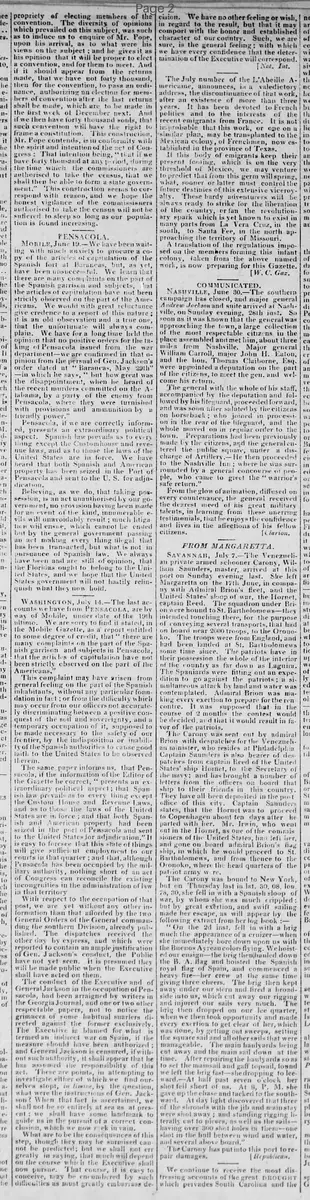
MOBILE, June 19—We have been waiting with much anxiety to procure a copy of the articles of capitulation of the Spanish fort at Barrancas, but, as yet, have been unsuccessful. We learn that there are many complaints on the part of the Spanish garrison and subjects, but the articles of capitulation have not been strictly observed on the part of the Americans. We would with great reluctance give credence to a report of this nature: it is an old observation and a true one, that the unfortunate will always complain. We have for a long time held the opinion that no positive orders for the taking of Pensacola issued from the war department—we are confirmed in that opinion from the perusal of Gen. Jackson's order dated at Barrancas, May 20th—in which he says, "but how great was the disappointment, when he heard of the recent murders committed on the Alabama, by a party of the enemy from Pensacola, where they were furnished with provisions and ammunition by a friendly power."
Pensacola, if we are correctly informed, presents an extraordinary political aspect. Spanish law prevails as to every thing except the Customhouse and revenue laws, and as to those the laws of the United States are in force. We have heard that both Spanish and American property has been seized in the Port of Pensacola and sent to the U. S. for adjudication.
Believing, as we do, that taking possession, is an act unauthorised by our government, no provision having been made for an event of the kind, innumerable evils will unavoidably result: much litigation will ensue, which cannot be ended but by the general government passing an act making every thing legal that has been transacted, but what is not in pursuance of Spanish law. We always have been and are still of opinion, that the Floridas ought to belong to the United States, and we hope that the United States government will not hastily relinquish what they now hold.
WASHINGTON, July 14.—The last accounts we have from Pensacola, are by way of Mobile, under date of the 10th ultimo. We are sorry to find it stated, in the Mobile Gazette, as a report entitled to some degree of credit, that "there are many complaints on the part of the Spanish garrison and subjects in Pensacola, that the articles of capitulation have not been strictly observed on the part of the Americans."
This complaint may have arisen from general feeling on the part of the Spanish inhabitants, without any particular foundation in fact; or from the difficulty which may occur from our officers not accurately discriminating between a positive conquest of the soil and sovereignty, and a temporary occupation of it, supposed to be made necessary to the safety of our frontier, by the indisposition or inability of the Spanish authorities to cause good faith, to the United States to be observed therein.
The same paper informs us, that Pensacola, if the information of the Editor of the Gazette be correct, "presents an extraordinary political aspect; that Spanish law prevails as to every thing except the Custom House and Revenue Laws, and as to those the laws of the United States are in force; and that both Spanish and American property had been seized in the port of Pensacola and sent to the United States for adjudication." It is easy to foresee that this state of things will give sufficient employment to our courts in that quarter; and that, although Pensacola has been occupied by the military authorities, nothing short of an act of Congress can reconcile the existing incongruities in the administration of law in that territory.
With respect to the occupation of that post, we are yet without any other information than that afforded by the two General Orders of the General commanding the southern Division, already published. The dispatches received the other day by express, and which were reported to contain an ample justification of Gen. Jackson's conduct, the Public have not yet seen. It is presumed they will be made public when the Executive shall have acted on them.
The conduct of the Executive and of General Jackson in the occupation of Pensacola, had been arraigned by writers in the Georgia Journal, and one or two other respectable papers, not to notice the grimaces of some habitual snarlers directed against the former exclusively. The Executive is blamed for what is termed an indirect war on Spain, if the measure should have been authorized; and General Jackson is censured, if without such authority, it shall appear that he has assumed the responsibility of this act. These are points, in attempting to investigate either of which we find ourselves stopped, in limine, by the question, what were the instructions of Gen. Jackson? When that fact is ascertained, we shall not be so entirely at sea as at present: we shall have some landmark to guide us in the pursuit of a correct conclusion, which we now seek in vain.
What are to be the consequences of this step, though, they may be surmised cannot be predicted; but we shall not err greatly in saying, that much will depend on the course which the Executive shall now pursue. That course, it is easy to conceive, may be encumbered by such difficulties as must greatly embarrass decision. We have no other feeling or wish, in regard to the result, but that it may comport with the honor and established character of our country. Such, we are sure, is the general feeling: with which we have every confidence that the determination of the Executive will correspond.
What sub-type of article is it?
What keywords are associated?
What entities or persons were involved?
Where did it happen?
Domestic News Details
Primary Location
Pensacola
Event Date
May 20th
Key Persons
Outcome
many complaints from spanish garrison and subjects that articles of capitulation not strictly observed by americans; both spanish and american property seized in port and sent to u.s. for adjudication; potential litigation and need for act of congress to reconcile laws.
Event Details
American forces under Gen. Jackson occupied Spanish fort at Barrancas and Pensacola following reports of enemy actions from Pensacola; Spanish law prevails except for U.S. customhouse and revenue laws; occupation unauthorized by government, leading to political and legal issues; reports from Mobile and Washington discuss complaints and implications.