Thank you for visiting SNEWPapers!
Sign up free
Literary
June 5, 1787
The New York Packet
New York, New York County, New York
What is this article about?
Descriptive essay on June as the loveliest month, detailing genial weather, blooming flowers, showers, sheep-shearing, fragrant fields of clover and beans, corn and grass growth, with poetic excerpts from Thomson, Dyer, and Milton celebrating rural nature.
Clipping
OCR Quality
95%
Excellent
Full Text
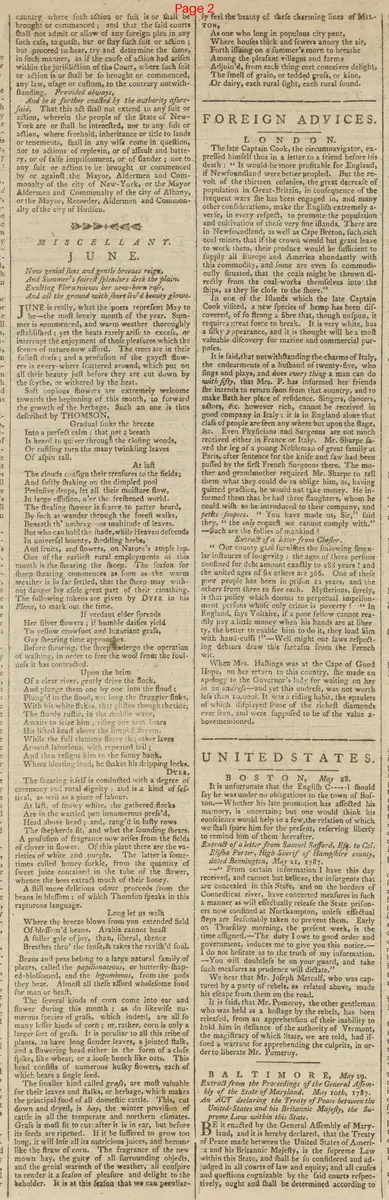
MISCELLANY.
JUNE.
Now genial suns and gentle breezes reign,
And Summer's fairest splendors deck the plain
Exulting Flora views her new-born rose,
And all the ground with short liv'd beauty glows.
JUNE is really, what the poets represent May to be--the most lovely month of the year. Summer is commenced, and warm weather thoroughly established: yet the heats rarely arise to excess, or interrupt the enjoyment of those pleasures which the scenes of nature now afford. The trees are in their fullest dress; and a profusion of the gayest flowers is every-where scattered around, which put on all their beauty just before they are cut down by the scythe, or withered by the heat.
Soft copious showers are extremely welcome towards the beginning of this month, to forward the growth of the herbage. Such an one is thus described by THOMSON,
Gradual sinks the breeze
Into a perfect calm; that not a breath
Is heard to quiver through the closing woods,
Or rustling turn the many twinkling leaves
Of aspin tall.
At last
The clouds consign their treasures to the fields;
And, softly shaking on the dimpled pool
Prelusive drops, let all their moisture flow
In large effusion, o'er the freshen'd world.
The stealing shower is scarce to patter heard,
By such as wander through the forest walks,
Beneath th' umbrageous multitude of leaves.
But who can hold the shade, while Heaven descends
In universal bounty, shedding herbs,
And fruits, and flowers, on Nature's ample lap.
One of the earliest rural employments of this month is the shearing the sheep. The season for sheep-shearing commences as soon as the warm weather is so far settled, that the sheep may with-out danger lay aside great part of their clothing.
The following tokens are given by DYER in his Fleece, to mark out the time.
If verdant elder spread
Her silver flowers; if humble daisies yield
To yellow crowfoot and luxuriant grass.
Gay shearing time approaches.
Before shearing, the sheep undergo the operation of washing, in order to free the wool from the foul-ness it has contracted.
Upon the brim
Of a clear river, gently drive the flock,
And plunge them one by one into the flood:
Plung'd in the flood, not long the struggler sinks.
With his white flakes, that glisten through the tide;
The sturdy rustic, in the middle wave,
Awaits to seize him: rising one arm bears
His lifted head above the limpid stream,
While the full clammy fleece the other laves
Around laborious, with repeated toil;
And then resigns him to the sunny bank,
Where bleating loud, he shakes his dripping locks.
DYER.
The shearing itself is conducted with a degree of ceremony and rural dignity; and is a kind of fe-stival, as well as a piece of labour.
At last, of snowy white, the gathered flocks
Are in the wattled pen innumerous press'd,
Head above head; and, rang'd in lusty rows
The shepherds sit, and whet the sounding shears.
A profusion of fragrance now arises from the fields of clover in flower. Of this plant there are the va-rieties of white and purple. The latter is some-times called honey-suckle, from the quantity of sweet juice contained in the tube of the flower, whence the bees extract much of their honey.
A still more delicious odour proceeds from the beans in bloom: of which Thomson speaks in this rapturous language.
Long let us walk
Where the breeze blows from yon extended field
Of bloom'd beans. Arabia cannot boast
A fuller gale of joy, than, liberal, thence
Breathes thro' the sense, & takes the ravish'd soul.
Beans and peas belong to a large natural family of plants, called the papilionaceous, or butterfly-shap-ed-bloomed, and the leguminous, from the pods they bear. Almost all these afford wholesome food for man or beast.
The several kinds of corn come into ear and flower during this month; as do likewise nu-merous species of grass, which indeed, are all so many lesser kinds of corn; or, rather, corn is only a larger sort of grass. It is peculiar to all this tribe of plants, to have long slender leaves, a jointed stalk, and a flowering head either in the form of a close pike, like wheat, or a loose bunch like oats. This head consists of numerous husky flowers, each of which bears a single seed.
The smaller kind called grass, are most valuable for their leaves and stalks, or herbage, which makes the principal food of all domestic cattle. This, cut down and dried, is hay, the winter provision of cattle in all the temperate and northern climates.
Grass is most fit to cut after it is in ear, but before its seeds are ripened. If it be suffered to grow too long, it will lose all its nutritious juices, and become like the straw of corn. The fragrance of the new mown hay, the gaiety of all surrounding objects, and the genial warmth of the weather, all conspire to render it a season of pleasure and delight to the beholder. It is at this season that we can peculiar-ly feel the beauty of these charming lines of MIL-TON,
As one who long in populous city pent.
Where houses thick and sewers annoy the air
Forth issuing on a summer's morn to breathe
Among the pleasant villages and farms
Adjoin'd, from each thing met conceives delight
JUNE.
Now genial suns and gentle breezes reign,
And Summer's fairest splendors deck the plain
Exulting Flora views her new-born rose,
And all the ground with short liv'd beauty glows.
JUNE is really, what the poets represent May to be--the most lovely month of the year. Summer is commenced, and warm weather thoroughly established: yet the heats rarely arise to excess, or interrupt the enjoyment of those pleasures which the scenes of nature now afford. The trees are in their fullest dress; and a profusion of the gayest flowers is every-where scattered around, which put on all their beauty just before they are cut down by the scythe, or withered by the heat.
Soft copious showers are extremely welcome towards the beginning of this month, to forward the growth of the herbage. Such an one is thus described by THOMSON,
Gradual sinks the breeze
Into a perfect calm; that not a breath
Is heard to quiver through the closing woods,
Or rustling turn the many twinkling leaves
Of aspin tall.
At last
The clouds consign their treasures to the fields;
And, softly shaking on the dimpled pool
Prelusive drops, let all their moisture flow
In large effusion, o'er the freshen'd world.
The stealing shower is scarce to patter heard,
By such as wander through the forest walks,
Beneath th' umbrageous multitude of leaves.
But who can hold the shade, while Heaven descends
In universal bounty, shedding herbs,
And fruits, and flowers, on Nature's ample lap.
One of the earliest rural employments of this month is the shearing the sheep. The season for sheep-shearing commences as soon as the warm weather is so far settled, that the sheep may with-out danger lay aside great part of their clothing.
The following tokens are given by DYER in his Fleece, to mark out the time.
If verdant elder spread
Her silver flowers; if humble daisies yield
To yellow crowfoot and luxuriant grass.
Gay shearing time approaches.
Before shearing, the sheep undergo the operation of washing, in order to free the wool from the foul-ness it has contracted.
Upon the brim
Of a clear river, gently drive the flock,
And plunge them one by one into the flood:
Plung'd in the flood, not long the struggler sinks.
With his white flakes, that glisten through the tide;
The sturdy rustic, in the middle wave,
Awaits to seize him: rising one arm bears
His lifted head above the limpid stream,
While the full clammy fleece the other laves
Around laborious, with repeated toil;
And then resigns him to the sunny bank,
Where bleating loud, he shakes his dripping locks.
DYER.
The shearing itself is conducted with a degree of ceremony and rural dignity; and is a kind of fe-stival, as well as a piece of labour.
At last, of snowy white, the gathered flocks
Are in the wattled pen innumerous press'd,
Head above head; and, rang'd in lusty rows
The shepherds sit, and whet the sounding shears.
A profusion of fragrance now arises from the fields of clover in flower. Of this plant there are the va-rieties of white and purple. The latter is some-times called honey-suckle, from the quantity of sweet juice contained in the tube of the flower, whence the bees extract much of their honey.
A still more delicious odour proceeds from the beans in bloom: of which Thomson speaks in this rapturous language.
Long let us walk
Where the breeze blows from yon extended field
Of bloom'd beans. Arabia cannot boast
A fuller gale of joy, than, liberal, thence
Breathes thro' the sense, & takes the ravish'd soul.
Beans and peas belong to a large natural family of plants, called the papilionaceous, or butterfly-shap-ed-bloomed, and the leguminous, from the pods they bear. Almost all these afford wholesome food for man or beast.
The several kinds of corn come into ear and flower during this month; as do likewise nu-merous species of grass, which indeed, are all so many lesser kinds of corn; or, rather, corn is only a larger sort of grass. It is peculiar to all this tribe of plants, to have long slender leaves, a jointed stalk, and a flowering head either in the form of a close pike, like wheat, or a loose bunch like oats. This head consists of numerous husky flowers, each of which bears a single seed.
The smaller kind called grass, are most valuable for their leaves and stalks, or herbage, which makes the principal food of all domestic cattle. This, cut down and dried, is hay, the winter provision of cattle in all the temperate and northern climates.
Grass is most fit to cut after it is in ear, but before its seeds are ripened. If it be suffered to grow too long, it will lose all its nutritious juices, and become like the straw of corn. The fragrance of the new mown hay, the gaiety of all surrounding objects, and the genial warmth of the weather, all conspire to render it a season of pleasure and delight to the beholder. It is at this season that we can peculiar-ly feel the beauty of these charming lines of MIL-TON,
As one who long in populous city pent.
Where houses thick and sewers annoy the air
Forth issuing on a summer's morn to breathe
Among the pleasant villages and farms
Adjoin'd, from each thing met conceives delight
What sub-type of article is it?
Essay
Poem
What themes does it cover?
Agriculture Rural
Nature
Seasonal Cycle
What keywords are associated?
June
Nature
Sheep Shearing
Rural Employments
Poetic Descriptions
Flowers
Grass
Hay
Thomson
Dyer
Milton
Literary Details
Title
Miscellany. June.
Form / Style
Prose Essay With Incorporated Poetic Excerpts On Rural June
Key Lines
Now Genial Suns And Gentle Breezes Reign,
And Summer's Fairest Splendors Deck The Plain
Exulting Flora Views Her New Born Rose,
And All The Ground With Short Liv'd Beauty Glows.
Gradual Sinks The Breeze
Into A Perfect Calm; That Not A Breath
Is Heard To Quiver Through The Closing Woods,
Or Rustling Turn The Many Twinkling Leaves
Of Aspin Tall.
If Verdant Elder Spread
Her Silver Flowers; If Humble Daisies Yield
To Yellow Crowfoot And Luxuriant Grass.
Gay Shearing Time Approaches.
Long Let Us Walk
Where The Breeze Blows From Yon Extended Field
Of Bloom'd Beans. Arabia Cannot Boast
A Fuller Gale Of Joy, Than, Liberal, Thence
Breathes Thro' The Sense, & Takes The Ravish'd Soul.
As One Who Long In Populous City Pent.
Where Houses Thick And Sewers Annoy The Air
Forth Issuing On A Summer's Morn To Breathe
Among The Pleasant Villages And Farms
Adjoin'd, From Each Thing Met Conceives Delight