Thank you for visiting SNEWPapers!
Sign up free
Winchester Gazette
Winchester, Virginia
What is this article about?
John C. Hamilton was executed in Kentucky in 1817 for murdering Dr. Sanderson of Natchez, MS, based on circumstantial evidence despite his innocence. A recent execution in Mobile revealed the true murderer's confession, exonerating Hamilton posthumously. The tale warns against convicting on indirect proof.
Merged-components note: These two components continue the same story about the wrongful execution of John C. Hamilton for the murder of Doctor Sanderson.
Clippings
1 of 2
OCR Quality
Full Text
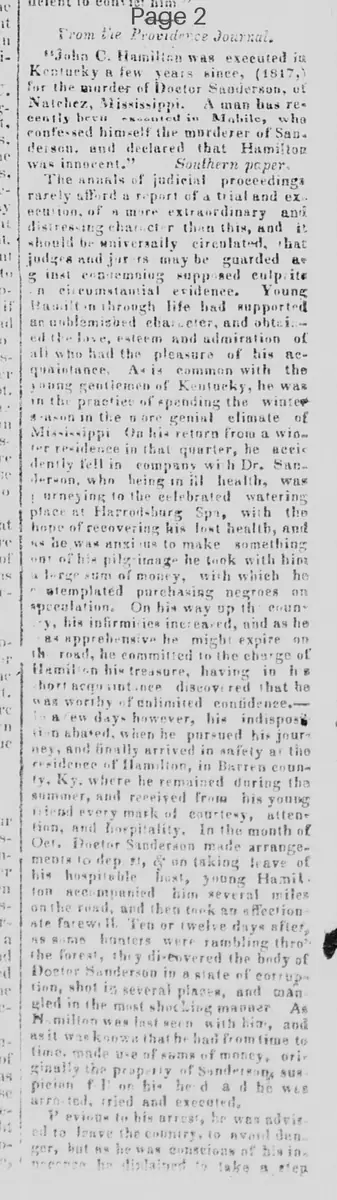
John C. Hamilton was executed in Kentucky a few years since, (1817,) for the murder of Doctor Sanderson, of Natchez, Mississippi. A man has recently been executed in Mobile, who confessed himself the murderer of Sanderson, and declared that Hamilton was innocent.
[Southern paper.]
The annals of judicial proceedings rarely afford a report of a trial and execution, of a more extraordinary and distressing character than this, and it should be universally circulated, that judges and juries may be guarded against condemning supposed culprits on circumstantial evidence. Young Hamilton through life had supported an unblemished character, and obtained the close esteem and admiration of all who had the pleasure of his acquaintance. As common with the young gentlemen of Kentucky, he was in the practice of spending the winter season in the more genial climate of Mississippi. On his return from a winter residence in that quarter, he accidentally fell in company with Dr. Sanderson, who being in ill health, was journeying to the celebrated watering place at Harrodsburg Springs, with the hope of recovering his lost health, and as he was anxious to make something on his pilgrimage he took with him a large sum of money, with which he contemplated purchasing negroes on speculation. On his way up the country, his infirmities increased, and as he was apprehensive he might expire on the road, he committed to the charge of Hamilton his treasure, having in his short acquaintance discovered that he was worthy of unlimited confidence. A few days however, his indisposition abated, when he pursued his journey, and finally arrived safely at the residence of Hamilton, in Barren county, Ky. where he remained during the summer, and received from his young friend every mark of courtesy, attention, and hospitality. In the month of Oct, Doctor Sanderson made arrangements to depart, on taking leave of his hospitable host, young Hamilton accompanied him several miles on the road, and then took an affectionate farewell. Ten or twelve days after, as some hunters were rambling through the forest, they discovered the body of Doctor Sanderson in a state of corruption, shot in several places, and mangled in the most shocking manner. As Hamilton was last seen with him, and as it was known that he had from time to time, made use of sums of money, originally the property of Sanderson suspicion fell on him. He was arrested, tried and executed. Previous to his arrest, he was advised to leave the country, to avoid danger, but as he was conscious of having hands unstained he disdained to take a step which would cast a cloud of obloquy and disgrace upon his character, and resolutely remained at home. As the inhabitants of the county were divided in their opinions as to their guilt, the affair gradually died away; but Hamilton being anxious that a trial should take place, firmly believing that in such an event his reputation would remain unspotted, he solicited at the hands of justice a trial, which to his astonishment and sorrow closed with his condemnation. The only evidence against him was circumstantial viz: that near the body of Sanderson were found a bloody pair of pantaloons, and a pistol, both bearing the name of Hamilton. Through the whole of the trial he manifested that fortitude and determined coolness, characteristic of innocence, and expired with a full conviction that the real murderer would ultimately be discovered. When on the scaffold he took a manly leave of the world, expressed not the least regret for his fate, but lamented that his misfortunes would cloud the prospects of his family, and shed an indelible disgrace on his memory. Thus, through the weakness of the law, was an interesting young man and a worthy citizen hurried from the world, and doomed to expiate on the gallows, that crime, committed by the hands of a villain and assassin. It may be proper for the welfare of the world, to pass sentence on the accused, on the authority of circumstantial evidence, but it would be far better, by statute, to annul the practice; and it was the opinion of Lord Hale, that it were better to suffer ninety guilty persons to escape, than to punish, unjustly, one that is innocent.
What sub-type of article is it?
What themes does it cover?
What keywords are associated?
What entities or persons were involved?
Where did it happen?
Story Details
Key Persons
Location
Kentucky, Mississippi
Event Date
1817
Story Details
John C. Hamilton was wrongly executed in 1817 for the murder of Dr. Sanderson after entrusting him with money during travel. Circumstantial evidence led to his conviction despite his innocence and good character. A later confession by the true murderer in Mobile proved Hamilton's innocence, highlighting dangers of circumstantial evidence.