Thank you for visiting SNEWPapers!
Sign up free
Letter to Editor
June 7, 1771
The New Hampshire Gazette And Historical Chronicle
Portsmouth, Greenland, Rockingham County, New Hampshire
What is this article about?
Syphax satirically critiques recent letters by female correspondents Charlotte, Lucretia, and Portia on matrimony, arguing that modern women prefer titles, fortune, and flattery over virtue in husbands, and mocks unmarried women's complaints in a May 1774 gazette context.
Clipping
OCR Quality
95%
Excellent
Full Text
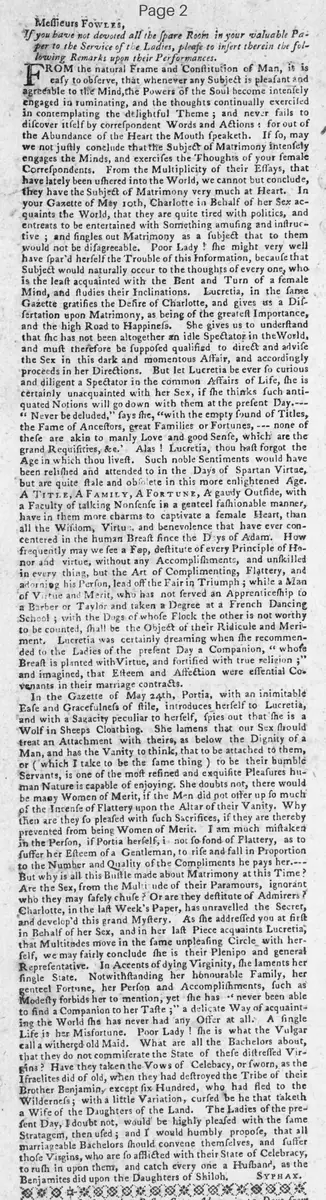
Messieurs Fowles,
If you have not devoted all the spare Room in your valuable Paper to the Service of the Ladies, please to insert therein the following Remarks upon their Performances.
From the natural Frame and Constitution of Man, it is easy to observe, that whenever any Subject is pleasant and agreeable to the Mind, the Powers of the Soul become intensely engaged in ruminating, and the thoughts continually exercised in contemplating the delightful Theme; and never fails to discover itself by correspondent Words and Actions: for out of the Abundance of the Heart the Mouth speaketh. If so, may we not justly conclude that the Subject of Matrimony intensely engages the Minds, and exercises the Thoughts of your female Correspondents. From the Multiplicity of their Essays, that have lately been ushered into the World, we cannot but conclude, they have the Subject of Matrimony very much at Heart. In your Gazette of May 10th, Charlotte in Behalf of her Sex acquaints the World, that they are quite tired with politics, and entreats to be entertained with Something amusing and instructive; and singles out Matrimony as a Subject that to them would not be disagreeable. Poor Lady! she might very well have spared herself the Trouble of this Information, because that Subject would naturally occur to the thoughts of every one, who is the least acquainted with the Bent and Turn of a female Mind, and studies their Inclinations. Lucretia, in the same Gazette gratifies the Desire of Charlotte, and gives us a Dissertation upon Matrimony, as being of the greatest Importance, and the high Road to Happiness. She gives us to understand that she has not been altogether an idle Spectator in the World, and must therefore be supposed qualified to direct and advise the Sex in this dark and momentous Affair, and accordingly proceeds in her Directions. But let Lucretia be ever so curious and diligent a Spectator in the common Affairs of Life, she is certainly unacquainted with her Sex, if she thinks such antiquated Notions will go down with them at the present Day.--- "Never be deluded," says she, "with the empty sound of Titles, the Fame of Ancestors, great Families or Fortunes, --- none of these are akin to manly Love and good Sense, which are the grand Requisites, &c.' Alas! Lucretia, thou hast forgot the Age in which thou livest. Such noble Sentiments would have been relished and attended to in the Days of Spartan Virtue, but are quite stale and obsolete in this more enlightened Age. A TITLE, A FAMILY, A FORTUNE, A gaudy Outside, with a Faculty of talking Nonsense in a genteel fashionable manner, have in them more charms to captivate a female Heart, than all the Wisdom, Virtue, and Benevolence that have ever centered in the human Breast since the Days of Adam. How frequently may we see a Fop, destitute of every Principle of Honor and Virtue, without any Accomplishments, and un-skilled in every thing, but the Art of Complimenting, Flattery, and adorning his Person, lead off the Fair in Triumph; while a Man of Virtue and Merit, who has not served an Apprenticeship to a Barber or Taylor and taken a Degree at a French Dancing School; with the Dogs of whose Flock the other is not worthy to be counted, shall be the Object of their Ridicule and Merriment. Lucretia was certainly dreaming when she recommended to the Ladies of the present Day a Companion, "whose Breast is planted with Virtue, and fortified with true Religion;" and imagined, that Esteem and Affection were essential Covenants in their Marriage Contracts.
In the Gazette of May 24th, Portia, with an inimitable Ease and Gracefulness of Style, introduces herself to Lucretia, and with a Sagacity peculiar to herself, spies out that she is a Wolf in Sheep's Clothing. She laments that our Sex should treat an Attachment with theirs, as below the Dignity of a Man, and has the Vanity to think, that to be attached to them, or (which I take to be the same thing) to be their humble Servants, is one of the most refined and exquisite Pleasures human Nature is capable of enjoying. She doubts not, there would be many Women of Merit, if the Men did not offer up so much of the Incense of Flattery upon the Altar of their Vanity. Why then are they so pleased with such Sacrifices, if they are thereby prevented from being Women of Merit. I am much mistaken in the Person, if Portia herself, is not so fond of Flattery, as to suffer her Esteem of a Gentleman, to rise and fall in Proportion to the Number and Quality of the Compliments he pays her.-- But why is all this Bustle made about Matrimony at this Time? Are the Sex, from the Multitude of their Paramours, ignorant who they may safely choose? Or are they destitute of Admirers? Charlotte, in the last Week's Paper, has unravelled the Secret, and developed this grand Mystery. As she addressed you at first in Behalf of her Sex, and in her last Piece acquaints Lucretia, that Multitudes move in the same unpleasant Circle with herself, we may fairly conclude she is their Plenipo and general Representative. In Accents of dying Virginity, she laments her single State. Notwithstanding her honourable Family, her genteel Fortune, her Person and Accomplishments, such as Modesty forbids her to mention, yet she has 'never been able to find a Companion to her Taste;' a delicate Way of acquainting the World she has never had any Offer at all. A single Life is her Misfortune. Poor Lady! she is what the Vulgar call a withered old Maid. What are all the Bachelors about, that they do not commiserate the State of these distressed Virgins? Have they taken the Vows of Celibacy, or sworn, as the Israelites did of old, when they had destroyed the Tribe of their Brother Benjamin, except six Hundred, who had fled to the Wilderness; with a little Variation, cursed be he that taketh a Wife of the Daughters of the Land. The Ladies of the present Day, I doubt not, would' be highly pleased with the same Stratagem, then used; and I would humbly propose, that all marriageable Bachelors should convene themselves, and suffer those Virgins, who are so afflicted with their State of Celibacy, to rush in upon them, and catch every one a Husband, as the Benjamites did upon the Daughters of Shiloh.
SYPHAX.
If you have not devoted all the spare Room in your valuable Paper to the Service of the Ladies, please to insert therein the following Remarks upon their Performances.
From the natural Frame and Constitution of Man, it is easy to observe, that whenever any Subject is pleasant and agreeable to the Mind, the Powers of the Soul become intensely engaged in ruminating, and the thoughts continually exercised in contemplating the delightful Theme; and never fails to discover itself by correspondent Words and Actions: for out of the Abundance of the Heart the Mouth speaketh. If so, may we not justly conclude that the Subject of Matrimony intensely engages the Minds, and exercises the Thoughts of your female Correspondents. From the Multiplicity of their Essays, that have lately been ushered into the World, we cannot but conclude, they have the Subject of Matrimony very much at Heart. In your Gazette of May 10th, Charlotte in Behalf of her Sex acquaints the World, that they are quite tired with politics, and entreats to be entertained with Something amusing and instructive; and singles out Matrimony as a Subject that to them would not be disagreeable. Poor Lady! she might very well have spared herself the Trouble of this Information, because that Subject would naturally occur to the thoughts of every one, who is the least acquainted with the Bent and Turn of a female Mind, and studies their Inclinations. Lucretia, in the same Gazette gratifies the Desire of Charlotte, and gives us a Dissertation upon Matrimony, as being of the greatest Importance, and the high Road to Happiness. She gives us to understand that she has not been altogether an idle Spectator in the World, and must therefore be supposed qualified to direct and advise the Sex in this dark and momentous Affair, and accordingly proceeds in her Directions. But let Lucretia be ever so curious and diligent a Spectator in the common Affairs of Life, she is certainly unacquainted with her Sex, if she thinks such antiquated Notions will go down with them at the present Day.--- "Never be deluded," says she, "with the empty sound of Titles, the Fame of Ancestors, great Families or Fortunes, --- none of these are akin to manly Love and good Sense, which are the grand Requisites, &c.' Alas! Lucretia, thou hast forgot the Age in which thou livest. Such noble Sentiments would have been relished and attended to in the Days of Spartan Virtue, but are quite stale and obsolete in this more enlightened Age. A TITLE, A FAMILY, A FORTUNE, A gaudy Outside, with a Faculty of talking Nonsense in a genteel fashionable manner, have in them more charms to captivate a female Heart, than all the Wisdom, Virtue, and Benevolence that have ever centered in the human Breast since the Days of Adam. How frequently may we see a Fop, destitute of every Principle of Honor and Virtue, without any Accomplishments, and un-skilled in every thing, but the Art of Complimenting, Flattery, and adorning his Person, lead off the Fair in Triumph; while a Man of Virtue and Merit, who has not served an Apprenticeship to a Barber or Taylor and taken a Degree at a French Dancing School; with the Dogs of whose Flock the other is not worthy to be counted, shall be the Object of their Ridicule and Merriment. Lucretia was certainly dreaming when she recommended to the Ladies of the present Day a Companion, "whose Breast is planted with Virtue, and fortified with true Religion;" and imagined, that Esteem and Affection were essential Covenants in their Marriage Contracts.
In the Gazette of May 24th, Portia, with an inimitable Ease and Gracefulness of Style, introduces herself to Lucretia, and with a Sagacity peculiar to herself, spies out that she is a Wolf in Sheep's Clothing. She laments that our Sex should treat an Attachment with theirs, as below the Dignity of a Man, and has the Vanity to think, that to be attached to them, or (which I take to be the same thing) to be their humble Servants, is one of the most refined and exquisite Pleasures human Nature is capable of enjoying. She doubts not, there would be many Women of Merit, if the Men did not offer up so much of the Incense of Flattery upon the Altar of their Vanity. Why then are they so pleased with such Sacrifices, if they are thereby prevented from being Women of Merit. I am much mistaken in the Person, if Portia herself, is not so fond of Flattery, as to suffer her Esteem of a Gentleman, to rise and fall in Proportion to the Number and Quality of the Compliments he pays her.-- But why is all this Bustle made about Matrimony at this Time? Are the Sex, from the Multitude of their Paramours, ignorant who they may safely choose? Or are they destitute of Admirers? Charlotte, in the last Week's Paper, has unravelled the Secret, and developed this grand Mystery. As she addressed you at first in Behalf of her Sex, and in her last Piece acquaints Lucretia, that Multitudes move in the same unpleasant Circle with herself, we may fairly conclude she is their Plenipo and general Representative. In Accents of dying Virginity, she laments her single State. Notwithstanding her honourable Family, her genteel Fortune, her Person and Accomplishments, such as Modesty forbids her to mention, yet she has 'never been able to find a Companion to her Taste;' a delicate Way of acquainting the World she has never had any Offer at all. A single Life is her Misfortune. Poor Lady! she is what the Vulgar call a withered old Maid. What are all the Bachelors about, that they do not commiserate the State of these distressed Virgins? Have they taken the Vows of Celibacy, or sworn, as the Israelites did of old, when they had destroyed the Tribe of their Brother Benjamin, except six Hundred, who had fled to the Wilderness; with a little Variation, cursed be he that taketh a Wife of the Daughters of the Land. The Ladies of the present Day, I doubt not, would' be highly pleased with the same Stratagem, then used; and I would humbly propose, that all marriageable Bachelors should convene themselves, and suffer those Virgins, who are so afflicted with their State of Celibacy, to rush in upon them, and catch every one a Husband, as the Benjamites did upon the Daughters of Shiloh.
SYPHAX.
What sub-type of article is it?
Satirical
Social Critique
Provocative
What themes does it cover?
Social Issues
Morality
What keywords are associated?
Matrimony
Female Inclinations
Marriage Satire
Virtue Vs Fortune
Spinsters
Flattery
Bachelors
What entities or persons were involved?
Syphax.
Messieurs Fowles
Letter to Editor Details
Author
Syphax.
Recipient
Messieurs Fowles
Main Argument
modern women prioritize superficial qualities like titles, family, fortune, and flattery over virtue and sense in choosing husbands, rendering advice on esteem and affection obsolete; the writer mocks unmarried women's laments and proposes a satirical solution for bachelors and spinsters.
Notable Details
Critiques Charlotte's Request For Matrimony Topics
Mocks Lucretia's Advice Against Titles And Fortunes
References Portia's Views On Flattery And Attachment
Alludes To Biblical Story Of Benjamites And Daughters Of Shiloh
Contrasts Spartan Virtue With Modern 'Enlightened' Preferences