Thank you for visiting SNEWPapers!
Sign up free
Letter to Editor
May 5, 1819
Alexandria Gazette & Daily Advertiser
Alexandria, Virginia
What is this article about?
Letter from Alexandria, May 5, 1819, continuing advocacy for early Bible study in schools, emphasizing its literary sublimity, poetic superiority to pagan and Christian poets, and historical authenticity transmitted through tradition.
Clipping
OCR Quality
98%
Excellent
Full Text
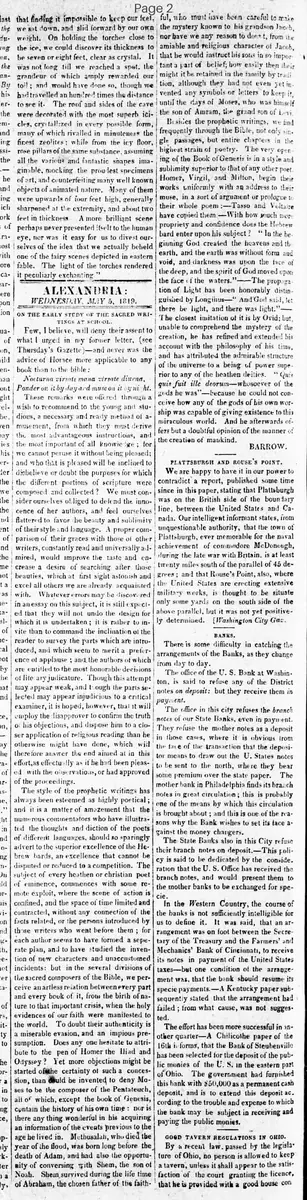
ALEXANDRIA:
WEDNESDAY, MAY 5, 1819.
ON THE EARLY STUDY OF THE SACRED WRITINGS AT SCHOOL.
Few, I believe, will deny their assent to what I urged in my former letter, (see Thursday's Gazette)—and never was the advice of Horace more applicable to any book than to the bible:
Nocturna versate manu, versate diurna.
Ponder on it by day and muse on it by night.
These remarks were offered through a wish to recommend to the young and studious, a necessary and ready method of amusement, from which they must derive the most advantageous instructions, and the most important of all knowledge: for we cannot peruse it without being pleased: and who that is pleased will be inclined to disbelieve or doubt the purposes for which the different portions of scripture were composed and collected? We must consider ourselves obliged to defend the innocence of her authors, and feel ourselves flattered to favor the beauty and sublimity of their style and language. A proper comparison of their graces with those of other writers, constantly read and universally admired, would improve the taste and increase a desire of searching after those beauties, which at first sight astonish and excel all others we are already acquainted with. Whatever errors may be discovered in an essay on this subject, it is still expected that they will not undo the design for which it is undertaken; it is rather to invite than to command the inclination of the reader to survey the parts which are introduced, and which seem to merit a preference of applause: and the authors of which are entitled to the most honorable decisions of literary judicature. Though this attempt may appear weak, and though the parts selected may appear injudicious to a critical examiner, it is hoped, however, that it will employ the disapprover to confirm the truth of his objections, and dispose him to a closer application of religious reading than he otherwise might have done, which will therefore answer the end aimed at in this effort, as effectually as if he had been pleased with the observations, or had approved of the proceedings.
The style of the prophetic writings has always been esteemed as highly poetical: and it is a matter of amazement that the numerous commentators who have illustrated the thoughts and diction of the poets of different languages, should so sparingly advert to the superior excellence of the Hebrew bards, an excellence that cannot be disputed or reduced to a competition. The subject of every heathen or christian poet of eminence, commences with some remote exploit, where the scene of action is confined, and the space of time limited and contracted, without any connection of the facts related, or the persons introduced by those writers who went before them; for each author seems to have formed a separate plan, and to have studied the invention of new characters and unaccustomed incidents: but in the several divisions of the sacred composers of the Bible, we perceive an artless relation between every part and every book of it, from the birth of nature to that important crisis, when the holy evidences of our faith were manifested to the world. To doubt their authenticity is a miserable evasion, and an impious presumption. Does any one hesitate to attribute to the pen of Homer the Iliad and Odyssey? Yet more objections might be started of the certainty of such a concession, than could be invented to deny Moses to be the composer of the Pentateuch, all of which, except the book of Genesis, contain the history of his own time: nor is there any thing wonderful in his acquiring an information of the events previous to the age he lived in. Methuselah, who died the year of the flood, was born long before the death of Adam, and had also the opportunity of conversing with Shem, the son of Noah. Shem survived during the life time of Abraham, the chosen father of the faithful, who must have been careful to make the mystery known to his grandson Jacob nor have we any reason to doubt, from the amiable and religious character of Jacob, that he would instruct his sons in so important a part of belief; how easily then might it be retained in the family by tradition, although they had not even yet invented any symbols or letters to keep it, until the days of Moses, who was himself the son of Amram, the grand son of Levi
Besides the prophetic writings, we find frequently through the Bible, not only single passages, but entire chapters in the highest strain of poetry. The very opening of the Book of Genesis is in a style and sublimity superior to that of any other poet. Homer, Virgil, and Milton, begin their works uniformly with an address to their muse, in a sort of argument or prologue to their whole poem:—Tasso and Voltaire have copied them.—With how much more propriety and confidence does the Hebrew bard enter upon his subject? "In the beginning God created the heavens and the earth, and the earth was without form and void, and darkness was upon the face of the deep, and the spirit of God moved upon the face of the waters."—The propagation of Light has been honorably distinguished by Longinus—"And God said, let there be light, and there was light."….
The closest imitation of it is by Ovid: but, unable to comprehend the mystery of the creation, he has refined and extended his account with the philosophy of his time, and has attributed the admirable structure of the universe to a being of power superior to any of the heathen deities." Quis quis fuit ille deorum—whosoever of the gods he was"—because he could not conceive how any of the gods of his own worship was capable of giving existence to this miraculous world. And he afterwards offers but a doubtful opinion of the manner of the creation of mankind
BARROW.
WEDNESDAY, MAY 5, 1819.
ON THE EARLY STUDY OF THE SACRED WRITINGS AT SCHOOL.
Few, I believe, will deny their assent to what I urged in my former letter, (see Thursday's Gazette)—and never was the advice of Horace more applicable to any book than to the bible:
Nocturna versate manu, versate diurna.
Ponder on it by day and muse on it by night.
These remarks were offered through a wish to recommend to the young and studious, a necessary and ready method of amusement, from which they must derive the most advantageous instructions, and the most important of all knowledge: for we cannot peruse it without being pleased: and who that is pleased will be inclined to disbelieve or doubt the purposes for which the different portions of scripture were composed and collected? We must consider ourselves obliged to defend the innocence of her authors, and feel ourselves flattered to favor the beauty and sublimity of their style and language. A proper comparison of their graces with those of other writers, constantly read and universally admired, would improve the taste and increase a desire of searching after those beauties, which at first sight astonish and excel all others we are already acquainted with. Whatever errors may be discovered in an essay on this subject, it is still expected that they will not undo the design for which it is undertaken; it is rather to invite than to command the inclination of the reader to survey the parts which are introduced, and which seem to merit a preference of applause: and the authors of which are entitled to the most honorable decisions of literary judicature. Though this attempt may appear weak, and though the parts selected may appear injudicious to a critical examiner, it is hoped, however, that it will employ the disapprover to confirm the truth of his objections, and dispose him to a closer application of religious reading than he otherwise might have done, which will therefore answer the end aimed at in this effort, as effectually as if he had been pleased with the observations, or had approved of the proceedings.
The style of the prophetic writings has always been esteemed as highly poetical: and it is a matter of amazement that the numerous commentators who have illustrated the thoughts and diction of the poets of different languages, should so sparingly advert to the superior excellence of the Hebrew bards, an excellence that cannot be disputed or reduced to a competition. The subject of every heathen or christian poet of eminence, commences with some remote exploit, where the scene of action is confined, and the space of time limited and contracted, without any connection of the facts related, or the persons introduced by those writers who went before them; for each author seems to have formed a separate plan, and to have studied the invention of new characters and unaccustomed incidents: but in the several divisions of the sacred composers of the Bible, we perceive an artless relation between every part and every book of it, from the birth of nature to that important crisis, when the holy evidences of our faith were manifested to the world. To doubt their authenticity is a miserable evasion, and an impious presumption. Does any one hesitate to attribute to the pen of Homer the Iliad and Odyssey? Yet more objections might be started of the certainty of such a concession, than could be invented to deny Moses to be the composer of the Pentateuch, all of which, except the book of Genesis, contain the history of his own time: nor is there any thing wonderful in his acquiring an information of the events previous to the age he lived in. Methuselah, who died the year of the flood, was born long before the death of Adam, and had also the opportunity of conversing with Shem, the son of Noah. Shem survived during the life time of Abraham, the chosen father of the faithful, who must have been careful to make the mystery known to his grandson Jacob nor have we any reason to doubt, from the amiable and religious character of Jacob, that he would instruct his sons in so important a part of belief; how easily then might it be retained in the family by tradition, although they had not even yet invented any symbols or letters to keep it, until the days of Moses, who was himself the son of Amram, the grand son of Levi
Besides the prophetic writings, we find frequently through the Bible, not only single passages, but entire chapters in the highest strain of poetry. The very opening of the Book of Genesis is in a style and sublimity superior to that of any other poet. Homer, Virgil, and Milton, begin their works uniformly with an address to their muse, in a sort of argument or prologue to their whole poem:—Tasso and Voltaire have copied them.—With how much more propriety and confidence does the Hebrew bard enter upon his subject? "In the beginning God created the heavens and the earth, and the earth was without form and void, and darkness was upon the face of the deep, and the spirit of God moved upon the face of the waters."—The propagation of Light has been honorably distinguished by Longinus—"And God said, let there be light, and there was light."….
The closest imitation of it is by Ovid: but, unable to comprehend the mystery of the creation, he has refined and extended his account with the philosophy of his time, and has attributed the admirable structure of the universe to a being of power superior to any of the heathen deities." Quis quis fuit ille deorum—whosoever of the gods he was"—because he could not conceive how any of the gods of his own worship was capable of giving existence to this miraculous world. And he afterwards offers but a doubtful opinion of the manner of the creation of mankind
BARROW.
What sub-type of article is it?
Religious
Philosophical
Persuasive
What themes does it cover?
Religion
Education
What keywords are associated?
Bible Study
Sacred Writings
Prophetic Poetry
Hebrew Bards
Biblical Authenticity
Religious Education
What entities or persons were involved?
Barrow.
Letter to Editor Details
Author
Barrow.
Main Argument
advocates for the early study of the bible in schools as a source of amusement, moral instruction, and superior knowledge, praising its poetic excellence and authenticity over classical works like those of homer and virgil.
Notable Details
References Horace's Advice
Quotes Genesis Creation
Compares Biblical Style To Homer, Virgil, Milton, Tasso, Voltaire, Ovid
Discusses Transmission Of Biblical History Through Tradition From Methuselah To Moses