Thank you for visiting SNEWPapers!
Sign up free
Fowle's New Hampshire Gazette And General Advertiser
Portsmouth, Rockingham County, New Hampshire
What is this article about?
Detailed geographical description of the U.S. territory west of the Allegheny Mountains, highlighting the Great Lakes as inland seas, the Mississippi River's features, length, navigation, fertility, and potential for future population, trade, and power, based on a late American publication.
Merged-components note: This is a single continuous article describing the geography and rivers west of the Allegheny Mountains, including detailed accounts of the Mississippi and related waterways. The second component picks up directly from the end of the first, indicating a page break split; relabeling from 'story' to 'domestic_news' as it fits local/national non-narrative news about American territories.
Clippings
1 of 2
OCR Quality
Full Text
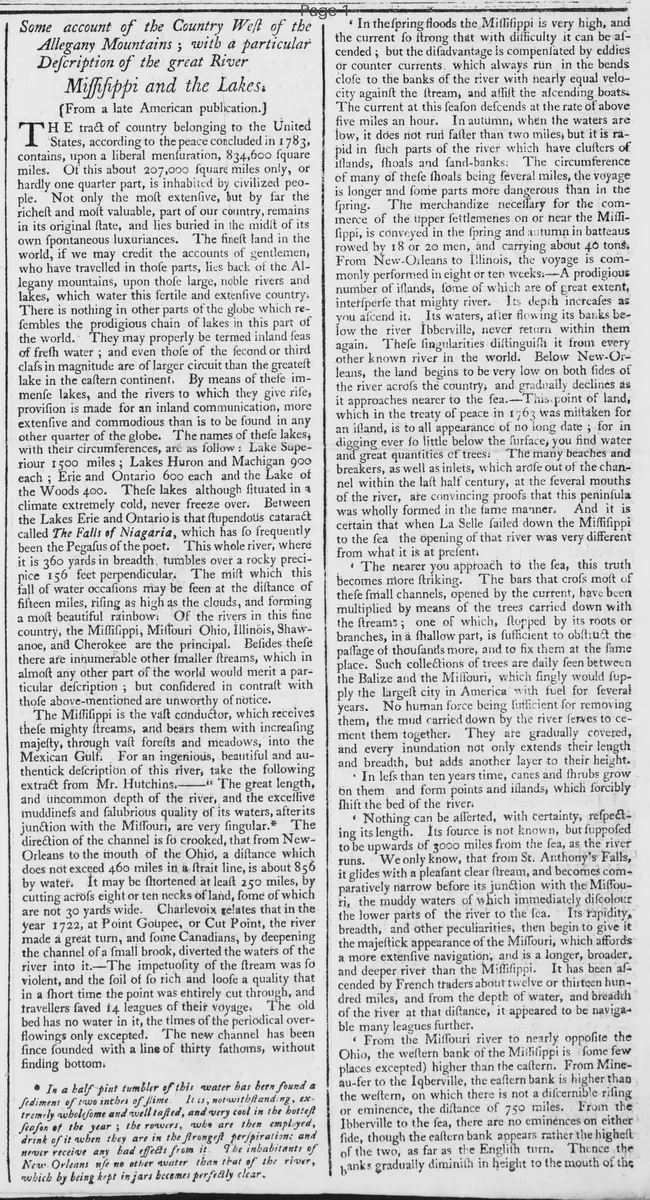
(From a late American publication.)
THE tract of country belonging to the United States, according to the peace concluded in 1783, contains, upon a liberal mensuration, 834,600 square miles. Of this about 207,000 square miles only, or hardly one quarter part, is inhabited by civilized people. Not only the most extensive, but by far the richest and most valuable, part of our country, remains in its original state, and lies buried in the midst of its own spontaneous luxuriances. The finest land in the world, if we may credit the accounts of gentlemen, who have travelled in those parts, lies back of the Allegany mountains, upon those large, noble rivers and lakes, which water this fertile and extensive country: There is nothing in other parts of the globe which resembles the prodigious chain of lakes in this part of the world. They may properly be termed inland seas of fresh water; and even those of the second or third class in magnitude are of larger circuit than the greatest lake in the eastern continent. By means of these immense lakes, and the rivers to which they give rise, provision is made for an inland communication, more extensive and commodious than is to be found in any other quarter of the globe. The names of these lakes: with their circumferences, are as follow: Lake Superior 1500 miles; Lakes Huron and Michigan 900 each; Erie and Ontario 600 each and the Lake of the Woods 400. These lakes although situated in a climate extremely cold, never freeze over. Between the Lakes Erie and Ontario is that stupendous cataract called The Falls of Niagara, which has so frequently been the Pegasus of the poet. This whole river, where it is 360 yards in breadth, tumbles over a rocky precipice 156 feet perpendicular. The mist which this fall of water occasions may be seen at the distance of fifteen miles, rising as high as the clouds, and forming a most beautiful rainbow: Of the rivers in this fine country, the Mississippi, Missouri Ohio, Illinois, Shawanese, and Cherokee are the principal. Besides these there are innumerable other smaller streams, which in almost any other part of the world would merit a particular description; but considered in contrast with those above-mentioned are unworthy of notice.
The Mississippi is the vast conductor. which receives these mighty streams, and bears them with increasing majesty, through vast forests and meadows, into the Mexican Gulf. For an ingenious, beautiful and authentick description of this river, take the following extract from Mr. Hutchins.- "The great length, and uncommon depth of the river. and the excessive muddiness and salubrious quality of its waters, after its junction with the Missouri, are very singular. The direction of the channel is so crooked. that from New-Orleans to the south of the Ohio. a distance which does not exceed 460 miles in a strait line, is about 856 by water. It may be shortened at least 250 miles, by cutting across eight or ten necks of land. some of which are not 30 yards wide. Charlevoix relates that in the year 1722, at Point Goupee, or Cut Point, the river made a great turn, and some Canadians, by deepening the channel of a small brook, diverted the waters of the river into it.--The impetuosity of the stream was so violent, and the soil of so rich and loose a quality that in a short time the point was entirely cut through, and travellers saved 14 leagues of their voyage. The old bed has no water in it, the times of the periodical overflowings only excepted. The new channel has been since sounded with a line of thirty fathoms, without finding bottom
* In a half pint tumbler of this water has been found a Sediment of two inches of slime. It is, notwithstanding, extremely wholesome and well tasted, and very cool in the hottest season of the year; the rowers, who are then employed, drink of it when they are in the strongest perspiration: and never receive any bad effects from it. The inhabitants of New-Orleans use no other water than that of the river, which by being kept in jars becomes perfectly clear.
In the spring floods the Mississippi is very high, and the current so strong that with difficulty it can be ascended; but the disadvantage is compensated by eddies or counter currents. which always run in the bends close to the banks of the river with nearly equal velocity against the stream, and assist the ascending boats The current at this season descends at the rate of above five miles an hour. In autumn, when the waters are low, it does not run faster than two miles, but it is rapid in such parts of the river which have clusters of islands, shoals and sand-banks: The circumference of many of these shoals being several miles, the voyage is longer and some parts more dangerous than in the spring. The merchandize necessary for the commerce of the upper settlements on or near the Mississippi, is conveyed in the spring and autumn in batteaus rowed by 18 or 20 men, and carrying about 40 tons. From New-Orleans to Illinois, the voyage is commonly performed in eight or ten weeks.--A prodigious number of islands, some of which are of great extent, intersperse that mighty river. Its depth increases as you ascend it: Its waters, after flowing its banks below the river Iberville, never return within them again. These singularities distinguish it from every other known river in the world. Below New-Orleans, the land begins to be very low on both sides of the river across the country; and gradually declines as it approaches nearer to the sea.--This point of land, which in the treaty of peace in 1763 was mistaken for an island, is to all appearance of no long date; for in digging ever so little below the surface, you find water and great quantities of trees: The many beaches and breakers, as well as inlets, which arose out of the channel within the last half century, at the several mouths of the river, are convincing proofs that this peninsula was wholly formed in the same manner. And it is certain that when La Salle sailed down the Mississippi to the sea the opening of that river was very different from what it is at present:
The nearer you approach to the sea, this truth becomes more striking. The bars that cross most of these small channels, opened by the current, have been multiplied by means of the trees carried down with the streams; one of which, stopped by its roots or branches, in a shallow part, is sufficient to obstruct the passage of thousands more, and to fix them at the same place. Such collections of trees are daily seen between the Balize and the Missouri, which singly would supply the largest city in America with fuel for several years. No human force being sufficient for removing them, the mud carried down by the river serves to cement them together. They are gradually covered, and every inundation not only extends their length and breadth, but adds another layer to their height. In less than ten years time, canes and shrubs grow on them and form points and islands, which forcibly shift the bed of the river
Nothing can be asserted, with certainty, respecting its length. Its source is not known, but supposed to be upwards of 2000 miles from the sea, as the river runs. We only know, that from St. Anthony's Falls, it glides with a pleasant clear stream, and becomes comparatively narrow before its junction with the Missouri, the muddy waters of which immediately discolour the lower parts of the river to the sea. Its rapidity, breadth, and other peculiarities, then begin to give it the majestick appearance of the Missouri, which affords a more extensive navigation; and is a longer, broader. and deeper river than the Mississippi. It has been ascended by French traders about twelve or thirteen hundred miles, and from the depth of water, and breadth of the river at that distance, it appeared to be navigable many leagues further.
From the Missouri river to nearly opposite the Ohio, the western bank of the Mississippi is some few places excepted) higher than the eastern. From Mineret to the Iberville, the eastern bank is higher than the western, on which there is not a discernible rising or eminence, the distance of 750 miles. From the Iberville to the sea, there are no eminences on either side, though the eastern bank appears rather the highest of the two, as far as the English turn. Thence the banks gradually diminish in height to the mouth of the river, where they are not more than two or three feet higher than the common surface of the water.
The slime which the annual floods of the river Mississippi leaves on the surface of the adjacent shores, may be compared with that of the Nile, which deposits a similar manure, and for many ages past has insured the fertility of Egypt. When its banks shall have been cultivated as the excellency of its soil and temperature of the climate deserve, its population will equal that of any other part of the world. The trade, wealth and power of America will, at some future period, depend and perhaps centre upon the Mississippi.
This also resembles the Nile in the number of its mouths, all issuing into a sea that may be compared to the Mediterranean, which is bounded on the north and south by the two continents of Europe and Africa, as the Mexican bay is by North and South America.
The smaller mouths of this river might be easily stopped up by means of the floating trees with which the river, during the floods, is always covered. The whole force of the channel being united, the only opening then left would probably grow deep as well as the bar.
The Ohio rises in the north-west part of the state of New-York, a little south of lake Ontario; bounds Pennsylvania on the west, and Virginia on the north, and falls into the Mississippi in 37 degrees north latitude.
In its serpentine course it receives a great number of noble rivers, of which the Shawanoe and Cherokee are the largest, the latter being navigable 900 miles.
The Illinois rises in lake Michigan, runs S. W. and falls into the Mississippi just above the mouth of the Missouri.
What sub-type of article is it?
What keywords are associated?
What entities or persons were involved?
Where did it happen?
Domestic News Details
Primary Location
West Of The Allegany Mountains
Key Persons
Event Details
Descriptive account of the U.S. territory from the 1783 peace treaty, emphasizing the uninhabited, fertile lands west of the Allegheny Mountains, the Great Lakes' sizes and navigation potential, the Mississippi River's length, features, muddiness, navigation challenges, islands, banks, annual floods, comparisons to the Nile, and future prospects for population, trade, and power; includes details on tributaries like Ohio, Missouri, Illinois, Shawanese, and Cherokee.