Thank you for visiting SNEWPapers!
Sign up free
Letter to Editor
April 28, 1809
Virginia Argus
Richmond, Virginia
What is this article about?
John Adams' 1808 letter critiques excessive party spirit, ineffective trade embargoes against Britain and France, and state overreach into federal affairs. He proposes arming merchants and building frigates for defense rather than war or prolonged restrictions. (214 characters)
Clipping
OCR Quality
95%
Excellent
Full Text
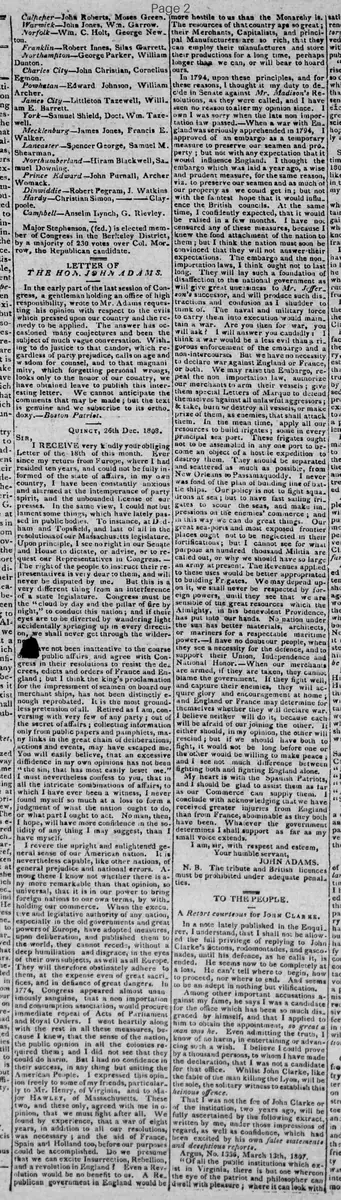
LETTER OF
THE HON. JOHN ADAMS.
In the early part of the last session of Congress, a gentleman holding an office of high responsibility, wrote to Mr. Adams requesting his opinion with respect to the evils which pressed upon our country and the remedy to be applied. The answer has occasioned many conjectures and been the subject of much vague conversation. Wishing to do justice to that candor, which regardless of party prejudice calls on age and wisdom for counsel, and to that magnanimity, which forgetting personal wrongs, looks only to the honor of our country, we have obtained leave to publish this interesting letter.
We cannot anticipate the comments that may be made; but the text is genuine and we subscribe to its orthodoxy. Boston Patriot.
Quincy, 26th Dec. 1808.
SIR,
I RECEIVE very kindly your obliging Letter of the 18th of this month. Ever since my return from Europe, where I had resided ten years, and could not be fully informed of the state of affairs, in my own country, I have been constantly anxious and alarmed at the intemperance of party spirit, and the unbounded license of our presses. In the same view, I could not but lament some things, which have lately passed in public bodies. To instance, at Dedham and Topsfield, and last of all in the resolutions of our Massachusetts legislature. Upon principle, I see no right in our Senate and House to dictate, or advise, or to request our Representatives in Congress. - The right of the people to instruct their representatives is very dear to them, and will never be disputed by me. But this is a very different thing from an interference of a state legislature. Congress must be the "cloud by day and the pillar of fire by night," to conduct this nation; and if their eyes are to be diverted by wandering light accidentally springing up in every direction, we shall never get through the wilderness. I have not been inattentive to the course public affairs, and agree with Congress in their resolutions to resist the decrees, edicts and orders of France and England; but I think the king's proclamation for the impressment of seamen on board our merchant ships, has not been distinctly enough reprobated. It is the most groundless pretension of all. Retired as I am, conversing with very few of any party; out of the secret of affairs; collecting information only from public papers and pamphlets, many links in the great chain of deliberations, actions and events, may have escaped me. You will easily believe, that an excessive diffidence in my own opinions has not been "the sin, that has most easily beset me." I must nevertheless confess to you, that in all the intricate combinations of affairs, to which I have ever been a witness, I never found myself so much at a loss to form a judgment of what the nation ought to do, or what part I ought to act. No man, then, I hope, will have more confidence in the solidity of any thing I may suggest, than I have myself.
I revere the upright and enlightened general sense of our American nation. It is nevertheless capable, like other nations, of general prejudice and national errors. Among these I know not whether there is any more remarkable than that opinion, so universal, that it is in our power to bring foreign nations to our own terms, by withholding our commerce. When the executive and legislative authority of any nation, especially in the old governments and great powers of Europe, have adopted measures, upon deliberation, and published them to the world, they cannot recede, without a deep humiliation and disgrace, in the eyes of their own subjects, as well as all Europe, They will therefore obstinately adhere to them, at the expense even of great sacrifices, and in defiance of great dangers. In 1774, Congress appeared almost unanimously sanguine, that a non importation and consumption association, would procure immediate repeal of Acts of Parliament and Royal Orders. I went heartily along with the rest in all these measures, because I knew, that the sense of the nation, the public opinion in all the colonies required them; and I did not see that they could do harm. But I had no confidence in their success, in anything but uniting the American People. I expressed this opinion freely to some of my friends, particularly to Mr. Henry, of Virginia, and to Major HAWLEY, of Massachusetts. These two, and these only, agreed with me in opinion, that we must fight after all. We found by experience, that a war of eight years, in addition to all our resolutions, was necessary; and the aid of France, Spain and Holland too, before our purposes could be accomplished. Do we presume that we can excite Insurrection, Rebellion, and a revolution in England? Even a Revolution would be no benefit to us. A Republican government in England would be more hostile to us than the Monarchy is. The resources of that country are so great; their Merchants, Capitalists, and principal Manufacturers are so rich, that they can employ their manufactures and store their productions for a long time, perhaps longer than we can, or will bear to hoard ours. In 1794, upon these principles, and for these reasons, I thought it my duty to decide in Senate against Mr. Madison's Resolutions, as they were called, and I have seen no reason to alter my opinion since. I own I was sorry when the late non importation law passed. -When a war with England was seriously apprehended in 1794, I approved of an embargo as a temporary measure to preserve our seamen and property; but not with any expectation that it would influence England: I thought the embargo which was laid a year ago, a wise and prudent measure, for the same reason, viz. to preserve our seamen and as much of our property as we could get in; but not with the faintest hope that it would influence the British councils. At the same time, I confidently expected, that it would be raised in a few months. I have not censured any of these measures, because I knew the fond attachment of the nation to them; but I think the nation must soon be convinced that they will not answer their expectations. The embargo and the non-importation laws, I think ought not to last long. They will lay such a foundation of disaffection to the national government as will give great uneasiness to Mr. Jefferson's successor, and will produce such distractions and confusion as I shudder to think of. The naval and military force to carry them into execution would maintain a war. Are you then for war, you will ask? I will answer you candidly: I think a war would be a less evil than a rigorous enforcement of the embargo and a non-intercourse But we have no necessity to declare war against England or France, or both. We may raise the Embargo, repeal the non importation law, authorize our merchants to arm their vessels; give them special Letters of Marque to defend themselves against all unlawful aggressors; & take, burn or destroy all vessels, or make prize of them, as enemies, that shall attack them. In the mean time, apply all our resources to build frigates; some in every principal sea port. These frigates ought not to be assembled in any one port to become an object of a hostile expedition to destroy them. They should be separated and scattered as much as possible, from New Orleans to Passamaquoddy. I never was fond of the plan of building line of battle ships. Our policy is not to fight squadrons at sea; but to have fast sailing frigates to scour the seas, and make impressions on the enemies' commerce; and in this way we can do great things. Our great sea-ports and most exposed frontier places ought not to be neglected in their fortifications; but I cannot see for what purpose an hundred thousand Militia are called out, or why we should have so large an army at present. The Revenues applied to these uses would be better appropriated to building Frigates. We may depend upon it, we shall never be respected by foreign powers, until they see that we are sensible of the great resources which the Almighty, in his benevolent Providence, has put into our hands. No nation under the sun has better materials, architects, or mariners for a respectable maritime power. -I have no doubt our people, when they see a necessity for the defence, and to support their Union, Independence and National Honor.-When our merchants are armed, if they are taken, they cannot blame the government. If they fight well, and capture their enemies, they will acquire glory and encouragement at home; and England or France may determine for themselves whether they will declare war. I believe neither will do it, because each will be afraid of our joining the other. It either should, in my opinion, the other will rescind; but if we should have both to fight, it would not be long before one or the other would be willing to make peace; and I see not much difference between fighting both and fighting England alone. My heart is with the Spanish Patriots, and I should be glad to assist them as far as our Commerce can supply them. I conclude with acknowledging that we have received greater injuries from England than from France, abominable as they both have been. Whatever the government determines I shall support as far as my small voice extends.
I am, sir, with respect and esteem,
Your humble servant,
JOHN ADAMS.
N. B. The tribute and British licences must be prohibited under adequate penalties.
THE HON. JOHN ADAMS.
In the early part of the last session of Congress, a gentleman holding an office of high responsibility, wrote to Mr. Adams requesting his opinion with respect to the evils which pressed upon our country and the remedy to be applied. The answer has occasioned many conjectures and been the subject of much vague conversation. Wishing to do justice to that candor, which regardless of party prejudice calls on age and wisdom for counsel, and to that magnanimity, which forgetting personal wrongs, looks only to the honor of our country, we have obtained leave to publish this interesting letter.
We cannot anticipate the comments that may be made; but the text is genuine and we subscribe to its orthodoxy. Boston Patriot.
Quincy, 26th Dec. 1808.
SIR,
I RECEIVE very kindly your obliging Letter of the 18th of this month. Ever since my return from Europe, where I had resided ten years, and could not be fully informed of the state of affairs, in my own country, I have been constantly anxious and alarmed at the intemperance of party spirit, and the unbounded license of our presses. In the same view, I could not but lament some things, which have lately passed in public bodies. To instance, at Dedham and Topsfield, and last of all in the resolutions of our Massachusetts legislature. Upon principle, I see no right in our Senate and House to dictate, or advise, or to request our Representatives in Congress. - The right of the people to instruct their representatives is very dear to them, and will never be disputed by me. But this is a very different thing from an interference of a state legislature. Congress must be the "cloud by day and the pillar of fire by night," to conduct this nation; and if their eyes are to be diverted by wandering light accidentally springing up in every direction, we shall never get through the wilderness. I have not been inattentive to the course public affairs, and agree with Congress in their resolutions to resist the decrees, edicts and orders of France and England; but I think the king's proclamation for the impressment of seamen on board our merchant ships, has not been distinctly enough reprobated. It is the most groundless pretension of all. Retired as I am, conversing with very few of any party; out of the secret of affairs; collecting information only from public papers and pamphlets, many links in the great chain of deliberations, actions and events, may have escaped me. You will easily believe, that an excessive diffidence in my own opinions has not been "the sin, that has most easily beset me." I must nevertheless confess to you, that in all the intricate combinations of affairs, to which I have ever been a witness, I never found myself so much at a loss to form a judgment of what the nation ought to do, or what part I ought to act. No man, then, I hope, will have more confidence in the solidity of any thing I may suggest, than I have myself.
I revere the upright and enlightened general sense of our American nation. It is nevertheless capable, like other nations, of general prejudice and national errors. Among these I know not whether there is any more remarkable than that opinion, so universal, that it is in our power to bring foreign nations to our own terms, by withholding our commerce. When the executive and legislative authority of any nation, especially in the old governments and great powers of Europe, have adopted measures, upon deliberation, and published them to the world, they cannot recede, without a deep humiliation and disgrace, in the eyes of their own subjects, as well as all Europe, They will therefore obstinately adhere to them, at the expense even of great sacrifices, and in defiance of great dangers. In 1774, Congress appeared almost unanimously sanguine, that a non importation and consumption association, would procure immediate repeal of Acts of Parliament and Royal Orders. I went heartily along with the rest in all these measures, because I knew, that the sense of the nation, the public opinion in all the colonies required them; and I did not see that they could do harm. But I had no confidence in their success, in anything but uniting the American People. I expressed this opinion freely to some of my friends, particularly to Mr. Henry, of Virginia, and to Major HAWLEY, of Massachusetts. These two, and these only, agreed with me in opinion, that we must fight after all. We found by experience, that a war of eight years, in addition to all our resolutions, was necessary; and the aid of France, Spain and Holland too, before our purposes could be accomplished. Do we presume that we can excite Insurrection, Rebellion, and a revolution in England? Even a Revolution would be no benefit to us. A Republican government in England would be more hostile to us than the Monarchy is. The resources of that country are so great; their Merchants, Capitalists, and principal Manufacturers are so rich, that they can employ their manufactures and store their productions for a long time, perhaps longer than we can, or will bear to hoard ours. In 1794, upon these principles, and for these reasons, I thought it my duty to decide in Senate against Mr. Madison's Resolutions, as they were called, and I have seen no reason to alter my opinion since. I own I was sorry when the late non importation law passed. -When a war with England was seriously apprehended in 1794, I approved of an embargo as a temporary measure to preserve our seamen and property; but not with any expectation that it would influence England: I thought the embargo which was laid a year ago, a wise and prudent measure, for the same reason, viz. to preserve our seamen and as much of our property as we could get in; but not with the faintest hope that it would influence the British councils. At the same time, I confidently expected, that it would be raised in a few months. I have not censured any of these measures, because I knew the fond attachment of the nation to them; but I think the nation must soon be convinced that they will not answer their expectations. The embargo and the non-importation laws, I think ought not to last long. They will lay such a foundation of disaffection to the national government as will give great uneasiness to Mr. Jefferson's successor, and will produce such distractions and confusion as I shudder to think of. The naval and military force to carry them into execution would maintain a war. Are you then for war, you will ask? I will answer you candidly: I think a war would be a less evil than a rigorous enforcement of the embargo and a non-intercourse But we have no necessity to declare war against England or France, or both. We may raise the Embargo, repeal the non importation law, authorize our merchants to arm their vessels; give them special Letters of Marque to defend themselves against all unlawful aggressors; & take, burn or destroy all vessels, or make prize of them, as enemies, that shall attack them. In the mean time, apply all our resources to build frigates; some in every principal sea port. These frigates ought not to be assembled in any one port to become an object of a hostile expedition to destroy them. They should be separated and scattered as much as possible, from New Orleans to Passamaquoddy. I never was fond of the plan of building line of battle ships. Our policy is not to fight squadrons at sea; but to have fast sailing frigates to scour the seas, and make impressions on the enemies' commerce; and in this way we can do great things. Our great sea-ports and most exposed frontier places ought not to be neglected in their fortifications; but I cannot see for what purpose an hundred thousand Militia are called out, or why we should have so large an army at present. The Revenues applied to these uses would be better appropriated to building Frigates. We may depend upon it, we shall never be respected by foreign powers, until they see that we are sensible of the great resources which the Almighty, in his benevolent Providence, has put into our hands. No nation under the sun has better materials, architects, or mariners for a respectable maritime power. -I have no doubt our people, when they see a necessity for the defence, and to support their Union, Independence and National Honor.-When our merchants are armed, if they are taken, they cannot blame the government. If they fight well, and capture their enemies, they will acquire glory and encouragement at home; and England or France may determine for themselves whether they will declare war. I believe neither will do it, because each will be afraid of our joining the other. It either should, in my opinion, the other will rescind; but if we should have both to fight, it would not be long before one or the other would be willing to make peace; and I see not much difference between fighting both and fighting England alone. My heart is with the Spanish Patriots, and I should be glad to assist them as far as our Commerce can supply them. I conclude with acknowledging that we have received greater injuries from England than from France, abominable as they both have been. Whatever the government determines I shall support as far as my small voice extends.
I am, sir, with respect and esteem,
Your humble servant,
JOHN ADAMS.
N. B. The tribute and British licences must be prohibited under adequate penalties.
What sub-type of article is it?
Political
Persuasive
Reflective
What themes does it cover?
Politics
Economic Policy
Military War
What keywords are associated?
Party Spirit
Embargo
Non Importation
Frigates
Merchant Vessels
Impressment
John Adams
British Decrees
French Edicts
National Defense
What entities or persons were involved?
John Adams
Sir
Letter to Editor Details
Author
John Adams
Recipient
Sir
Main Argument
adams laments party spirit, press license, and state legislative interference with congress. he doubts the efficacy of embargo and non-importation against england and france, suggesting instead to arm merchant vessels, build frigates, and fortify ports to defend commerce without declaring war.
Notable Details
References 1774 Non Importation
Mentions Mr. Henry Of Virginia And Major Hawley Of Massachusetts
Cites 1794 Resolutions And Embargo
Discusses Impressment Of Seamen
Quincy, 26th Dec. 1808