Thank you for visiting SNEWPapers!
Sign up free
Alexandria Gazette & Advertiser
Alexandria, Virginia
What is this article about?
The Scioto Valley in Ohio, from Columbus to Piketon, boasts fertile alluvial lands producing an estimated 1.8 million bushels of corn annually at low cost. The soil suits wheat cultivation, with potential for 1 million bushels yearly, though limited by markets. The planned Ohio Canal will cross fertile counties like Licking and Fairfield.
Clipping
OCR Quality
Full Text
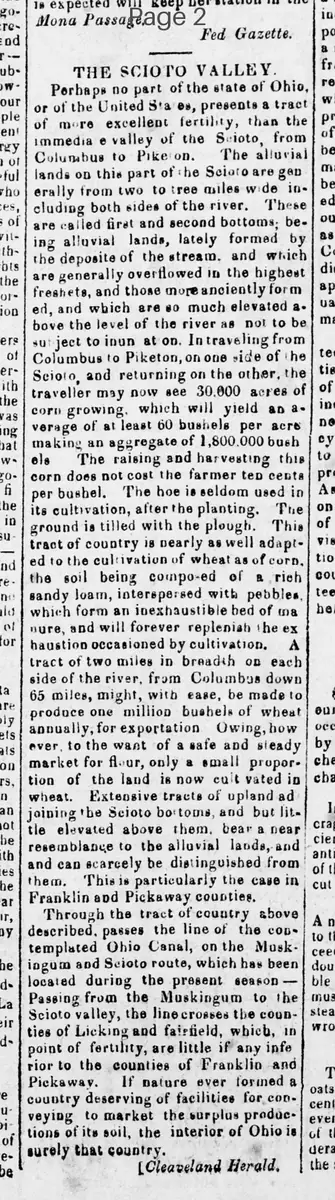
Perhaps no part of the state of Ohio, or of the United States, presents a tract of more excellent fertility, than the immediate valley of the Scioto, from Columbus to Piketon.
The alluvial lands on this part of the Scioto are generally from two to three miles wide including both sides of the river. These are called first and second bottoms: being alluvial lands, lately formed by the deposite of the stream, and which are generally overflowed in the highest freshets, and those more anciently formed, and which are so much elevated as above the level of the river as not to be subject to inundation. In traveling from Columbus to Piketon, on one side of the Scioto and returning on the other, the traveller may now see 30,000 acres of corn growing, which will yield an average of at least 60 bushels per acre making an aggregate of 1,800,000 bushels.
The raising and harvesting this corn does not cost the farmer ten cents per bushel. The hoe is seldom used in its cultivation, after the planting. The ground is tilled with the plough. This tract of country is nearly as well adapted to the cultivation of wheat as of corn, the soil being composed of a rich sandy loam, interspersed with pebbles, which form an inexhaustible bed of manure, and will forever replenish the exhaustion occasioned by cultivation.
A tract of two miles in breadth on each side of the river, from Columbus down 65 miles, might, with ease, be made to produce one million bushels of wheat annually, for exportation. Owing, however, to the want of a safe and steady market for flour, only a small proportion of the land is now cultivated in wheat. Extensive tracts of upland adjoining the Scioto bottoms, and but little elevated above them, bear a near resemblance to the alluvial lands, and can scarcely be distinguished from them. This is particularly the case in Franklin and Pickaway counties.
Through the tract of country above described, passes the line of the contemplated Ohio Canal, on the Muskingum and Scioto route, which has been located during the present season—Passing from the Muskingum to the Scioto valley, the line crosses the counties of Licking and Fairfield, which, in point of fertility, are little if any inferior to the counties of Franklin and Pickaway. If nature ever formed a country deserving of facilities for conveying to market the surplus productions of its soil, the interior of Ohio is surely that country.
[Cleaveland Herald.]
What sub-type of article is it?
What keywords are associated?
Where did it happen?
Domestic News Details
Primary Location
Scioto Valley, Ohio
Outcome
estimated corn yield of 1,800,000 bushels from 30,000 acres; potential annual wheat production of 1,000,000 bushels for exportation, limited by market availability.
Event Details
The Scioto Valley from Columbus to Piketon features fertile alluvial lands two to three miles wide, suitable for corn and wheat cultivation with rich sandy loam soil. Corn is grown on 30,000 acres yielding 60 bushels per acre at low cost using plows. Upland areas in Franklin and Pickaway counties resemble the bottoms. The Ohio Canal line on the Muskingum and Scioto route has been located this season, crossing fertile counties like Licking and Fairfield.