Thank you for visiting SNEWPapers!
Sign up free
Daily National Intelligencer
Washington, District Of Columbia
What is this article about?
During a late-night debate in the U.S. House of Representatives on a treaty, Mr. Huger speaks in support without arguing, instead quoting President George Washington's 1796 messages on Jay's Treaty to affirm that treaty-making power is exclusively with the President and Senate, not requiring House consent. The vote is about to be taken.
Clipping
OCR Quality
Full Text
In the House of Representatives.
(CONCLUDED
The ayes and noes being about to be called—
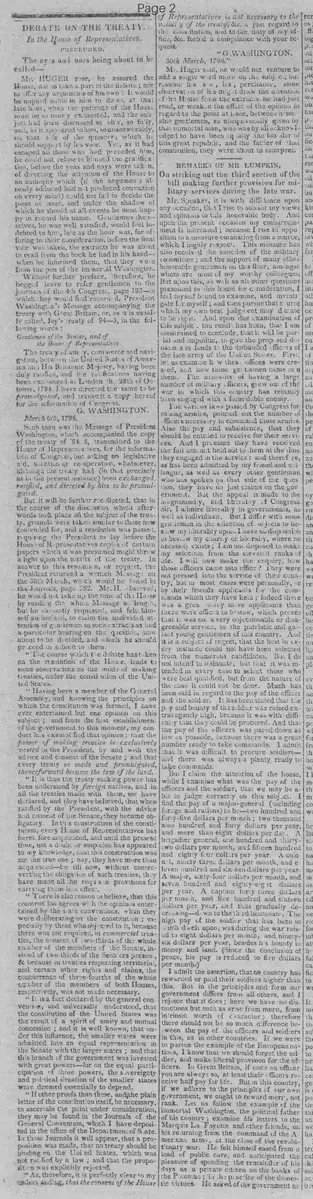
Mr. HUGER rose, he assured the House, not to take a part in the debate; nor to offer any arguments of his own: It would be unpardonable in him to do so, at that late hour, when the patience of the House must be so nearly exhausted, and the subject had been discussed so ably, so fully, and, as it appeared to him, so unanswerably, on that side of the question, which he should support by his vote. Yet, as it had escaped all those who had preceded him, he could not refuse to himself the gratification, before the yeas and nays were taken, of directing the attention of the House to an authority which (if the arguments already adduced had not produced conviction on every mind) could not fail to decide the point at issue, and under the shadow of which he should at all events be most happy to record his name. Gentlemen themselves, he was well satisfied, would feel indebted to him, late as the hour was, for offering to their consideration, before the final vote was taken, the extracts he was about to read from the book he had in his hand—when he informed them, that they were from the pen of the immortal Washington.
Without further preface, therefore, he begged leave to refer gentlemen to the journals of the 4th Congress, page 193—in which they would find recorded, President Washington's Message accompanying the treaty with Great Britain, or, as it is usually called, Jay's treaty of '94-5, in the following words:
Gentlemen of the Senate, and of the House of Representatives
The treaty of amity, commerce and navigation, between the United States of America and His Britannic Majesty, having been duly ratified, and the ratifications having been exchanged at London the 28th of October, 1795, I have directed the same to be promulgated, and transmit a copy hereof for the information of Congress.
G. WASHINGTON.
March 6th, 1796.
Such then was the Message of President Washington, which accompanied the copy of the treaty of '94-5, transmitted to the House of Representatives, for the information of Congress, but asking no legislative aid, suction or co-operation, whatsoever; although the treaty had (in that precisely as in the present instance) been exchanged, ratified, and directed by him to be promulgated.
But it will be further recollected, that in the course of the discussion which afterwards took place on the subject of the treaty, grounds were taken similar to those now contended for, and a resolution was passed, requiring the President to lay before the House of Representatives copies of certain papers which it was presumed might throw a light upon the merits of the treaty. In answer to this resolution, or request, the President returned a written Message, on the 30th March, which would be found in the Journals, page 292. Mr. H. observed, he would not take up the time of the House by reading the whole Message at length, but he earnestly requested, and felt himself authorized, to claim the undivided attention of gentlemen to such extracts as had a particular bearing on the question, now about to be decided, and which he should proceed to submit to them.
"The course which the debate has taken on the resolution of the House, leads to some observations on the mode of making treaties, under the constitution of the United States.
"Having been a member of the General Assembly, and knowing the principles on which the constitution was formed, I have ever entertained but one opinion on this subject; and from the first establishment of the government to this moment, my conduct has exemplified that opinion: that the power of making treaties is exclusively vested in the President, by and with the advice and consent of the Senate; and that every treaty so made and promulgated, thenceforward became the law of the land.
"It is thus the treaty-making power has been understood by foreign nations, and in all the treaties made with them, we have declared, and they have believed, that when ratified by the President, with the advice and consent of the Senate, they became obligatory. In this construction of the constitution, every House of Representatives has heretofore acquiesced, and until the present time, not a doubt or suspicion has appeared to my knowledge, that this construction was not the true one; nay, they have more than acquiesced—for till now, without controverting the obligation of such treaties, they have made all the requisite provisions for carrying them into effect.
"There is also reason to believe, that this construction agrees with the opinions entertained by the state conventions, when they were deliberating on the constitution; especially by those who objected to it, because there was not required, in commercial treaties, the consent of two-thirds of the whole number of the members of the Senate, instead of two thirds of the Senators present, & because in treaties respecting territorial, and certain other rights and claims, the concurrence of three-fourths of the whole number of the members of both Houses, respectively, was not made necessary.
"It is a fact declared by the general convention, and universally understood, that the constitution of the United States was the result of a spirit of amity and of mutual concession; and it is well known, that under this influence, the smaller states were admitted into an equal representation in the Senate with the larger states; and that this branch of the government was invested with great powers—for on the equal participation of those powers, the sovereignty and political situation of the smaller states were deemed essentially to depend.
"If other proofs than these, and the plain letter of the constitution itself, be necessary, to ascertain the point under consideration, they may be found in the Journals of the General Convention, which I have deposited in the office of the Department of State. In those Journals it will appear, that a proposition was made, that no treaty should be binding on the United States, which was not ratified by a law; and that the proposition was explicitly rejected.
"As, therefore, it is perfectly clear to my understanding, that the consent of the House of Representatives is not necessary to the validity of the treaty, &c. a just regard to the Constitution, and to the duty of my office, &c. forbid a compliance with your request.
"G. WASHINGTON.
30th March, 1796."
Mr. Huger said, he would not venture to add a single word more on the subject, but resume his seat, perchance, some observation of his might draw the attention of the House from the extracts he had just read, or weaken the effect of the opinion in regard to the point at issue, between honorable gentlemen, so unequivocally given by that immortal man, who was by all acknowledged to have been equally the founder of this great republic, and the father of that constitution, they were about to interpret.
What sub-type of article is it?
What keywords are associated?
What entities or persons were involved?
Where did it happen?
Domestic News Details
Primary Location
House Of Representatives
Key Persons
Outcome
debate concluded; vote on the treaty about to be taken, with mr. huger supporting ratification based on washington's precedent.
Event Details
Mr. Huger addresses the House late in the debate on the treaty, declining to argue but quoting Washington's 1796 messages on Jay's Treaty to assert that treaty-making is exclusively the President's power with Senate consent, not requiring House involvement, and that such treaties become law upon promulgation.