Thank you for visiting SNEWPapers!
Sign up free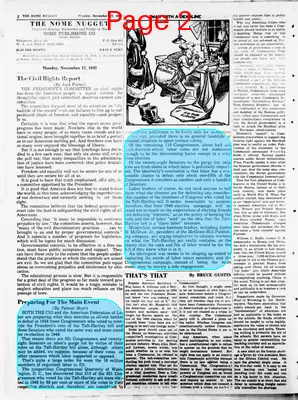
Editorial
November 17, 1947
The Nome Nugget
Nome, Nome County, Alaska
What is this article about?
Labor unions CIO and AFL plan all-out efforts to defeat 331 Congressmen and 28 Senators who supported overriding veto of Taft-Hartley Act in 1948 elections. Analysis shows limited chances of success, shifting focus to ideological campaign portraying the act as 'slave labor measure' while business leaders urge education on its contents.
Clipping
OCR Quality
98%
Excellent
Full Text
Preparing For The Main Event
(By Palmer Hoyt)
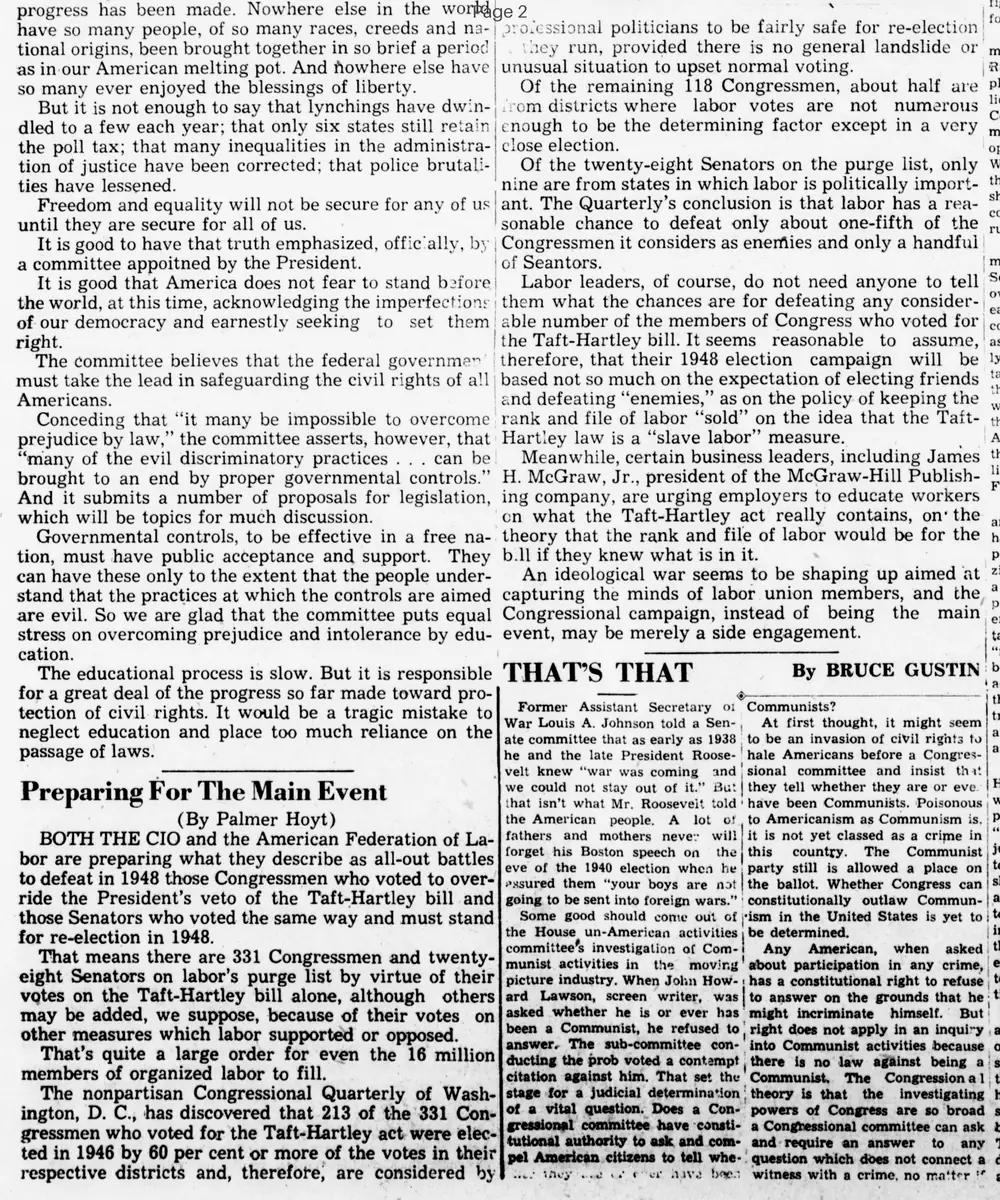
BOTH THE CIO and the American Federation of Labor are preparing what they describe as all-out battles to defeat in 1948 those Congressmen who voted to override the President's veto of the Taft-Hartley bill and those Senators who voted the same way and must stand for re-election in 1948.
That means there are 331 Congressmen and twenty-eight Senators on labor's purge list by virtue of their votes on the Taft-Hartley bill alone, although others may be added, we suppose, because of their votes on other measures which labor supported or opposed.
That's quite a large order for even the 16 million members of organized labor to fill.
The nonpartisan Congressional Quarterly of Washington, D. C., has discovered that 213 of the 331 Congressmen who voted for the Taft-Hartley act were elected in 1946 by 60 per cent or more of the votes in their respective districts and, therefore, are considered by professional politicians to be fairly safe for re-election if they run, provided there is no general landslide or unusual situation to upset normal voting.
Of the remaining 118 Congressmen, about half are from districts where labor votes are not numerous enough to be the determining factor except in a very close election.
Of the twenty-eight Senators on the purge list, only nine are from states in which labor is politically important. The Quarterly's conclusion is that labor has a reasonable chance to defeat only about one-fifth of the Congressmen it considers as enemies and only a handful of Senators.
Labor leaders, of course, do not need anyone to tell them what the chances are for defeating any considerable number of the members of Congress who voted for the Taft-Hartley bill. It seems reasonable to assume, therefore, that their 1948 election campaign will be based not so much on the expectation of electing friends and defeating "enemies," as on the policy of keeping the rank and file of labor "sold" on the idea that the Taft-Hartley law is a "slave labor measure."
Meanwhile, certain business leaders, including James H. McGraw, Jr., president of the McGraw-Hill Publishing company, are urging employers to educate workers on what the Taft-Hartley act really contains, on the theory that the rank and file of labor would be for the bill if they knew what is in it.
An ideological war seems to be shaping up aimed at capturing the minds of labor union members, and the Congressional campaign, instead of being the main event, may be merely a side engagement.
(By Palmer Hoyt)
BOTH THE CIO and the American Federation of Labor are preparing what they describe as all-out battles to defeat in 1948 those Congressmen who voted to override the President's veto of the Taft-Hartley bill and those Senators who voted the same way and must stand for re-election in 1948.
That means there are 331 Congressmen and twenty-eight Senators on labor's purge list by virtue of their votes on the Taft-Hartley bill alone, although others may be added, we suppose, because of their votes on other measures which labor supported or opposed.
That's quite a large order for even the 16 million members of organized labor to fill.
The nonpartisan Congressional Quarterly of Washington, D. C., has discovered that 213 of the 331 Congressmen who voted for the Taft-Hartley act were elected in 1946 by 60 per cent or more of the votes in their respective districts and, therefore, are considered by professional politicians to be fairly safe for re-election if they run, provided there is no general landslide or unusual situation to upset normal voting.
Of the remaining 118 Congressmen, about half are from districts where labor votes are not numerous enough to be the determining factor except in a very close election.
Of the twenty-eight Senators on the purge list, only nine are from states in which labor is politically important. The Quarterly's conclusion is that labor has a reasonable chance to defeat only about one-fifth of the Congressmen it considers as enemies and only a handful of Senators.
Labor leaders, of course, do not need anyone to tell them what the chances are for defeating any considerable number of the members of Congress who voted for the Taft-Hartley bill. It seems reasonable to assume, therefore, that their 1948 election campaign will be based not so much on the expectation of electing friends and defeating "enemies," as on the policy of keeping the rank and file of labor "sold" on the idea that the Taft-Hartley law is a "slave labor measure."
Meanwhile, certain business leaders, including James H. McGraw, Jr., president of the McGraw-Hill Publishing company, are urging employers to educate workers on what the Taft-Hartley act really contains, on the theory that the rank and file of labor would be for the bill if they knew what is in it.
An ideological war seems to be shaping up aimed at capturing the minds of labor union members, and the Congressional campaign, instead of being the main event, may be merely a side engagement.
What sub-type of article is it?
Labor
Partisan Politics
What keywords are associated?
Taft Hartley Act
Labor Purge List
1948 Elections
Cio
Afl
Ideological War
Congressional Quarterly
What entities or persons were involved?
Cio
American Federation Of Labor
Congressmen
Senators
Taft Hartley Bill
Congressional Quarterly
James H. Mcgraw, Jr.
Mcgraw Hill Publishing Company
Editorial Details
Primary Topic
Labor's Electoral Campaign Against Taft Hartley Supporters
Stance / Tone
Analytical Observation Of Limited Success And Ideological Battle
Key Figures
Cio
American Federation Of Labor
Congressmen
Senators
Taft Hartley Bill
Congressional Quarterly
James H. Mcgraw, Jr.
Mcgraw Hill Publishing Company
Key Arguments
Labor Plans To Target 331 Congressmen And 28 Senators Who Voted To Override Taft Hartley Veto
Many Targeted Politicians Are Safely Re Electable Based On 1946 Margins
Labor Likely To Defeat Only About One Fifth Of Targeted Congressmen And Few Senators
Campaign Focuses On Portraying Taft Hartley As 'Slave Labor Measure' To Maintain Union Support
Business Leaders Urge Educating Workers On The Act's Contents To Gain Support