Thank you for visiting SNEWPapers!
Sign up free
Story
June 19, 1905
Evening Times Republican
Marshalltown, Marshall County, Iowa
What is this article about?
Article discusses the role of newspaper correspondents in gathering local and general news, the challenges in finding reliable ones, and an anecdote about a poor correspondent in northwest Iowa who buried a major murder story amid trivial items, leading to its discovery and the murderer's capture.
Clipping
OCR Quality
98%
Excellent
Full Text
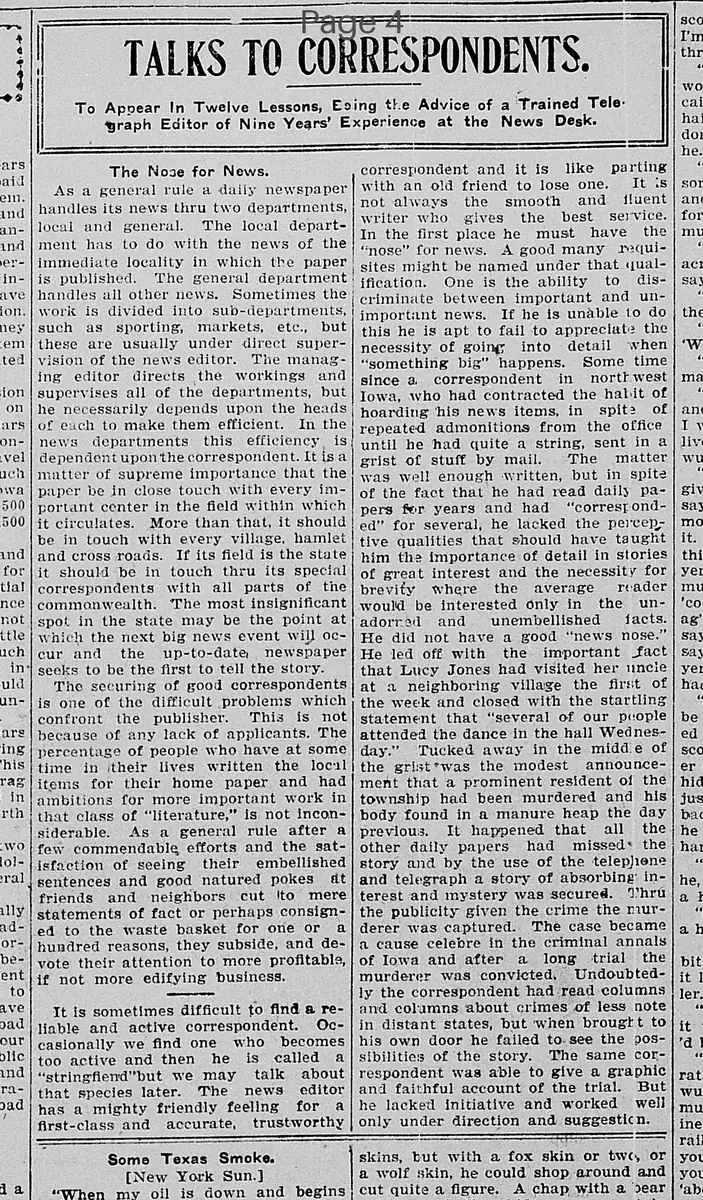
TALKS TO CORRESPONDENTS.
The Note for News.
As a general rule a daily newspaper handles its news thru two departments, local and general. The local department has to do with the news of the immediate locality in which the paper is published. The general department handles all other news. Sometimes the work is divided into sub-departments, such as sporting, markets, etc., but these are usually under direct supervision of the news editor. The managing editor directs the workings and supervises all of the departments, but he necessarily depends upon the heads of each to make them efficient. In the news departments this efficiency is dependent upon the correspondent. It is a matter of supreme importance that the paper be in close touch with every important center in the field within which it circulates. More than that, it should be in touch with every village, hamlet and cross roads. If its field is the state it should be in touch thru its special correspondents with all parts of the commonwealth. The most insignificant spot in the state may be the point at which the next big news event will occur and the up-to-date newspaper seeks to be the first to tell the story.
The securing of good correspondents is one of the difficult problems which confront the publisher. This is not because of any lack of applicants. The percentage of people who have at some time in their lives written the local items for their home paper and had ambitions for more important work in that class of "literature," is not inconsiderable. As a general rule after a few commendable efforts and the satisfaction of seeing their embellished sentences and good natured pokes at friends and neighbors cut to mere statements of fact or perhaps consigned to the waste basket for one or a hundred reasons, they subside, and devote their attention to more profitable, if not more edifying business.
It is sometimes difficult to find a reliable and active correspondent. Occasionally we find one who becomes too active and then he is called a "stringfiend" but we may talk about that species later. The news editor has a mighty friendly feeling for a first-class and accurate, trustworthy correspondent and it is like parting with an old friend to lose one.
It is not always the smooth and fluent writer who gives the best service. In the first place he must have the "nose" for news. A good many requirements might be named under that qualification. One is the ability to discriminate between important and unimportant news. If he is unable to do this he is apt to fail to appreciate the necessity of going into detail when "something big" happens. Some time since a correspondent in northwest Iowa, who had contracted the habit of hoarding his news items, in spite of repeated admonitions from the office until he had quite a string, sent in a grist of stuff by mail. The matter was well enough written, but in spite of the fact that he had read daily papers for years and had "corresponded" for several, he lacked the perceptive qualities that should have taught him the importance of detail in stories of great interest and the necessity for brevity where the average reader would be interested only in the unadorned and unembellished facts.
He did not have a good "news nose." He led off with the important fact that Lucy Jones had visited her uncle at a neighboring village the first of the week and closed with the startling statement that "several of our people attended the dance in the hall Wednesday." Tucked away in the middle of the grist was the modest announcement that a prominent resident of the township had been murdered and his body found in a manure heap the day previous. It happened that all the other daily papers had missed the story and by the use of the telephone and telegraph a story of absorbing interest and mystery was secured. Thru the publicity given the crime the murderer was captured. The case became a cause celebre in the criminal annals of Iowa and after a long trial the murderer was convicted. Undoubtedly the correspondent had read columns and columns about crimes of less note in distant states, but when brought to his own door he failed to see the possibilities of the story. The same correspondent was able to give a graphic and faithful account of the trial. But he lacked initiative and worked well only under direction and suggestion.
The Note for News.
As a general rule a daily newspaper handles its news thru two departments, local and general. The local department has to do with the news of the immediate locality in which the paper is published. The general department handles all other news. Sometimes the work is divided into sub-departments, such as sporting, markets, etc., but these are usually under direct supervision of the news editor. The managing editor directs the workings and supervises all of the departments, but he necessarily depends upon the heads of each to make them efficient. In the news departments this efficiency is dependent upon the correspondent. It is a matter of supreme importance that the paper be in close touch with every important center in the field within which it circulates. More than that, it should be in touch with every village, hamlet and cross roads. If its field is the state it should be in touch thru its special correspondents with all parts of the commonwealth. The most insignificant spot in the state may be the point at which the next big news event will occur and the up-to-date newspaper seeks to be the first to tell the story.
The securing of good correspondents is one of the difficult problems which confront the publisher. This is not because of any lack of applicants. The percentage of people who have at some time in their lives written the local items for their home paper and had ambitions for more important work in that class of "literature," is not inconsiderable. As a general rule after a few commendable efforts and the satisfaction of seeing their embellished sentences and good natured pokes at friends and neighbors cut to mere statements of fact or perhaps consigned to the waste basket for one or a hundred reasons, they subside, and devote their attention to more profitable, if not more edifying business.
It is sometimes difficult to find a reliable and active correspondent. Occasionally we find one who becomes too active and then he is called a "stringfiend" but we may talk about that species later. The news editor has a mighty friendly feeling for a first-class and accurate, trustworthy correspondent and it is like parting with an old friend to lose one.
It is not always the smooth and fluent writer who gives the best service. In the first place he must have the "nose" for news. A good many requirements might be named under that qualification. One is the ability to discriminate between important and unimportant news. If he is unable to do this he is apt to fail to appreciate the necessity of going into detail when "something big" happens. Some time since a correspondent in northwest Iowa, who had contracted the habit of hoarding his news items, in spite of repeated admonitions from the office until he had quite a string, sent in a grist of stuff by mail. The matter was well enough written, but in spite of the fact that he had read daily papers for years and had "corresponded" for several, he lacked the perceptive qualities that should have taught him the importance of detail in stories of great interest and the necessity for brevity where the average reader would be interested only in the unadorned and unembellished facts.
He did not have a good "news nose." He led off with the important fact that Lucy Jones had visited her uncle at a neighboring village the first of the week and closed with the startling statement that "several of our people attended the dance in the hall Wednesday." Tucked away in the middle of the grist was the modest announcement that a prominent resident of the township had been murdered and his body found in a manure heap the day previous. It happened that all the other daily papers had missed the story and by the use of the telephone and telegraph a story of absorbing interest and mystery was secured. Thru the publicity given the crime the murderer was captured. The case became a cause celebre in the criminal annals of Iowa and after a long trial the murderer was convicted. Undoubtedly the correspondent had read columns and columns about crimes of less note in distant states, but when brought to his own door he failed to see the possibilities of the story. The same correspondent was able to give a graphic and faithful account of the trial. But he lacked initiative and worked well only under direction and suggestion.
What sub-type of article is it?
Historical Event
Crime Story
What themes does it cover?
Moral Virtue
Justice
What keywords are associated?
Newspaper Correspondents
News Reporting
Murder Discovery
Iowa Crime
Journalism Practices
What entities or persons were involved?
Lucy Jones
Where did it happen?
Northwest Iowa
Story Details
Key Persons
Lucy Jones
Location
Northwest Iowa
Event Date
Some Time Since
Story Details
Newspaper article explains the importance of reliable correspondents with 'nose for news'; anecdote of Iowa correspondent who buried murder story in trivial items, leading to its discovery, murderer's capture, trial, and conviction.