Thank you for visiting SNEWPapers!
Sign up free
Boon's Lick Times
Fayette, Howard County, Missouri
What is this article about?
Compilation of testimonials from US Congress, presidents (Washington to Adams), governors, and military figures praising Gen. William Henry Harrison's patriotism, military valor, and career achievements, including battles like Tippecanoe and Thames, from 1791 to 1828.
Merged-components note: Sequential components form a single continuous article compiling testimonials and historical records honoring General Harrison's career and appointments.
Clipping
OCR Quality
Full Text
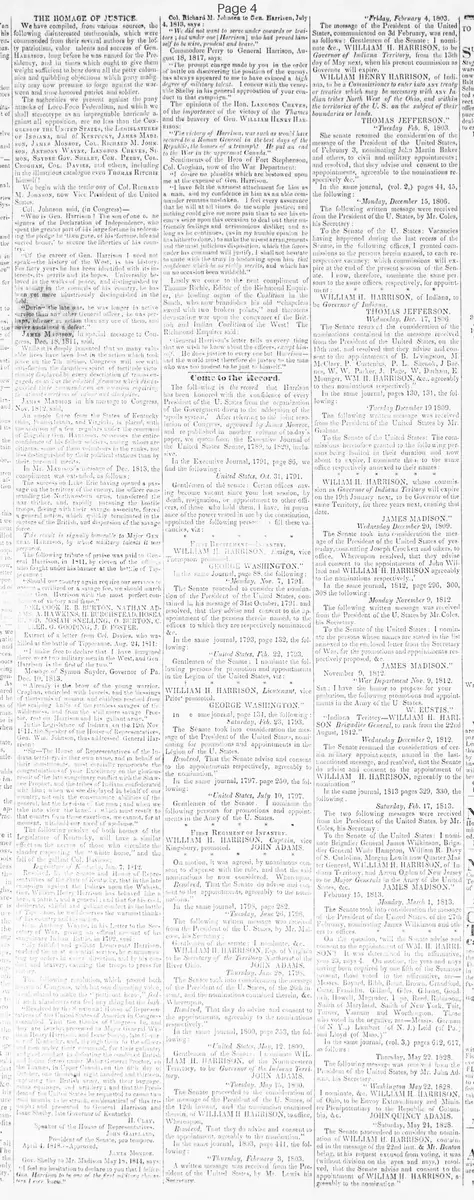
We have compiled, from various sources, the following disinterested testimonials, which were commanded from their several authors by the lofty patriotism, valor talents and success of Gen. Harrison, long before he was named for the Presidency, and in times which ought to give them weight sufficient to bear down all the petty calumnies and quibbling objections which party malignity may now presume to forge against the war-worn and time honored patriot and soldier.
The authorities we present against the puny attacks of Loco-Foco Federalism, and which we shall stereotype as an impregnable barricade against all opposition, are no less than the Congress of the United States, the Legislatures of Indiana, and of Kentucky, James Madison, James Monroe, Col. Richard M. Johnson, Anthony Wayne, Langdon Cheves, Simon Snyder, Gov. Shelby, Com. Perry, Col. Croghan, Col. Davies, and others, including in the illustrious catalogue even Thomas Ritchie himself!
We begin with the testimony of Col. Richard M. Johnson, now Vice President of the United States.
Col. Johnson said, (in Congress)-
Who is Gen. Harrison? The son of one of the signers of the Declaration of Independence, who spent the greater part of his large fortune in redeeming the pledge he then gave, of his fortune, life and sacred honor,' to secure the liberties of his country.
Of the career of Gen. Harrison I need not speak--the history of the West, is his history. For forty years he has been identified with its interests, its perils and its hopes. Universally beloved in the walks of peace, and distinguished by his ability in the councils of his country, he has been yet more illustriously distinguished in the field.
During the late war, he was longer in active service than any other General officer, he was perhaps oftener in action than any one of them, and never sustained a defeat."
James Madison, in special message to Congress, Dec. 18, 1811, said,
While it is deeply lamented that so many valuable lives have been lost in the action which took place on the 7th ultimo, Congress will see with satisfaction the dauntless spirit of fortitude victoriously displayed by every description of troops engaged, as well as the collected firmness which distinguished their commander on an occasion requiring the utmost exertions of valor and discipline.
James Madison in his message to Congress Nov. 1812. said.
An ample force from the States of Kentucky Ohio, Pennsylvania, and Virginia, is placed, with the addition of a few regulars under the command of Brigadier Gen. Harrison. He possesses the entire confidence of his fellow soldiers, among whom are citizens, some of them volunteers in the ranks, not less distinguished by their political stations than by their personal merits.
In Mr. Madison's message of Dec. 1813, the compliment was extended, as follows:
The success on Lake Erie having opened a passage on the territory of the enemy, the officer commanding the Northwestern army, transferred the war thither, and, rapidly pursuing the hostile troops, fleeing with their savage associates, forced a general action, which quickly terminated in the capture of the British, and dispersion of the savage force.
This result is signally honorable to Major General William Henry Harrison, by whose military talents it was prepared.
The following tribute of praise was paid to General Harrison, in 1811, by eleven of the officers who fought under his banner at the battle of Tippecanoe:
"Should our country again require our services against a civilized or a savage foe, we should march ten. Harrison with the most perfect confidence of victory and fame."
EL COOK R. B. BURTON. NATHAN AD. M S A.IIA WKINS. H. BURCHSTEAD. HOSEA , OD. JOSIAH SNELLING, O BURTON. C. LER, G. GOODING. J. D. FOSTER.
Extract of a letter from Col. Davies, who was killed at the battle of Tippecanoe. Aug. 24, 1811:
"I make free to declare that I have imagined there were two military men in the West, and Gen Harrison is the first of the two."
Message of Simon Snyder, Governor of Pa. Dec. 10, 1813.
Already is the brow of the young warrior. Croghan, encircled with laurels, and the blessings of thousands of woman and children rescued from the scalping knife of the ruthless savages of the wilderness, and from the still more savage Proctor, rest on Harrison and his gallant army.'
In the Legislature of Indiana, on the 12th Nov 1811. the Speaker of the House of Representatives Gen. Wm. Johnson, thus addressed General Harrison:
"Sir-The House of Representatives of the Indiana territory, in their own name, and in behalf of their constituents, most cordially reciprocate the congratulations of your Excellency on the glorious result of the late sanguinary conflict with the Shawnee Prophet, and the tribes of Indian confederated with him : when we see displayed in behalf of our country, not only the consummate abilities of the general, but the heroism of the man ; and when we take into view the benefits, which must result to that country from those exertions. we cannot, for a moment, withhold our meed of applause."
The following resolve of both houses of the Legislature of Kentucky, will have a similar effect on the nerves of those who circulate the slander respecting the " white house," and the fall of the gallant Col. Davies:
Legislature Ky. Jan.7 1812.
Resolved, By the Senate and House of Representatives of the state of Kentucky, that in the late campaign against the Indians upon the Wabash. Gen. William Henry Harrison has behaved like a hero, a patriot, and a general : and that for his cool, skilful and gallant conduct in the battle of Tippecanoe, he merits the warmest thanks of his country and admiration.
Col. Anthony Wayne, in his Letter to the Secretary of War, giving an official account of his sanguinary Indian Battle, in 1794, said
My faithful and gallant Lieutenant Harrison rendered the most essential service, by maneuvering under every direction, and by his courage and bravery, carrying the troops to press for victory.
The following resolution, which passed both houses of Congress, with but one dissenting vote, calculated to make the "petticoat hero," &c. such slanderers can feed on nothing but the lash
Resolved by the House of Representatives of the United States of America in Congress assembled That the thanks of Congress be, and they are hereby, presented to Major General William Henry Harrison, and Isaac Shelby, late Governor of Kentucky, and, through them to the officers and men under their command, for their gallantry and good conduct in defeating the combined British Indian forces under Major General Proctor, on the Thames, in Upper Canada, on the 5th day of October, one thousand eight hundred and thirteen, capturing the British army, with their baggage equipage, and artillery; and that the President of the United States be requested to cause two gold medals to be struck, emblematical of this triumph: and presented to General Harrison and Isaac Shelby, late Governor of Kentucky
II. CLAY,
Speaker of the House of Representatives.
JOHN GAILLARD,
President of the Senate, pro tempore.
April 4, 1813.--Approved.
JAMES MONROE.
Gov. Shelby to Mr. Madison May 15, 1814, says
I feel no hesitation to declare to you that I believe Gen. Harrison to be one of the first military characters I ever knew."
Col. Richard M. Johnson to Gen. Harrison, July 4, 1813, says :
" We did not want to serve under cowards or traitors ; but under one Harrison who had proved himself to be wise, prudent and brave."
Commodore Perry to General Harrison, August 18, 1813, says:
"The prompt charge made by you in the order of battle on discovering the position of the enemy, has always appeared to me to have evinced a high degree of military talent. I concur with the venerable Shelby in his general approbation of your conduct in that campaign."
The opinions of the Hon. Langdon Cheves, of the importance of the victory of the Thames and the bravery of Gen. William Henry Harrison:
"The victory of Harrison, was such as would have secured to a Roman General in the best days of the Republic, the honors of a triumph! He put an end to the war in the uppermost Canada."
Sentiments of the Hero of Fort Stephenson, Col. Croghan, now of the War Department:
"I desire no plaudits which are bestowed upon me at the expense of Gen. Harrison.
I have felt the warmest attachment for him as a man, and my confidence in him as an able commander remains unshaken. I feel every assurance that he will at all times do me ample justice; and nothing could give me more pain than to see his enemies seize upon this occasion to deal out their unfriendly feelings and acrimonious dislike; and as long as he continues, (as in my humble opinion he has hitherto done,) to make the wisest arrangements and the most judicious disposition, which the forces under his command will justify, I shall not hesitate to unite with the army in bestowing upon him that confidence which he so richly merits, and which has on no occasion been withheld."
Lastly we come to the neat compliment of Thomas Ritchie, Editor of the Richmond Enquirer, the leading organ of the Coalition in the South, who now brandishes his old "chapless sword with two broken points," and threatens devastating war upon the conqueror of the British and Indian Coalition of the West! The Richmond Enquirer said.
General Harrison's letter tells us every thing that we wish to know about the officers, except himself. He does justice to every one but Harrison- and the world must therefore do justice to the man who was too modest to be just to himself."
Come to the Record.
The following is the record that Harrison has been honored with the confidence of every President of the U. States from the organization of the Government down to the adoption of the 'spoils system,' After referring to the joint resolution of Congress, approved by James Monroe, and re-published in another column of to-day's paper, we quote from the Executive Journal of the United States Senate, 1789, to 1829, inclusive.
In the Executive Journal, 1791, page 86, we find the following ;
United States, Oct. 31, 1791.
Gentlemen of the senate: Certain offices having become vacant since your last session, by death, resignation, or appointment to other offices, of those who held them, I have, in pursuance of the power vested in me by the constitution, appointed the following persons to fill these vacancies, viz:
First Regiment of Infantry.
WILLIAM H. HARRISON Ensign, vice Thompson promoted.
GEORGE WASHINGTON."
In the same Journal, page 88. the following:
"Monday, Nov. 7, 1791.
The Senate proceeded to consider the nomination of the President of the United States, contained in his message of 31st October, 1791. and resolved, that they advise and consent to the appointment of the persons therein named, to the offices to which they are respectively nominated &c.
In the same journal, 1793, page 132, the following :
United States, Feb. 22. 1793.
Gentlemen of the Senate : I nominate the following persons for promotion and appointments in the Legion of the United States, viz:
WILLIAM H. HARRISON. Lieutenant, vice Prior promoted.
GEORGE WASHINGTON."
In same journal, page 131, the following :
Saturday, Feb. 23, 1793.
The Senate took into consideration the message of the President of the United States, nominating for promotions and appointments in the Legion of the U. States.
Resolved, That the Senate advise and consent to the appointments respectively, agreeably to the nomination.
In the same journal, 1797. page 250, the following:
United States, July 10, 1797.
Gentlemen of the Senate: I nominate the following persons for promotions and appointments in the Army of the U. States.
First Regiment of Infantry.
WILLIAM H. HARRISON, Captain, vice Kingsbury, promoted.
JOHN ADAMS.
On motion, it was agreed, by unanimous consent to dispense with the rule, and that the said nominations be now considered. Whereupon,
Resolved, That the Senate do advise and consent to the appointments, agreeably to the nominations.
In the same journal, 1798, page 282.
"Tuesday, June 26, 1798.
The following written message was received from the President of the U. States, by Mr. Malcor, his Secretary:
Gentlemen of the senate : I nominate, &c.
WILLIAM HARRISON. Esq of Virginia to be Secretary of the Territory Northwest of the River Ohio.
JOHN ADAMS.
Thursday, June 28, 1798.
The Senate took into consideration the message of the President of the U. States, of the 26th instant, and the nominations contained therein, &c.
Whereupon,
Resolved, That they do advise and consent to the appointments, agreeably to the nominations respectively.'
In the same journal, 1800, page 353, the following;
United States, March 12. 1800.
Gentlemen of the Senate I nominate WILLIAM H. HARRISON, of the Northwestern Territory, to be Governor of the Indiana Territory.
JOHN ADAMS.
"Tuesday, March 15, 1800.
The Senate proceeded to the consideration of the message of the President of the U. States, of the 12th instant, and the nomination contained therein, of WILLIAM H. HARRISON, to office,
Whereupon,
Resolved, That they do advise and consent to the appointment, agreeably to the nomination."
In the same journal, 1803, page 411, the following:
"Thursday, February 3, 1803.
A written message was received from the President of the United States, by Mr. Lewis, his Secretary
To the Senate of the United States: Vacancies having happened during the last recess of the Senate, in the following offices, I granted commissions to the persons herein named, to each respective vacancy: which commissions will expire at the end of the present session of the Senate. I now, therefore, nominate the same persons to the same offices. respectively, for appointment:
WILLIAM H. HARRISON, whose commission as Governor of Indiana Territory will expire on the 13th day of October next, to be Governor of the Indiana Territory, for four years.
THOMAS JEFFERSON.
"Friday, February 4, 1803.
The message of the President of the United States, communicated on 3d February, was read, as follows : Gentlemen of the Senate: I nominate WILLIAM H. HARRISON, to be Governor of Indiana Territory, from the 13th day of October next, when his present commission as Governor will expire.
WILLIAM HENRY HARRISON. of Indiana, to be a Commissioner to enter into any treaty or treaties which may be necessary with any Indian tribes North West of the Ohio, and within the territories of the U. S. on the subject of their boundaries or lands.
THOMAS JEFFERSON."
"Tuesday Feb. 8, 1803
The senate resumed the consideration of the message of the President of the United States. of February 3, nominating John Martin Baker and others, to civil and military appointments; and resolved, that they advise and consent to the appointments, agreeable to the nominations respectively &c.
In the same journal, (vol. 2,) pages 44, 45 the following :
"Monday, December 15, 1806.
The following written message were received from the President of the U. States, by Mr. Coles, his Secretary :
To the Senate of the U. States: Vacancies having happened during the last recess of the Senate, in the following offices, I granted commissions to the persons herein named, to each respective vacancy: which commissions will expire at the end of the present session of the Senate. I now, therefore, nominate the same persons to the same offices. respectively, for appointment:
WILLIAM H. HARRISON, of Indiana, to be Governor of Indiana.
THOMAS JEFFERSON.
Wednesday, Dec, 17. 1806
The Senate resumed the consideration of the nominations contained in the message received from the President of the United States, on the 15th inst. and resolved that they advise and consent to the appointments of B. Livingston, M MeClary. P. Curtenius. P. L. Shenok, J Barnes. W. W. Parker. J. Page, W. Durham. E Mounger, WM H. HARRISON, &c., agreeably to their nominations respectively
In the same journal, pages 130, 131, the following :
'Tuesday December 19 1809.
The following written message was received from the President of the United States by Mr. Grahame.
To the Senate of the United States: The commissions heretofore granted to the following persons being limited in their duration and now about to expire, I nominate them to the same office respectively annexed to their names:
WILLIAM H. HARRISON. whose commission as Governor of Indiana Territory will expire on the 19th January next, to be Governor of the same Territory, for three years next ensuing that date.
JAMES MADISON."
Wednesday December 20, 1809.
The Senate took into consideration the message of the President of the United States of yesterday, nominating Joseph Crockett and others, to office, Whereupon resolved, that they advise and consent to the appointments of John William Jard and WILLIAM H. HARRISON agreeably to the nominations respectively.
In the same journal. 1812, page 296, 300, 308 the following:
Monday November 9, 1812
The following written message was received from the President of the U, States by Mr. Coles, his Secretary
To the Senate of the United States : I nominate the persons whose names are stated in the list annexed to the enclosed letter from the Secretary of War, for the promotions and appointments respectively proposed, &c
JAMES MADISON."
November 9. 1812
"War Department Nov. 9, 1812.
Sir : I have the honor to propose for your approbation, the following promotions and appointments in the Army of the U States.
W. EUSTIS."
"Indiana Territory-WILLIAM H. HARRISON Brigadier General, to rank from the 22nd August, 1812."
Wednesday December 2, 1812.
The Senate resumed the consideration of certain military appointments, named in the last mentioned message, and resolved, that the Senate do advise and consent to the appointment of WILLIAM H. HARRISON, agreeably to the nomination
In the same journal, 1813 pages 329, 330, the following :
Saturday, Feb. 17, 1813.
The two following messages were received from the President of the United States, by Mr. Coles. his Secretary :
To the Senate of the United States: I nominate Brigadier General James Wilkinson, Brigadier General Wade Hampton, William R. Davy of S. Carolina. Morgan Lewis now Quarter Master General, WILLIAM H. HARRISON, of Indiana Territory, and Aaron Ogden of New Jersey to be Major Generals in the Army of the United States, &c.
JAMES MADISON."
February 15, 1813.
Monday, March 1, 1813.
The Senate took into consideration the message of the President of the United States. of the 27th February, nominating James Wilkinson and others to offices.
On the question, 'will the Senate advise and consent to the appointment of WM. H. HARRISON'? It was determined in the affirmative yeas 23, nays 1. On motion, the yeas and nays having been required by one fifth of the Senators present, those voted in the affirmative, are--
Messrs. Bayard, Bibb, Brent, Brown, Crawford. Cutts, Franklin, Gaillard, Giles, Grundy, Goodrich, Howell, Magruder, Pope, Reed, Robinson, Smith of Maryland, Smith of New York, Tait, Turner, Varnum and Worthington. Those who voted in the negative, are-Messrs. German (of N. Y.,) Lambert of N. J.) Reed (of Pa. and Lloyd (of Mass.)'
In the same journal, (vol. 3,) pages 612, 617, as follows :
Thursday, May 22, 1828.
The following message was received from the President of the United States, by Mr. John Adams. his Secretary
"Washington May 22. 1828.
I nominate, &c. WILLIAM H. HARRISON. of Ohio, to be Envoy Extraordinary and Minister Plenipotentiary to the Republic of Colombia, &c.
JOHN QUINCY ADAMS.
"Saturday, May 24, 1828.
The Senate proceeded to consider the nomination of WILLIAM H. HARRISON. contained in the message of the 22nd inst. & Mr. Benton being, at his request excused from voting, it was (without division on the ayes and nays,) resolved, that the Senate advise and consent to the appointment of WILLIAM H. HARRISON, agreeably to the nomination
What sub-type of article is it?
What themes does it cover?
What keywords are associated?
What entities or persons were involved?
Where did it happen?
Story Details
Key Persons
Location
United States, Indiana Territory, Kentucky, Northwest Territory, Upper Canada
Event Date
1791 To 1828
Story Details
Article compiles pre-presidential testimonials from US leaders, Congress, and military figures praising Harrison's military service in Indian wars and War of 1812, his heroism at Tippecanoe and Thames, and successive appointments from ensign to minister by presidents Washington to Adams.