Thank you for visiting SNEWPapers!
Sign up free
Gazette Of The United States, & Philadelphia Daily Advertiser
Philadelphia, Philadelphia County, Pennsylvania
What is this article about?
Debate in the U.S. House of Representatives on April 10 regarding a bill to fund hospitals for sick and disabled seamen through wage deductions. Speakers from Massachusetts and others oppose it as an unfair tax benefiting foreigners and burdening locals, while supporters argue it provides essential relief and national honor.
Clipping
OCR Quality
Full Text
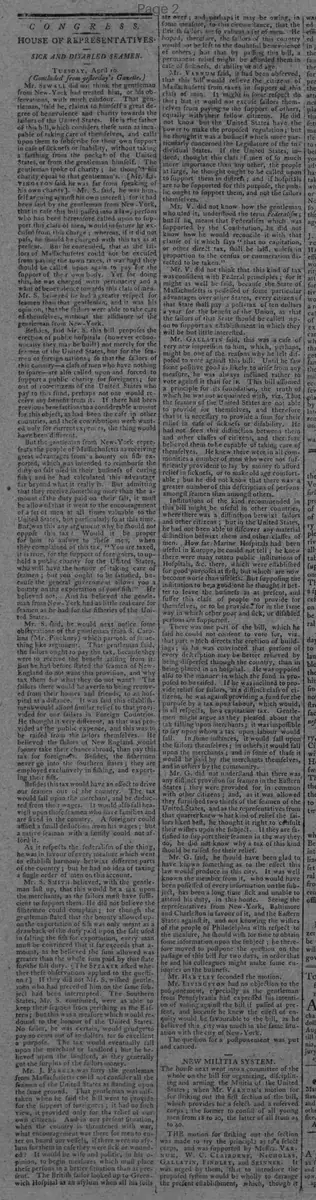
SICK AND DISABLED SEAMEN.
Thursday, April 10.
(Concluded from yesterday's Gazette.)
Mr. Sewall did not think the gentleman from New-York had treated him, or his observations, with much candour. That gentleman, said he, claims to himself a great degree of benevolence and charity towards the sailors of the United States. He is the father of this bill, which considers these men as incapable of taking care of themselves, and calls upon them to subscribe for their own support in case of sickness or inability, without taking a farthing from the pocket of the United States, or from the gentleman himself. The gentleman spoke of charity; he thought his charity equal to that gentleman's. [Mr. Livingston rose and said he was far from speaking of his own charity]. Mr. S. said, he was himself arguing against his own interest; for it had been said by the gentleman from New-York, that in case this bill passed into a law, persons who had been heretofore called upon to support this class of men, would in future be excused from this charge; whereas, if it did not pass, he should be charged with this tax as at present. But he contended, that as the sailors of Massachusetts could not be excused from paying the town taxes, it was hard they should be called upon again to pay for the support of the poor. Yet for doing this, he was charged with pertinacity and a want of benevolence towards this class of men. Mr. S. believed he had a greater respect for seamen than that gentleman, and it was his opinion, that the sailors were able to take care of themselves, without the assistance of the gentleman from New-York.
Besides, said Mr. S. this bill proposes the erection of public hospitals (however economically they may be built) not merely for the seamen of the United States, but for the seamen of foreign nations; so that the sailors of this country—a class of men who have nothing to spare—are also called upon and forced to support a public charity for foreigners; for out of 100 citizens of the United States who pay to this fund, perhaps not one would receive any benefit from it. If there had been previous benefactions to a considerable amount for this object, as had been the case in other countries, and these contributions were wanted only for current expenses, the thing would have been different.
But the gentleman from New-York represents the people of Massachusetts as receiving great advantages from a bounty on fish exported, which was intended to reimburse the duty on salt used in their business of curing fish; and he had calculated this advantage far beyond what it really is. But admitting that they receive something more than the amount of the duty paid on their salt, it must be allowed that it went to the encouragement of a set of men at all times valuable to the United States, but particularly so at this time.
But was this any argument why he should not oppose this tax? Would it be proper for him to answer to these men, when they complained of this tax, "You are taxed, it is true, for the support of foreigners, to uphold a public charity for the United States, who will have the honour of taking care of seamen; but you ought to be satisfied, because the general government allows you a bounty on the exportation of your fish." He believed not. And he believed the gentleman from New-York had as little real care for seamen as he had for the fisheries of the United States.
Mr. S. said, he would next notice some observations of the gentleman from S. Carolina (Mr. Pinckney) which partook of something like argument. That gentleman said, the sailors ought to pay the tax, because they were to receive the benefit arising from it. But he had before stated the seamen of New-England do not want this provision, and why tax them for what they do not want? The sailors there would be averse to being removed from their homes and friends, to an hospital at a distance. It was said this establishment would afford similar relief to that provided for our sailors in Foreign Countries. He thought it very different, as that was provided at the public expense, and this was to be raised from the sailors themselves. He believed the sailors of New England would sooner take their chance abroad, than pay this tax for foreigners. Besides, the fishermen never go into the southern states; they are employed exclusively in fishing, and exporting their fish.
Besides this tax would have an effect to drive our seamen out of the country. The tax would fall upon the merchant, and be deducted from their wages. It would also fall heaviest upon those seamen who have families and are fixed in the country. A foreigner could afford a small deduction from his wages; but a native seaman with a family could not afford it.
As it respects the federalism of the thing, he was in favour of every measure which went to establish harmony betwixt different parts of the country; but he had no idea of taxing a single order of men on this account.
Mr. S. Smith believed, with the gentleman last up, that this would be a tax upon the merchants, as the sailors must have sufficient to support them. He did not believe the fishermen could complain: for though the gentleman stated that the bounty allowed upon the exportation of fish was only meant as a drawback of the duty paid upon the salt used in salting the fish for exportation, every man must be convinced that it far exceeds that amount, as he believed the sum allowed was greater than the whole sum paid by that state for the salt duty. [The Speaker asked whether these observations applied to the question?] If they did not Mr. S. wished gentlemen who had preceded him on the same subject had been interrupted. The Southern States, Mr. S. continued, were as able to keep their seamen from perishing as the Eastern; but this was a measure which would redound to the honour of the United States. No sailor, he was certain, would grudge to pay 20 cents out of 10 dollars for so excellent a purpose. The tax would eventually fall upon the merchant or landlord; but he believed upon the landlord, as they generally got the surplus of the sailors money.
Mr. J. Parker was sorry the gentleman from Massachusetts could not consider all the seamen of the United States as standing upon the same ground. That gentleman was mistaken when he said the bill went to provide for the support of foreigners; it had no such view, it provided only for the relief of our own citizens. And in our present situation, when the country is threatened with war, what encouragement was there for men to enter on board our vessels, if there were no asylum for them in case they were sick or wounded? It would be wise and politic, in his opinion, to begin measures which must place these persons in a better situation than at present. The British sailor looked up to Greenwich Hospital as an asylum when all his toils were over; and, perhaps it may be owing, in some measure, to this circumstance, that the British sailors are so valiant a set of men. He hoped, therefore, the sailors of this country would not be left to the doubtful benevolence of others; but that by passing this bill, a permanent relief might be afforded them in case of sickness, disability or old age.
Mr. Varnum said, it had been observed, that this bill would relieve the citizens of Massachusetts from taxes in support of this class of men. It might in some respect do this; but it would not excuse sailors themselves from paying to the support of others, equally with their fellow citizens. He did not know but the United States have the power to make the proposed regulation; but he thought it was a business which more particularly concerned the Legislature of the individual States. If the United States, indeed, thought this class of men of so much more importance than any other, the people at large, he thought ought to be called upon to support them in distress; and if hospitals are to be supported for this purpose, the public ought to support them, and not the sailors themselves.
Mr. V. did not know how the gentleman who used it, understood the term Federalism; but if he meant that Federalism which was supported by the Constitution, he did not know how he would reconcile it with that clause of it which says "that no capitation, or other direct tax, shall be laid, unless in proportion to the census or enumeration directed to be taken."
Mr. V. did not think that this kind of tax was consistent with Federal principles; for it might as well be said, because the State of Massachusetts is possessed of some particular advantages over other States, every citizen of that State shall pay a poll-tax of ten dollars a year for the benefit of the Union, as that the sailors of that State should be called upon to support an establishment in which they will be but little interested.
Mr. Gallatin said, this was a case of very new impression to him, which, perhaps, might be one of the reasons why he felt disposed to vote against this bill. Until he saw some positive good as likely to arise from any measure, he was always inclined rather to vote against it than for it. This bill assumed a principle for its foundation, the truth of which he was not acquainted with, viz. That the seamen of the United States are not able to provide for themselves, and therefore that it is necessary to provide a sum for their relief in case of sickness or disability. He had not seen this distinction between them and other classes of citizens, and therefore believed them to be capable of taking care of themselves. He knew there were in all communities a number of men who were not sufficiently provident to lay by money to afford relief in sickness, or to make old age comfortable; but he did not know that there was a greater number of this description of persons amongst seamen than amongst others.
Institutions of the kind recommended in this bill might be useful in other countries, where there was a distinction betwixt sailors and other citizens; but in the United States, he had not been able to discover any material distinction betwixt them and other classes of men. How far Marine Hospitals had been useful in Europe, he could not tell; he knew there were many rotten public institutions of Hospitals, &c. there, which were established for good purposes at first, but which are now become worse than useless. But supposing the institution to be a good one he thought it better to leave the business as at present, and suffer this class of people to provide for themselves, or to be provided for in the same way in which other poor and sick, or disabled persons are supported.
There was one part of the bill, which he said he could not consent to vote for, viz. that part which directs the erection of buildings; as he was convinced that persons of every description may be better relieved by being dispersed through the country, than in being placed in an hospital. He was opposed also to the manner in which the fund is proposed to be raised. If he was inclined to provide relief for sailors, as a distinct class of citizens, he was against providing a fund for the purpose by a tax upon labour, which would, in all respects, be a capitation tax. Gentlemen might argue as they pleased about the tax falling upon merchants; it was impossible to say upon whom a tax upon labour would fall. In some instances, it would fall upon the sailors themselves; in others it would fall upon the merchants; and in some of these it would be paid by the merchants themselves, and in others by the community.
Mr. G. did not understand that there was any distinct provision for seamen in the Eastern States; they were provided for in common with other citizens; and, as it was allowed they furnished two thirds of the seamen of the United States, and as the representatives from that quarter knew what kind of relief the sailors liked best, he thought it right to consult their wishes upon the subject. If they are satisfied to support their seamen in the way they do, he did not know why a tax of this kind should be raised for their relief.
Mr. G. said, he should have been glad to have known something as to the effect this law would produce in this city. It was well known the member from it, who would have been possessed of every information on the subject, has been a long time sick and unable to attend his duty, in this house. Seeing the representatives from New-York, Baltimore and Charleston in favour of it, and the Eastern States against it, and not knowing the wishes of the people of Philadelphia with respect to the measure, he should wish for time to obtain some information upon the subject; he therefore moved to postpone the question on the passage of this bill for two days, in order that he and his colleagues might make some enquiries on the business.
Mr. Hartley seconded the motion.
Mr. Livingston had no objection to the postponement, especially as the gentleman from Pennsylvania had expressed his intention of voting against the bill if passed at present, and because he knew the effect of enquiry would be favourable to the bill, as he believed this city was much in the same situation with the city of New-York.
The question for a postponement was put and carried.
What sub-type of article is it?
What themes does it cover?
What keywords are associated?
What entities or persons were involved?
Where did it happen?
Story Details
Key Persons
Location
United States House Of Representatives
Event Date
Thursday, April 10.
Story Details
Debate on a bill to establish hospitals for sick and disabled seamen funded by a tax on their wages. Opponents argue it unfairly burdens American seamen, especially from New England, to support foreigners and violates federal principles. Supporters view it as a benevolent measure providing asylum and encouraging enlistment amid war threats. Motion to postpone passes.