Thank you for visiting SNEWPapers!
Sign up free
Pocahontas Times
Marlinton, Huntersville, Pocahontas County, West Virginia
What is this article about?
Historical account of the settlement of Marlins Bottom in the Greenbrier Valley, West Virginia, beginning with Gen. Andrew Lewis's 1751 survey of 480 acres, involving early settlers like Jacob Marlin and Stephen Sewell, and tracing land ownership through the Lewis, Poage, Price, and McLaughlin families up to the founding of Marlinton in 1891.
Clipping
OCR Quality
Full Text
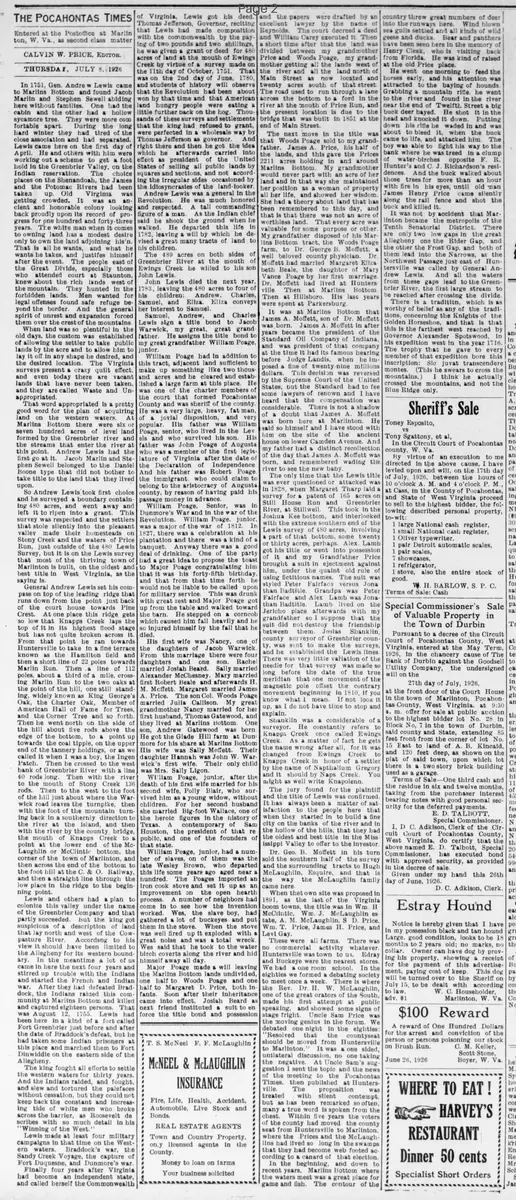
Entered at the Postoffice at Marlinton, W. Va., as second class matter.
CALVIN W. PRICE, EDITOR.
THURSDAY, JULY 8, 1926
In 1751, Gen. Andrew Lewis came to Marlins Bottom and found Jacob Marlin and Stephen Sewell abiding here without families. One had the cabin and the other had a hollow sycamore tree. They were more comfortable apart.
During the long hard winter they had tired of the close association and had separated.
Lewis came here on the first day of April. He and others with him were working out a scheme to get a foothold in the Greenbrier Valley, on the Indian reservation. The choice places on the Shenandoah, the James and the Potomac Rivers had been taken up. Old Virginia was getting crowded. It was an ancient and honorable colony looking back proudly upon its record of progress for one hundred and forty-three years. The white man when it comes to owning land has a modest desire only to own the land adjoining his'n. That is all he wants, and what he wants he takes, and justifies himself after the event. The people east of the Great Divide, especially those who attended court at Staunton, knew about the rich lands west of the mountain. They hunted in the forbidden lands. Men wanted for legal offenses found safe refuge beyond the border. And the general spirit of unrest and expansion forced them over the crest of the mountains.
When land was so plentiful in the old days, the custom was established of allowing the settler to take public lands by the acre and to allow him to lay it off in any shape he desired, and the desired location. The Virginia surveys present crazy quilt effect, and even today there are vacant lands that have never been taken, and they are called Waste and Unappropriated.
That word appropriated is a pretty good word for the plan of acquiring land on the western waters. At Marlins Bottom there were six or seven hundred acres of level land formed by the Greenbrier river and the streams that enter the river at this point. Andrew Lewis had the first go at it. Jacob Marlin and Stephen Sewell belonged to the Daniel Boone type that did not bother to take title to the land that they lived upon.
So Andrew Lewis took first choice and he surveyed a boundary containing 480 acres, and went away and left it to ripen into a grant. This survey was respected and the settlers that stole silently into the pleasant valley made their homesteads on Stony Creek and the waters of Price Run, just outside of the 480 Lewis Survey, but it is on the Lewis survey that most of the thriving town of Marlinton is built, on the oldest and best title in West Virginia, as the saying is.
General Andrew Lewis set his compass on top of the leading ridge that runs down from the point just back of the court house towards Pine Crest. At one place this ridge gets so low that Knapps Creek laps the top of it in its highest flood stage but has not quite broken across it. From that point he ran towards Huntersville to take in a fine terrace known as the Hamilton field and then a short line of 22 poles towards Marlin Run. Then a line of 112 poles, about a third of a mile, crossing Marlin Run to the two oaks at the point of the hill, one still standing, widely known as King George's Oak, the Charter Oak, Member of American Hall of Fame for Trees, and the Corner Tree and so forth.
Then he went north on the side of the hill about five rods above the edge of the bottom, to a point up towards the coal tipple, on the upper end of the tannery holdings, or as we called it when I was a boy, the Ingen Patch. Then he crossed to the west bank of Greenbrier River with a line 40 rods long. Then with the river to the mouth of Stony Creek 136 rods. Then to the west to the foot of the hill just about where the Warwick road leaves the turnpike, then with the foot of the mountain turning back in a southerly direction to the river at the island, and then with the river by the county bridge, the mouth of Knapps Creek to a point at the lower end of the McLaughlin or McClintic bottom, the corner of the town of Marlinton, and then across the end of the bottom to the foot hill at the C. & O. Railway, and then a straight line through the low place in the ridge to the beginning point.
Lewis and others had a plan to colonize this valley under the name of the Greenbrier Company and that partly succeeded. But the king got suspicious of a description of land that lay north and west of the Cowpasture River. According to his view it should have been limited to the Allegheny for its western boundary. In the meantime a lot of us came in here the next four years and stirred up trouble with the Indians and started the French and Indian war. After they had defeated Braddock, the Indians raided this community at Marlins Bottom and killed and captured eighteen persons. That was August 12, 1755. Lewis had been here in a kind of a fort called Fort Greenbrier just before and after the date of Braddock's defeat, but he had taken some Indian prisoners at this place and marched them to Fort Dinwiddie on the eastern side of the Allegheny.
The king fought all efforts to settle the western waters for thirty years. And the Indians raided, and fought, and slew and tortured the palefaces without cessation, but they could not keep back the constant and increasing tide of white men who broke across the barrier, as Roosevelt describes with so much detail in his "Winning of the West."
Lewis made at least four military campaigns in that time on the Western waters. Braddock's war, the Sandy Creek Voyage, the capture of Fort Duquesne, and Dunmore's war. Finally four years after Virginia had become an independent state, and called herself the Commonwealth of Virginia, Lewis got his deed. Thomas Jefferson, Governor, reciting that Lewis had made composition with the commonwealth by the paying of two pounds and two shillings, he was given a grant or deed for 480 acres of land at the mouth of Ewings Creek by virtue of a survey made on the 11th day of October, 1751. That was on the 2nd day of June, 1780, and students of history will observe that the Revolution had been about won by that time and that American land hungry people were eating a little further back on the hog. Thousands of these surveys and settlements that the king had refused to grant, were perfected in a wholesale way by Thomas Jefferson as governor. And right there and then he got the idea which he afterwards carried into effect as president of the United States of selling all public lands by squares and sections, and not according to the irregular sides occasioned by the idiosyncrasies of the land-looker.
Andrew Lewis was a general in the Revolution. He was much honored and respected. A tall commanding figure of a man. As the Indian chief said he shook the ground when he walked. He departed this life in 1782, leaving a will by which he devised a great many tracts of land to his children.
The 480 acres on both sides of Greenbrier River at the mouth of Ewings Creek he willed to his son John Lewis. John Lewis died the next year, 1783, leaving the 480 acres to four of his children: Andrew, Charles, Samuel, and Eliza. Eliza conveys her interest to Samuel. Samuel, Andrew, and Charles Lewis sign a title bond to Jacob Warwick, my great, great grandfather. He assigns the title bond to my great grandfather William Poage, junior.
William Poage had in addition to this tract, adjacent land sufficient to make up something like two thousand acres and he cleared and established a large farm at this place. He was one of the charter members of the court that formed Pocahontas County and was sheriff of the county. He was a very large, heavy, fat man, of a jovial disposition, and very popular. His father was William Poage, senior, who lived in the Levels and who survived his son. His father was John Poage of Augusta who was a member of the first legislature of Virginia after the date of the Declaration of Independence. And his father was Robert Poage, the immigrant, who could claim to belong to the aristocracy of Augusta county, by reason of having paid his passage money in advance.
William Poage, Senior, was in Dunmore's War and in the war of the Revolution. William Poage, junior, was a major of the war of 1812. In 1827, there was a celebration at his plantation and there was a kind of a banquet. Anyway there was a good deal of drinking. One of the party had a great idea to propose the toast to Major Poage congratulating him that it was his forty-fifth birthday, and that from that time forth he would not be liable to be called upon for military service. This was drunk with great zest and Major Poage got up from the table and walked toward the barn. He stepped on a corncob which caused him fall heavily and he so injured himself by the fall that he died.
His first wife was Nancy, one of the daughters of Jacob Warwick. From this marriage there were four daughters and one son. Rachel married Josiah Beard. Sally married Alexander McChesney. Mary married first Robert Beale and afterwards H. M. Moffett. Margaret married James A. Price. The son Col. Woods Poage married Julia Callison. My great grandmother Nancy married for her first husband, Thomas Gatewood, and they lived at Marlins Bottom. One son, Andrew Gatewood was born. He got the Glade Hill farm at Dunmore for his share at Marlins Bottom. His wife was Sally Moffett. Their daughter Hannah was John W. Warwick's first wife. Their only child was Mrs. Sally Ligon.
William Poage, junior, after the death of his first wife married for his second wife, Polly Blair, who survived him as a young widow, without children. For her second husband she married Big-foot Wallace, one of the heroic figures in the history of Texas. A contemporary of Sam Houston, the president of that republic, and one of the founders of that state.
William Poage, junior, had a number of slaves. One of them was the late Wesley Brown, who departed this life some years ago aged near a hundred. The Poages imported an iron cook stove and set it up as an improvement on the open hearth process. A number of neighbors had come in to see how the invention worked. Wes, the slave boy, had gathered a lot of buckeyes and put them in the stove. When the stove was well fired up it exploded with a great noise and was a total wreck. Wes said that he took to the water birch coverts along the river and hid himself away all day.
Major Poage made a will leaving the Marlins Bottom lands undivided, one half to Woods Poage and one half to Margaret D. Price, both infants. Soon after their inheritance came into effect, Josiah Beard as next friend instituted a suit to enforce the title bond and possession. T. S. McNeel F. F. McLaughlin McNEEL & McLAUGHLIN INSURANCE Fire, Life, Health, Accident, Automobile, Live Stock and Bonds. REAL ESTATE AGENTS Town and Country Property only licensed agents in the County Money to loan on farms Your business solicited
and the papers were drafted by an excellent lawyer by the name of Reynolds. The court decreed a deed and William Carey executed it. Then a short time after that the land was divided between my grandmother Price and Woods Poage, my grandmother getting all the lands west of the river and all the land north of Main Street as now located and twenty acres south of that street.
The road used to run through a lane across the bottom to a ford in the river at the mouth of Price Run, and the present location is due to the bridge that was built in 1851 at the end of Main Street.
The next move in the title was that Woods Poage sold to my grandfather, James A. Price, his half of the lands, and this gave the Prices 221 acres holding in and around Marlins Bottom. My grandmother would never part with an acre of her land and in that way she maintained her position as a woman of property all her life, and showed her wisdom.
She had a theory about land that has been remembered to this day, and that is that there was not an acre of worthless land. That every acre was valuable for some purpose or other.
My grandfather disposed of his Marlins Bottom tract, the Woods Poage farm, to Dr. George B. Moffett, a well beloved county physician. Dr. Moffett had married Margaret Elizabeth Beale, the daughter of Mary Vance Poage by her first marriage. Dr. Moffett had lived at Huntersville. Then at Marlins Bottom. Then at Hillsboro. His last years were spent at Parkersburg.
It was at Marlins Bottom that James A. Moffett, son of Dr. Moffett was born. James A. Moffett in after years became the president of the Standard Oil Company of Indiana and was president of that company at the time it had its famous hearing before Judge Landis, when he imposed a fine of twenty-nine millions dollars. This decision was reversed by the Supreme Court of the United States, but the Standard had to fee some lawyers of renown and I have heard that the compensation was considerable. There is not a shadow of a doubt that James A. Moffett was born here at Marlinton. He said so himself and I have stood with him on the site of the ancient house on lower Camden Avenue. And my father had a distinct recollection of the day that James A. Moffett was born, and remembered wading the river to see the new baby.
The only time that the Lewis title was ever questioned or attacked was in 1828, when Margaret Tharp laid a survey for a patent of 165 acres on Still House Run and Greenbrier River, at Stillwell. This took in the Joshua Kee bottom, and interlocked with the extreme southern end of the Lewis survey of 480 acres, involving a part of that bottom, some twenty or thirty acres, perhaps. Alex. Lamb got his title or went into possession of it and my Grandfather Price brought a suit in ejectment against him, under the quaint old rule of using fictitious names. The suit was styled Peter Fairface versus Jonathan Badtitle. Grandpa was Peter Fairface and Alex Lamb was Jonathan Badtitle. Lamb lived on the Jericho place afterwards with my grandfather so I suppose that the suit did not destroy the friendship between them. Josias Shanklin county surveyor of Greenbrier county, was sent to make the surveys, and he established the Lewis lines. There was very little variation of the needle for that survey was made so long before the date of the true meridian that one movement of the magnetic pole offset the contrary movement beginning in 1810, if you know what I mean. If not look it up, as I do not have time to stop and explain.
Shanklin was a considerable of a surveyor. He constantly refers to Knapps Creek once called Ewings Creek. As a matter of fact he gets the name wrong after all, for it was changed from Ewings Creek to Knapps Creek in honor of a settler by the name of Napthalium Gregory and it should by Naps Creek. You might as well write Knapolenn.
The jury found for the plaintiff and the title of Lewis was confirmed. It has always been a matter of satisfaction to the people here that when they started in to build a fine city on the banks of the river and in the hollow of the hills, that they had the oldest and best title in the Mississippi Valley to offer to the investor.
Dr. Geo. B. Moffett in his turn sold the southern half of the survey and the surrounding tracts to Hugh McLaughlin, Esquire, and that is the way the McLaughlin family came here.
When the town site was proposed in 1891, as the last of the Virginia boom towns, the title was in Wm. H. McClintic, Wm. J. McLaughlin estate, A. M. McLaughlin, S. D. Price, Wm. T. Price, James H. Price, and Levi Gay. These were all farms. There was no commercial activity whatever. Huntersville was town to us, Edray and Buckeye were the nearest stores. We had a one room school. In the eighties we formed a debating society to meet once a week. There is where the Rev. Dr. H. W. McLaughlin, one of the great orators of the South, made his first attempt at public speaking, and showed some signs of stage fright. Uncle Sam Price was the moving genius in the forum. We debated one night in the eighties: "Resolved that the county seat should be moved from Huntersville to Marlinton." It was a one sided, unilateral discussion, no one taking the negative. At Uncle Sam's suggestion I sent the topic and the news of the meeting to the Pocahontas Times, then published at Huntersville.
The proposition was treated with silent contempt, but as has been remarked so often, many a true word is spoken from the chest. Within five years the voters of the county had moved the county seat from Huntersville to Marlinton, where the Prices and the McLaughlins had lived so long in the swamps that they had become web footed according to a canard of that election.
In the beginning, and down to recent years, Marlins Bottom where the waters meet was a great place for game and fish. The contour of the country threw great numbers of deer into the runways here. Wind blown sea gulls settled and all kinds of wild geese and ducks. Bear and panthers have been seen here in the memory of Henry Cleek, who is visiting back from Florida. He was kind of raised at the old Price place.
He went one morning to feed the horses early, and his attention was attracted to the baying of hounds. Grabbing a mountain rifle, he went to the river and found in the river near the end of Twelfth Street a big buck deer bayed. He shot it in the head and knocked it down. Putting down his rifle he waded in and was about to bleed it, when the buck came to life, and attacked him. The boy was able to fight his way to the bank where he was treed in a clump of water-birches opposite F. R. Hunter's and C. J. Richardson's residences. And the buck walked about those trees for more than an hour with fire in his eyes, until old man James Henry Price came silently along the rail fence and shot the buck and killed it.
It was not by accident that Marlinton became the metropolis of the Tenth Senatorial District. There are only two low gaps in the great Allegheny one the Rider Gap, and the other the Frost Gap, and both of them lead into the Narrows, as the Northwest Passage just east of Huntersville was called by General Andrew Lewis. And all the waters from these gaps lead to the Greenbrier River, the first large stream to be reached after crossing the divide.
There is a tradition, which is as worthy of belief as any of the traditions, concerning the Knights of the Golden Horseshoe, and that is that this is the farthest west reached by Governor Alexander Spotswood, in his expedition west in the year 1716. The trophy that he gave to every member of that expedition bore this inscription: Sic juvat transcendere montes. (This he swears to cross the mountains.) I think he actually crossed the mountains, and not the Blue Ridge only.
What sub-type of article is it?
What themes does it cover?
What keywords are associated?
What entities or persons were involved?
Where did it happen?
Story Details
Key Persons
Location
Marlins Bottom, Greenbrier Valley, Marlinton, West Virginia
Event Date
1751 To 1926
Story Details
Gen. Andrew Lewis surveys 480 acres in 1751 at Marlins Bottom, respected by settlers; land passes through Lewis, Poage, Price, and McLaughlin families amid Indian conflicts and wars; becomes site of Marlinton town in 1891 with oldest title in West Virginia.