Thank you for visiting SNEWPapers!
Sign up free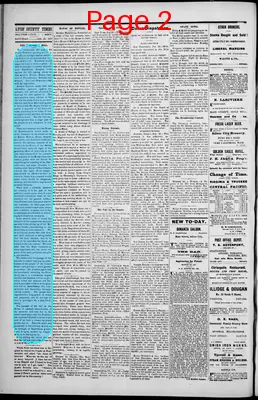
Editorial
January 27, 1877
Lyon County Times
Yerington, Silver City, Dayton, Lyon County, Nevada
What is this article about?
Editorial supports the compromise Electoral Bill passed by Senate in 1877, amid disputed 1876 presidential election between Hayes and Tilden. It praises the measure for averting crisis, ensuring peace and business recovery, despite some Republican opposition on constitutional grounds.
Clipping

OCR Quality
98%
Excellent
Full Text
THE ELECTORAL BILL.
The compromise bill passed the Senate Thursday morning at 7:10 A. M., after an all night session, continuous from noon the previous day, by a vote of 47 to 17. Elsewhere in this paper the vote in detail is given. It will be seen that a number of prominent Republican Senators voted against the bill, among whom we may mention Morton, Blaine, Cameron of Pennsylvania, Sherman and Sargent. Only one Democrat voted with the opposition,
Several Senators made able and exhaustive speeches against the measure, and perhaps advanced all that can be said against it. The main position taken adverse to the bill was the claim that it is unconstitutional, and those who voted against it believe that Mr. Hayes, having received a majority of the Electoral votes according to the forms of law, is legally elected and that the Senate should so insist. But the fact cannot be ignored that a large part of the people do not acquiesce in that belief.
There is a certainty that the House of Representatives would make a stout resistance to the claims set up by Messrs. Morton, Blaine, Sargent and others, and doubtless would proceed to the extreme measure of an election in the House, if the Senate should insist upon the right of the presiding officer of that body to decide what returns shall be counted. The majority in the House claim concurrent power with the Senate in supervising the counting of the Electoral votes, and many Senators, including some very good Republicans, concede this right. If no compromise should be effected we have no reason to doubt that a contest would ensue which would be dangerous, exciting, and still further depress and prostrate business.
When such a calamity menaces the country, it is the part of the patriot to secure peace, even if some cherished convictions must be surrendered for the general welfare. Clay, Webster, and other great American statesmen, in times past, advocated and carried compromise measures conducive to peace, and to-day no statesman should falter in following such illustrious examples.
Some persons seem to think the adoption of the compromise measure amounts to the giving up of all Mr. Hayes' claims—surrendering to the Democrats, as some express it. We do not by any means take this view, and shall entertain a strong belief that the final decision will be in favor of the candidate for whom we battled in the late canvass. We have faith that the High Commission, when appointed, will rise above the plane of the mere politician and give a just decision.
We believe that the passage of the bill will be hailed with joy by three-fourths of the people of the United States—and perhaps a much greater proportion. All accounts agree that the uncertainty attending the Presidency has to a considerable degree checked the business revival so generally noted last summer and fall. And a peaceable solution of the question will be immediately felt, commercially and financially, throughout the country. The people have experienced a long period of doubt and perplexity and do not care to have it prolonged by a dual Presidency.
The passage of the bill in the House is assured—three-fourths of the members will vote for it, the latest report says—and the President has expressed himself in its favor and said if he had a chance he would gladly sign it. Thus the peace and prosperity of the country, as well as the triumph of Republican government, is again secured by compromise, as in times gone by.
Since writing the above we learn that the bill has passed the House by a vote of 191 to 86.
The compromise bill passed the Senate Thursday morning at 7:10 A. M., after an all night session, continuous from noon the previous day, by a vote of 47 to 17. Elsewhere in this paper the vote in detail is given. It will be seen that a number of prominent Republican Senators voted against the bill, among whom we may mention Morton, Blaine, Cameron of Pennsylvania, Sherman and Sargent. Only one Democrat voted with the opposition,
Several Senators made able and exhaustive speeches against the measure, and perhaps advanced all that can be said against it. The main position taken adverse to the bill was the claim that it is unconstitutional, and those who voted against it believe that Mr. Hayes, having received a majority of the Electoral votes according to the forms of law, is legally elected and that the Senate should so insist. But the fact cannot be ignored that a large part of the people do not acquiesce in that belief.
There is a certainty that the House of Representatives would make a stout resistance to the claims set up by Messrs. Morton, Blaine, Sargent and others, and doubtless would proceed to the extreme measure of an election in the House, if the Senate should insist upon the right of the presiding officer of that body to decide what returns shall be counted. The majority in the House claim concurrent power with the Senate in supervising the counting of the Electoral votes, and many Senators, including some very good Republicans, concede this right. If no compromise should be effected we have no reason to doubt that a contest would ensue which would be dangerous, exciting, and still further depress and prostrate business.
When such a calamity menaces the country, it is the part of the patriot to secure peace, even if some cherished convictions must be surrendered for the general welfare. Clay, Webster, and other great American statesmen, in times past, advocated and carried compromise measures conducive to peace, and to-day no statesman should falter in following such illustrious examples.
Some persons seem to think the adoption of the compromise measure amounts to the giving up of all Mr. Hayes' claims—surrendering to the Democrats, as some express it. We do not by any means take this view, and shall entertain a strong belief that the final decision will be in favor of the candidate for whom we battled in the late canvass. We have faith that the High Commission, when appointed, will rise above the plane of the mere politician and give a just decision.
We believe that the passage of the bill will be hailed with joy by three-fourths of the people of the United States—and perhaps a much greater proportion. All accounts agree that the uncertainty attending the Presidency has to a considerable degree checked the business revival so generally noted last summer and fall. And a peaceable solution of the question will be immediately felt, commercially and financially, throughout the country. The people have experienced a long period of doubt and perplexity and do not care to have it prolonged by a dual Presidency.
The passage of the bill in the House is assured—three-fourths of the members will vote for it, the latest report says—and the President has expressed himself in its favor and said if he had a chance he would gladly sign it. Thus the peace and prosperity of the country, as well as the triumph of Republican government, is again secured by compromise, as in times gone by.
Since writing the above we learn that the bill has passed the House by a vote of 191 to 86.
What sub-type of article is it?
Partisan Politics
Constitutional
What keywords are associated?
Electoral Bill
Compromise
Hayes Election
Senate Vote
House Passage
Constitutional Dispute
National Peace
Business Revival
What entities or persons were involved?
Morton
Blaine
Cameron Of Pennsylvania
Sherman
Sargent
Mr. Hayes
Democrats
House Of Representatives
Clay
Webster
High Commission
Editorial Details
Primary Topic
Support For Electoral Commission Bill Compromise In 1876 Election Dispute
Stance / Tone
Supportive Of Compromise For National Peace And Prosperity
Key Figures
Morton
Blaine
Cameron Of Pennsylvania
Sherman
Sargent
Mr. Hayes
Democrats
House Of Representatives
Clay
Webster
High Commission
Key Arguments
Bill Passed Senate 47 17 After All Night Session
Opposition Claims Bill Unconstitutional And Hayes Legally Elected
House Would Resist Senate's Sole Authority, Risking Crisis
Compromise Averts Dangerous Contest And Business Depression
Patriots Should Surrender Convictions For Peace, Following Clay And Webster
Bill Not Surrender To Democrats; Faith In Just High Commission Decision
Passage Hailed By Most Americans, Ending Uncertainty And Aiding Economy
Bill Passed House 191 86, Ensuring Republican Triumph Via Compromise