Thank you for visiting SNEWPapers!
Sign up free
The National Intelligencer And Washington Advertiser
Washington, District Of Columbia
What is this article about?
Continuation of historical account of the 6th Congress session, covering debates on duties act provisions, Territory of Columbia jurisdiction, judiciary reorganization bill creating new courts and judges, and a House disturbance involving the Sergeant at Arms. Highlights political tensions between Federalists and opponents.
Clipping
OCR Quality
Full Text
HISTORY
OF THE
LAST SESSION OF CONGRESS.
[CONTINUED.]
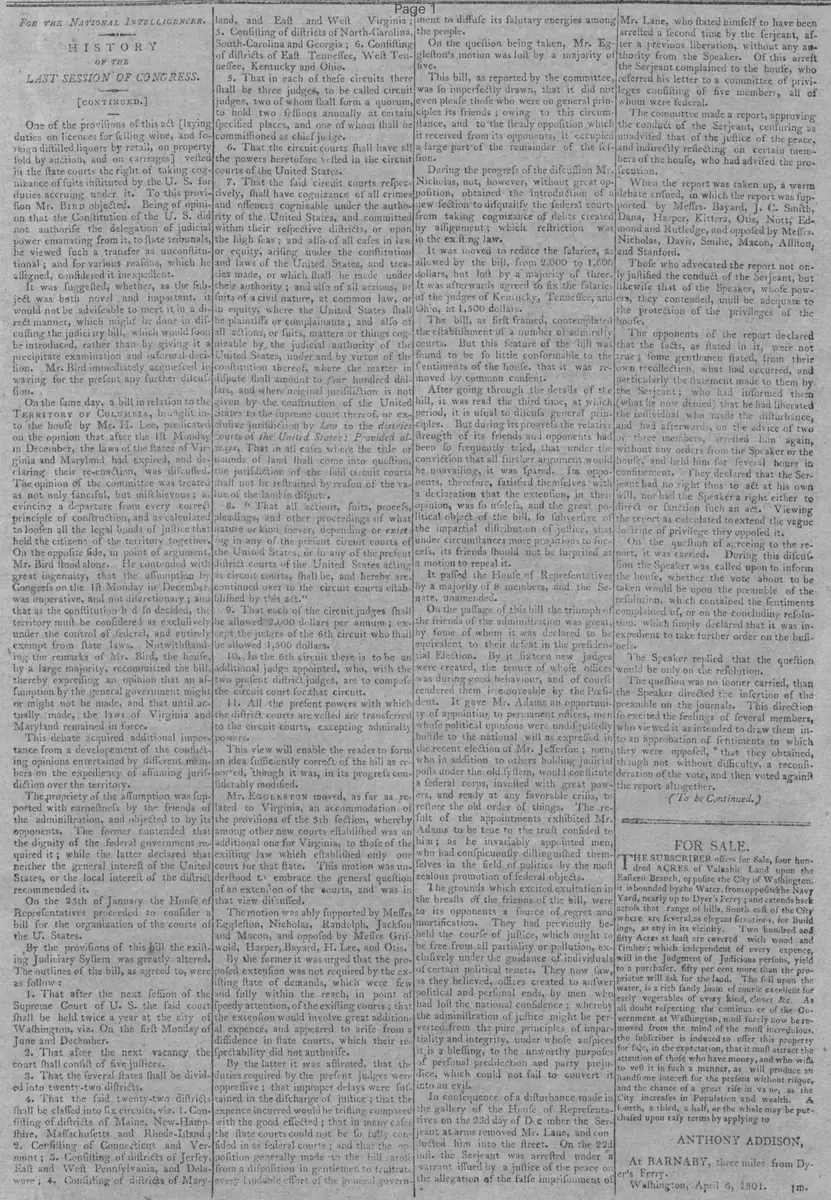
One of the provisions of this act [laying duties on licenses for selling wine, and foreign distilled liquors by retail, on property sold by auction, and on carriages] vested in the state courts the right of taking cognizance of suits instituted by the U. S. for duties accruing under it. To this provision Mr. Bird objected. Being of opinion that the Constitution of the U. S. did not authorize the delegation of judicial power emanating from it, to state tribunals. He viewed such a transfer as unconstitutional; and for various reasons, which he assigned, considered it inexpedient.
It was suggested, whether, as the subject was both novel and important, it would not be advisable to meet it in a direct manner, which might be done in discussing the judiciary bill, which would soon be introduced, rather than by giving it a precipitate examination and informal decision. Mr. Bird immediately acquiesced in waiving for the present any further discussion.
On the same day, a bill in relation to the Territory of Columbia, brought into the house by Mr. H. Lee, predicated on the opinion that after the 1st Monday in December, the laws of the states of Virginia and Maryland had expired, and declaring their re-enactment, was discussed. The opinion of the committee was treated as not only fanciful, but mischievous; as evincing a departure from every correct principle of construction, and as calculated to loosen all the legal bonds of justice that held the citizens of the territory together.
On the opposite side, in point of argument, Mr. Bird stood alone. He contended with great ingenuity, that the assumption by Congress on the 1st Monday in December, was imperative, and not discretionary; and that as the constitution had so decided, the territory must be considered as exclusively under the control of federal, and entirely exempt from state laws. Notwithstanding the remarks of Mr. Bird, the house, by a large majority, recommitted the bill, thereby expressing an opinion that an assumption by the general government might or might not be made, and that until actually made, the laws of Virginia and Maryland remained in force.
This debate acquired additional importance from a development of the conflicting opinions entertained by different members on the expediency of assuming jurisdiction over the territory.
The propriety of the assumption was supported with earnestness by the friends of the administration, and objected to by its opponents. The former contended that the dignity of the federal government required it; while the latter declared that neither the general interest of the United States, or the local interest of the district recommended it.
On the 25th of January the House of Representatives proceeded to consider a bill for the organization of the courts of the U. States.
By the provisions of this bill the existing Judiciary System was greatly altered. The outlines of the bill, as agreed to, were as follow:
1. That after the next session of the Supreme Court of U. S. the said court shall be held twice a year at the city of Washington, viz. On the first Monday of June and December.
2. That after the next vacancy the court shall consist of five justices.
3. That the several states shall be divided into twenty-two districts.
4. That the said twenty-two districts shall be classed into six circuits, viz. 1. Consisting of districts of Maine, New Hampshire, Massachusetts and Rhode-Island: 2. Consisting of Connecticut and Vermont; 3. Consisting of districts of Jersey, East and West Pennsylvania, and Delaware; 4. Consisting of districts of Maryland, and East and West Virginia;
5. Consisting of districts of North-Carolina, South-Carolina and Georgia; 6. Consisting of districts of East Tennessee, West Tennessee, Kentucky and Ohio.
5. That in each of these circuits there shall be three judges, to be called circuit judges, two of whom shall form a quorum, to hold two sessions annually at certain specified places, and one of whom shall be commissioned as chief judge.
6. That the circuit courts shall have all the powers heretofore vested in the circuit courts of the United States.
7. That the said circuit courts respectively, shall have cognizance of all crimes and offences cognizable under the authority of the United States, and committed within their respective districts, or upon the high seas: and also of all cases in law or equity, arising under the constitution and laws of the United States, and treaties made, or which shall be made under their authority; and also of all actions, or suits of a civil nature, at common law, or in equity, where the United States shall be plaintiffs or complainants; and also of all actions, or suits, matters or things cognizable by the judicial authority of the United States, under and by virtue of the constitution thereof, where the matter in dispute shall amount to four hundred dollars, and where original jurisdiction is not given by the constitution of the United States to the supreme court thereof, or exclusive jurisdiction by law to the district courts of the United States: Provided always, That in all cases where the title or bounds of land shall come into question, the jurisdiction of the said circuit courts shall not be restrained by reason of the value of the land in dispute.
8. " That all actions, suits, process, pleadings, and other proceedings of what nature or kind soever, depending or existing in any of the present circuit courts of the United States, or in any of the present district courts of the United States acting as circuit courts, shall be, and hereby are, continued over to the circuit courts established by this act."
9. That each of the circuit judges shall be allowed 2,000 dollars per annum; except the judges of the 6th circuit who shall be allowed 1,500 dollars.
10. In the 6th circuit there is to be an additional judge appointed, who, with the two present district judges, are to compose the circuit court for that circuit.
11. All the present powers with which the district courts are vested are transferred to the circuit courts, excepting admiralty powers.
This view will enable the reader to form an idea sufficiently correct of the bill as reported, though it was, in its progress considerably modified.
Mr. Eggleston moved, as far as related to Virginia, an accommodation of the provisions of the 5th section, whereby among other new courts established was an additional one for Virginia, to those of the existing law which established only one court for that state. This motion was understood to embrace the general question of an extension of the courts, and was in that view discussed.
The motion was ably supported by Messrs Eggleston, Nicholas, Randolph, Jackson and Macon, and opposed by Messrs. Griswold, Harper, Bayard, H. Lee, and Otis. By the former it was urged that the proposed extension was not required by the existing state of demands, which were few and fully within the reach, in point of speedy attention, of the existing courts; that the extension would involve great additional expense, and appeared to arise from a diffidence in state courts, which their respectability did not authorize.
By the latter it was affirmed, that the duties required by the present judges were oppressive; that improper delays were sustained in the discharge of justice; that the expense incurred would be trifling compared with the good effected; that in many cases the state courts could not be so fully confided in as federal courts; and that the opposition generally made to the bill arose from a disposition in gentlemen to frustrate every laudable effort of the general government to diffuse its salutary energies among the people
On the question being taken, Mr. Eggleston's motion was lost by a majority of five.
This bill, as reported by the committee, was so imperfectly drawn, that it did not even please those who were on general principles its friends; owing to this circumstance, and to the steady opposition which it received from its opponents, it occupied a large part of the remainder of the session.
During the progress of the discussion Mr. Nicholas, not, however, without great opposition, obtained the introduction of a new section to disqualify the federal courts from taking cognizance of debts created by assignment; which restriction was in the existing law.
It was moved to reduce the salaries, as allowed by the bill, from 2,000 to 1,600 dollars, but lost by a majority of three. It was afterwards agreed to fix the salaries of the judges of Kentucky, Tennessee, and Ohio, at 1,500 dollars.
The bill, as first framed, contemplated the establishment of a number of admiralty courts. But this feature of the bill was found to be so little conformable to the sentiments of the house, that it was removed by common consent.
After going through the details of the bill, it was read the third time, at which period, it is usual to discuss general principles. But during its progress the relative strength of its friends and opponents had been so frequently tried, that under the conviction that all further argument would be unavailing, it was passed. Its opponents, therefore, satisfied themselves with a declaration that the extension, in their opinion, was so useless, and the great political object of the bill, so subversive of the impartial distribution of justice, that under circumstances more propitious to success, its friends should not be surprised at a motion to repeal it.
It passed the House of Representatives by a majority of 8 members, and the Senate, unamended.
On the passage of this bill the triumph of the friends of the administration was great, by some of whom it was declared to be equivalent to their defeat in the presidential Election. By it sixteen new judges were created, the tenure of whose offices was during good behaviour, and of course rendered them irremovable by the President. It gave Mr. Adams an opportunity of appointing to permanent offices, men whose political opinions were undisguisedly hostile to the national will as expressed in the recent election of Mr. Jefferson; men, who in addition to others holding judicial posts under the old system, would constitute a federal corps, invested with great powers, and ready at any favorable crisis, to restore the old order of things. The result of the appointments exhibited Mr. Adams to be true to the trust confided to him; as he invariably appointed men, who had conspicuously distinguished themselves in the field of politics by the most zealous promotion of federal objects.
The grounds which excited exultation in the breasts of the friends of the bill, were to its opponents a source of regret and mortification. They had previously beheld the course of justice, which ought to be free from all partiality or pollution, exclusively under the guidance of individuals of certain political tenets. They now saw, as they believed, offices created to answer political and personal ends, by men who had lost the national confidence; whereby the administration of justice might be perverted from the pure principles of impartiality and integrity, under whose auspices it is a blessing, to the unworthy purposes of personal predilection and party prejudice, which could not fail to convert it into an evil.
In consequence of a disturbance made in the gallery of the House of Representatives on the 23d day of December the Sergeant at arms removed Mr. Lane, and conducted him into the street. On the 22d inst. the Sergeant was arrested under a warrant issued by a justice of the peace on the allegation of the false imprisonment of Mr. Lane, who stated himself to have been arrested a second time by the sergeant, after a previous liberation, without any authority from the Speaker. Of this arrest the Sergeant complained to the house, who referred his letter to a committee of privileges consisting of five members, all of whom were federal.
The committee made a report, approving the conduct of the Sergeant, censuring as unadvised that of the justice of the peace, and indirectly reflecting on certain members of the house, who had advised the prosecution.
When the report was taken up, a warm debate ensued, in which the report was supported by Messrs. Bayard, J. C. Smith, Dana, Harper, Kittera, Otis, Nott, Edmond and Rutledge, and opposed by Messrs. Nicholas, Davis, Smilie, Macon, Allston, and Stanford.
Those who advocated the report not only justified the conduct of the Sergeant, but likewise that of the Speaker, whose powers, they contended, must be adequate to the protection of the privileges of the house.
The opponents of the report declared that the facts, as stated in it, were not true; some gentlemen stated, from their own recollection, what had occurred, and particularly the statement made to them by the Sergeant; who had informed them (what he now denied) that he had liberated the individual who made the disturbance, and had afterwards, on the advice of two or three members, arrested him again, without any orders from the Speaker or the house, and held him for several hours in confinement. They declared that the Sergeant had no right thus to act at his own will, nor had the Speaker a right either to direct or sanction such an act. Viewing the report as calculated to extend the vague doctrine of privilege they opposed it.
On the question of agreeing to the report, it was carried. During this discussion the Speaker was called upon to inform the house, whether the vote about to be taken would be upon the preamble of the resolution, which contained the sentiments complained of, or on the concluding resolution, which simply declared that it was inexpedient to take further order on the business.
The Speaker replied that the question would be only on the resolution.
The question was no sooner carried, than the Speaker directed the insertion of the preamble on the journals. This direction so excited the feelings of several members, who viewed it as intended to draw them into an approbation of sentiments to which they were opposed, that they obtained, though not without difficulty, a reconsideration of the vote, and then voted against the report altogether.
(To be Continued.)
What sub-type of article is it?
What themes does it cover?
What keywords are associated?
What entities or persons were involved?
Where did it happen?
Story Details
Key Persons
Location
House Of Representatives, Washington
Event Date
25th Of January; 23d Day Of December
Story Details
Account of congressional debates on delegating judicial powers to state courts, jurisdiction over Territory of Columbia, reorganization of federal judiciary creating new circuits and judges amid political controversy, and a dispute over the Sergeant's arrest of Mr. Lane leading to privilege committee report.