Thank you for visiting SNEWPapers!
Sign up free
The Enquirer
Richmond, Henrico County, Virginia
What is this article about?
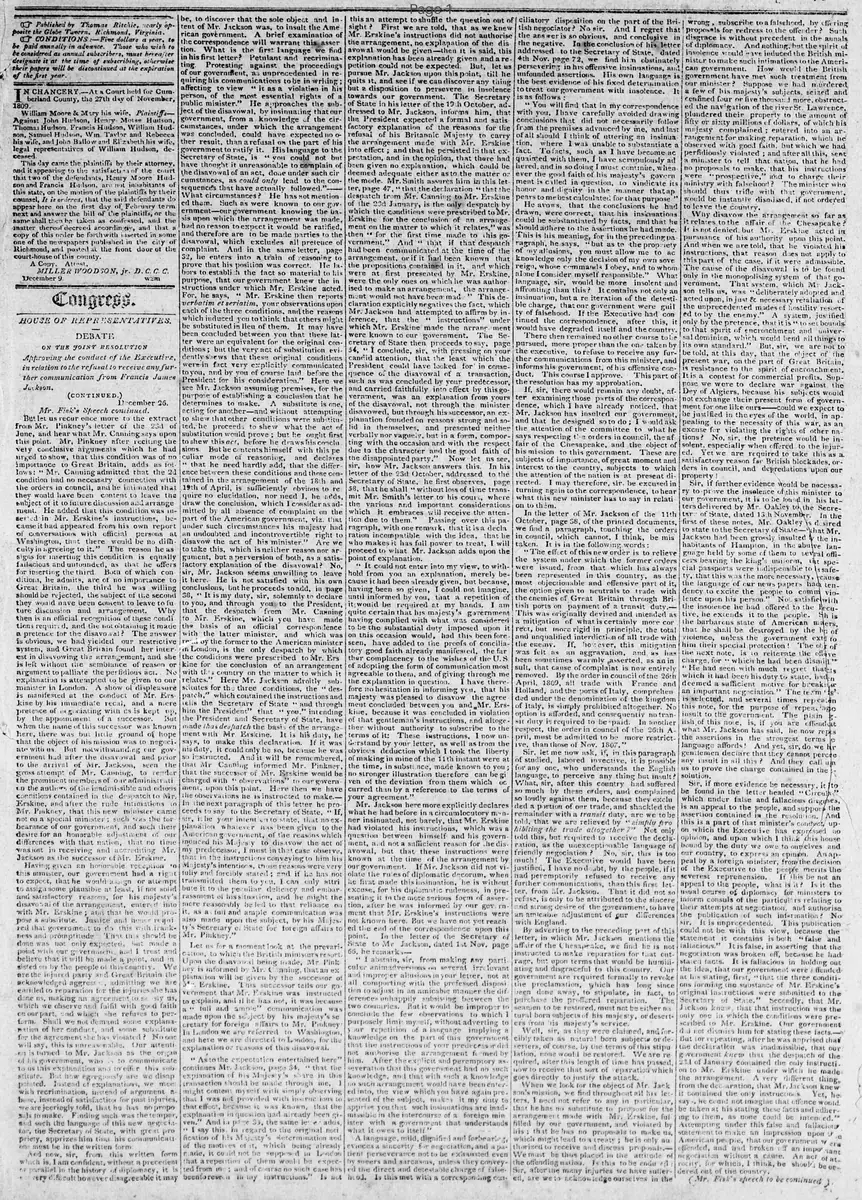
Continuation of Mr. Fisk's speech in the House of Representatives on December 26, debating a joint resolution approving the Executive's refusal to receive further communications from British Minister Francis James Jackson, whom Fisk accuses of insulting the U.S. government through insolent correspondence regarding the disavowal of the Erskine arrangement, orders in council, and the Chesapeake affair.
Clipping
OCR Quality
Full Text
HOUSE OF REPRESENTATIVES.
DEBATE
ON THE JOINT RESOLUTION
Approving the conduct of the Executive,
in relation to the refusal to receive any further communication from Francis James Jackson.
(CONTINUED.)
December 26.
Mr. Fisk's Speech continued.
But let us recur once more to the extract from Mr. Pinkney's letter of the 23d of June, and hear what Mr. Canning says upon this point. Mr. Pinkney after reciting the very conclusive arguments which he had urged to show, that this condition was of no importance to Great Britain, adds as follows: "Mr. Canning admitted that the 2d condition had no necessary connection with the orders in council, and he intimated that they would have been content to leave the subject of it to future discussion and arrangement. He added that this condition was inserted in Mr. Erskine's instructions, because it had appeared from his own report of conversations with official persons at Washington, that there would be no difficulty in agreeing to it." The reason he assigns for inserting this condition is equally fallacious and unfounded, as that he offers for inserting the third. Both of which conditions, he admits, are of no importance to Great Britain. The third he was willing should be rejected, the subject of the second they would have been content to leave to future discussion and arrangement. Why then is an official recognition of these conditions required, and the not obtaining it made a pretence for the disavowal? The answer is obvious, we had yielded our restrictive system, and Great Britain found her interest in disavowing the arrangement, and she is left without the semblance of reason or argument to palliate the perfidious act. No explanation is attempted to be given to our minister in London. A show of displeasure is manifested at the conduct of Mr. Erskine by his immediate recall, and a mere pretence of negotiating with us is kept up, by the appointment of a successor.
But when the name of this successor was known here, there was but little ground of hope that the object of his mission was to negotiate with us. But notwithstanding our government had after the disavowal and prior to the arrival of Mr. Jackson, seen the gross attempt of Mr. Canning, to render the prominent members of our administration the authors of the inadmissible and odious conditions contained in the despatch to Mr. Erskine, and after the rude intimations to Mr. Pinkney, that this new minister came not as a special minister: such was the forbearance of our government, and such their desire for an honorable adjustment of our differences with that nation, that no time was lost in receiving and accrediting Mr. Jackson as the successor of Mr. Erskine.
Having given an honorable reception to this minister, our government had a right to expect, that he would assign or attempt to assign some plausible at least, if not solid and satisfactory reasons, for his majesty's disavowal of the arrangement, entered into with Mr. Erskine: and that he would propose a substitute. Justice and honor required that government to do this with frankness and promptitude. That this should be done was not only expected, but made a point with our government, and I trust and believe that it will be made a point, and insisted on by the people of this country. We are the injured party and Great Britain the acknowledged aggressor, admitting we are entitled to reparation for the injuries she has done us, making an agreement to satisfy us, which we observe and fulfill with good faith on our part, and which she refuses to perform. "Shall we not demand some explanation of her conduct, and some substitute for the agreement she has violated? No one will say, this is unreasonable. Our attention is turned to Mr. Jackson as the organ of his government, who is to communicate to us this explanation and to offer this substitute. But how egregiously are we disappointed. Instead of explanations, we meet with recrimination, instead of argument abuse, instead of satisfaction for past injuries, we are jeeringly told, that he has no proposals to make."
Finding such was the temper, and such the language of this new negotiator, the Secretary of State, with great propriety, apprizes him that his communications must be in the written form.
And now, sir, from this written form which is, I am confident, without a precedent or parallel in the history of diplomacy, it is very difficult however disagreeable it may be, to discover that the sole object and intent of Mr. Jackson was, to insult the American government. A brief examination of the correspondence will warrant this assertion. What is the first language we find in his first letter? Petulant and recriminating. Protesting against the proceedings of our government, as unprecedented in requiring his communications to be in writing; affecting to view it as a violation in his person, of the most essential rights of a public minister. He approaches the subject of the disavowal, by insinuating that our government, from a knowledge of the circumstances, under which the arrangement was concluded, could have expected no other result, than a refusal on the part of his government to ratify it. His language to the Secretary of State, is "you could not but have thought it unreasonable to complain of the disavowal of an act, done under such circumstances, as could only lead to the consequences that have actually followed."
What circumstances? He has not mentioned them. Such as were known to our government--our government knowing the basis upon which the arrangement was made, had no reason to expect it would be ratified, and therefore are to be made parties to the disavowal, which excludes all pretence of complaint. And in the same letter, page 32, he enters into a train of reasoning to prove that his position was correct. He labors to establish the fact so material to his purpose, that our government knew the instructions under which Mr. Erskine acted.
For, he says, "Mr. Erskine then reports verbatim et seriatim, your observations upon each of the three conditions, and the reasons which induced you to think that others might be substituted in lieu of them. It may have been concluded between you that these latter were an equivalent for the original conditions; but the very act of substitution evidently shews that these original conditions were in fact very explicitly communicated to you, and by you of course laid before the President for his consideration." Here we see Mr. Jackson assuming premises, for the purpose of establishing a conclusion that he determines to make. A substitute is one, acting for another--and without attempting to shew that other conditions were substituted, he proceeds to shew what the act of substitution would prove; but he ought first to shew this act, before he draws his conclusions. But he contents himself with this peculiar mode of reasoning, and declares "that he need hardly add, that the difference between these conditions and those contained in the arrangement of the 18th and 19th of April, is sufficiently obvious to require no elucidation, nor need I, he adds, draw the conclusion, which I consider as admitted by all absence of complaint on the part of the American government, viz. that under such circumstances his majesty had an undoubted and incontrovertible right to disavow the act of his minister." Are we to take this, which is neither reason nor argument, but a perversion of both, as a satisfactory explanation of the disavowal? No, sir, Mr. Jackson seems unwilling to leave it here. He is not satisfied with his own conclusions, but he proceeds to add, in page 38, "It is my duty, sir, solemnly to declare to you, and through you to the President, that the despatch from Mr. Canning to Mr. Erskine, which you have made the basis of an official correspondence with the latter minister, and which was received by the former to the American minister in London, is the only despatch by which the conditions were prescribed to Mr. Erskine for the conclusion of an arrangement with this country on the matter to which it relates." Here Mr. Jackson adroitly substitutes for the three conditions, the "despatch," which contained the instructions and tells the Secretary of State "and through him the President" that "you," intending the President and Secretary of State, have made this despatch the basis of the arrangement with Mr. Erskine. It is his duty, he says, to make this declaration. If it was his duty, it could only be so, because he was so instructed. And it will be remembered, that Mr. Canning informed Mr. Pinkney, that the successor of Mr. Erskine would be charged with "observations" to our government, upon this point. Here then we have the observations he is instructed to make.
In the next paragraph of this letter he proceeds to say to the Secretary of State, "If, sir, it be your intent to state, that no explanation whatever has been given to the American government, of the reasons which induced his Majesty to disavow the act of my predecessor, I must in that case observe, that in the instructions conveying to him his Majesty's intentions, those reasons were very fully and forcibly stated; and if he has not transmitted them to you, I can only attribute it to the peculiar delicacy and embarrassment of his situation, and he might the more reasonably be led to that reliance on it, as a full and ample communication was also made upon the subject, by his Majesty's Secretary of State for foreign affairs to Mr. Pinkney.
Let us for a moment look at the prevarication, to which the British ministers resort. Upon the disavowal being made, Mr. Pinkney is informed by Mr. Canning, that an explanation will be given by the successor of Mr. Erskine. This successor tells our government that Mr. Erskine was instructed to explain, and if he has not, it was because a "full and ample" communication was made upon the subject by his majesty's secretary for foreign affairs to Mr. Pinkney. In London we are referred to Washington, and here we are directed to London, for the explanation or reasons of this disavowal.
"As to the expectation entertained here" continues Mr. Jackson, page 34. "that the explanation of his Majesty's share in this transaction should be made through me, I might content myself with simply observing that I was not provided with instructions to that effect, because it was known, that the explanation in question had already been given." And it page 35, the same letter adds, "I say this, in regard to the original notification of his Majesty's determination and of the motives of it, which being already made, it could not be supposed in London that a repetition of them would be expected from me; and of course no such case has been foreseen in my instructions." Is not this an attempt to shuffle the question out of sight? First we are told, that as we knew Mr. Erskine's instructions did not authorise the arrangement, no explanation of the disavowal would be given--then it is said, this explanation has been already given and a repetition could not be expected. But, let us pursue Mr. Jackson upon this point, till he quits it, and see if we can discover any thing but a disposition to persevere in insolence towards our government. The Secretary of State in his letter of the 19th October, addressed to Mr. Jackson, informs him, that the President expected a formal and satisfactory explanation of the reasons for the refusal of his Britannic Majesty to carry the arrangement made with Mr. Erskine into effect; and that he persisted in that expectation, and in the opinion, that there had been given no explanation, which could be deemed adequate either as to the matter or the mode. Mr. Smith assures him in this letter, page 47, "that the declaration " that the despatch from Mr. Canning to Mr. Erskine of the 23d January, is the only despatch by which the conditions were prescribed to Mr. Erskine for the conclusion of an arrangement on the matter to which it relates." was then for the first time made to this government." And "that if that despatch had been communicated at the time of the arrangement, or if it had been known that the propositions contained in it, and which were at first presented by Mr. Erskine, were the only ones on which he was authorised to make an arrangement, the arrangement would not have been made." This declaration explicitly negatives the fact, which Mr. Jackson had attempted to affirm by inference, that the "instructions" under which Mr. Erskine made the arrangement were known to our government. The Secretary of State then proceeds to say, page 54. "I conclude, sir, with pressing on your candid attention, that the least which the President could have looked for' in consequence of the disavowal of a transaction, such as was concluded by your predecessor, and carried faithfully into effect by this government, was an explanation from yours of the disavowal, not through the minister disavowed, but through his successor, an explanation founded on reasons strong and solid in themselves, and presented neither verbally nor vaguely, but in a form, comporting with the occasion and with the respect due to the character and the good faith of the disappointed party." Now let us see, sir, how Mr. Jackson answers this. In his letter of the 23d October, addressed to the Secretary of State, he first observes, page 58, that he shall "without loss of time transmit Mr. Smith's letter to his court, where the various and important considerations which it embraces will receive the attention due to them." Passing over this paragraph, with one remark, that it is a declaration incompatible with the idea, that he who makes it has full power to treat, I will proceed to what Mr. Jackson adds upon the point of explanation.
"It could not enter into my view, to withhold from you an explanation, merely because it had been already given, but because, having been so given, I could not imagine, until informed by you, that a repetition of it would be required at my hands. I am quite certain that his majesty's government having complied with what was considered to be the substantial duty imposed upon it on this occasion would, had this been foreseen, have added to the proofs of conciliatory good faith already manifested, the farther complacency to the wishes of the U. S. of adopting the form of communication most agreeable to them, and of giving through me the explanation in question. I have therefore no hesitation in informing you, that his majesty was pleased to disavow the agreement concluded between you and Mr. Erskine, because it was concluded in violation of that gentleman's instructions, and altogether without authority to subscribe to the terms of it: These instructions, I now understand by your letter, as well as from the obvious deduction which I took the liberty of making in mine of the 11th instant were at the time, in substance, made known to you; no stronger illustration therefore can be given of the deviation from them which occurred than by a reference to the terms of your agreement."
Mr. Jackson here more explicitly declares what he had before in a circumlocutory manner insinuated, not barely, that Mr. Erskine had violated his instructions, which was a question between himself and his government, and not a sufficient reason for the disavowal, but that these instructions were known at the time of the arrangement by our government. If Mr. Jackson did not violate the rules of diplomatic decorum, when he first made this insinuation, he is without excuse, for his diplomatic rudeness, in presenting it in the more serious form of assertion, after he was informed by our government that Mr. Erskine's instructions were not known here. But we have not yet reached the end of the correspondence upon this point. In the letter of the Secretary of State to Mr. Jackson, dated 1st Nov. page 66, he remarks,--
"I abstain, sir, from making any particular animadversions on several irrelevant and improper allusions in your letter, not at all comporting with the professed disposition to adjust in an amicable manner the differences unhappily subsisting between the two countries." But it would be improper to conclude the few observations to which I purposely limit myself, without adverting to your repetition of a language implying a knowledge on the part of this government that the instructions of your predecessor did not authorise the arrangement formed by him. After the explicit and peremptory asseveration that this government had no such knowledge, and that with such a knowledge no such arrangement would have been entered into, the view which you have again presented of the subject, makes it my duty to apprise you that such insinuations are inadmissible in the intercourse of a foreign minister with a government that understands what it owes to itself."
A language, mild, dignified and forbearing, evincing a sincerity for negociation, and a patient perseverance not to be exhausted even by sneers and sarcasms, unless they conveyed the direct and detestable charge of falsehood. Is this met with a corresponding conciliatory disposition on the part of the British negociator? No sir. And I regret that the answer is so obvious, and conclusive in the negative. In the conclusion of his letter addressed to the Secretary of State, dated 4th Nov. page 72, we find him obstinately persevering in his offensive insinuations, and unfounded assertions. His own language is the best evidence of his fixed determination to treat our government with insolence. It is as follows:
"You will find that in my correspondence with you, I have carefully avoided drawing conclusions that did not necessarily follow from the premises advanced by me, and last of all should I think of uttering an insinuation, where I was unable to substantiate a fact. To facts, such as I have become acquainted with them, I have scrupulously adhered, and in so doing I must continue, whenever the good faith of his majesty's government is called in question, to vindicate its honor and dignity in the manner that appears to me best calculated for that purpose."
He avows, that the conclusions he had drawn, were correct, that his insinuations could be substantiated by facts, and that he should adhere to the assertions he had made. This is his meaning, for in the preceding paragraph, he says, "but as to the propriety of my allusions, you must allow me to acknowledge only the decision of my own sovereign, whose commands I obey, and to whom alone I consider myself responsible." What language, sir, would be more insolent and affronting than this? It contains not only an insinuation, but a reiteration of the detestable charge, that our government were guilty of falsehood. If the Executive had continued the correspondence, after this, it would have degraded itself and the country.
There then remained no other course to be pursued, more proper than the one taken by the executive, to refuse to receive any further communications from this minister, and informs his government, of his offensive Conduct. This course I approve. This part of the resolution has my approbation.
If, sir, there would remain any doubt, after examining those parts of the correspondence, which I have already noticed, that Mr. Jackson has insulted our government, and that he designed so to do; I would ask the attention of the committee to what he says respecting the orders in council, the affair of the Chesapeake, and the object of his mission to this government. These are subjects of importance, of great moment and interest to the country, subjects to which the attention of the nation is at present directed. I may therefore, sir, be excused in turning again to the correspondence, to hear what this new minister has to say in relation to them.
In the letter of Mr. Jackson of the 11th October, page 38, of the printed documents, we find a paragraph, touching the orders in council, which cannot, I think, be mistaken. It is in the following words:
"The effect of this new order is to relieve the system under which the former orders were issued, from that which has always been represented in this country, as the most objectionable and offensive part of it, the option given to neutrals to trade with the enemies of Great Britain through British ports on payment of a transit duty. This was originally devised and intended as a mitigation of what is certainly more correct, but more rigid in principle, the total and unqualified interdiction of all trade with the enemy. If, however, this mitigation was felt as an aggravation, and as has been sometimes warmly asserted, as an insult, that cause of complaint is now entirely removed. By the order in council of the 26th April, 1809, all trade with France and Holland, and the ports of Italy, comprehended under the denomination of the kingdom of Italy, is simply prohibited altogether. No option is afforded, and consequently no transit duty is required to be paid. In another respect, the order in council of the 26th April, must be admitted to be more restrictive, than those of Nov. 1807."
Sir, let me now ask, if, in this paragraph of studied, labored invective, it is possible for any one, who understands the English language, to perceive any thing but insult? What, sir, after this country had suffered so much by these orders, and complained so loudly against them, because they excluded a portion of our trade, and shackled the remainder with a transit duty, are we to be told, that we are relieved by "simply prohibiting the trade altogether?" Not only told this, but required to receive the declaration, as the unexceptionable language of friendly negociation? No, sir, this is too much! The Executive would have been justified, I have no doubt, by the people, if it had peremptorily refused to receive any further communications, than this first letter, from Mr. Jackson. That it did not so refuse, is only to be attributed to the sincere and strong desire of the government, to have an amicable adjustment of our differences with England.
By adverting to the preceding part of this letter, in which Mr. Jackson mentions the affair of the Chesapeake, we find he is not instructed to make reparation for that outrage, but upon terms that would be humiliating and disgraceful to this Country. Our government are required formally to revoke the proclamation, which has long since been done away, to stipulate, in fact, to purchase the proffered reparation. The seamen to be restored, must not be either natural born subjects of his majesty, or deserters from his majesty's service.
Well, sir, as they were claimed, and forcibly taken as natural born subjects or deserters, of course, by the terms of this stipulation, none would be restored. We are required, after this length of time has passed, now to receive that sort of reparation which goes directly to justify the attack.
When we look for the object of Mr. Jackson's mission, we find throughout all his letters, I need not refer to any in particular, that he has no substitute to propose for the arrangement made with Mr. Erskine, fulfilled by our government, and violated by his; that he has no proposals to make us, which might lead to a treaty; he is only authorized to receive and discuss proposals.
We must be thus placed in the attitude of the offending nation. Is this to be endured? Sir, after the many injuries we have suffered, are we to acknowledge ourselves in the wrong, subscribe to a falsehood, by offering proposals for redress to the offender? Such disgrace is without precedent in the annals of diplomacy. And nothing, but the spirit of insolence would have induced the British minister to make such intimations to the American government.
How would the British government have met such treatment from our minister? Suppose we had murdered a few of his majesty's subjects, seized and confined four or five thousand more, obstructed the navigation of the river St. Lawrence, plundered their property to the amount of fifty or sixty millions of dollars, of which his majesty complained; entered into an arrangement for making reparation, which he observed with good faith, but which we had perfidiously violated; and after all this, sent a minister to tell that nation, that he had no proposals to make, that his instructions were "prospective," and to charge their ministry with falsehood? The minister who should thus trifle with that government, would be instantly dismissed, if not ordered to leave the country.
Why disavow the arrangement so far as it relates to the affair of the Chesapeake? It is not denied, but Mr. Erskine acted in pursuance of his authority upon this point. And when we are told, that he violated his instructions, that reason does not apply to this part of the case, if it were admissible. The cause of the disavowal is to be found only in the monopolising system of that government. That system, which Mr. Jackson tells us, was "deliberately adopted and acted upon, in just & necessary retaliation of the unprecedented modes of hostility resorted to by the enemy." A system, justified only by the pretence, that it is "to set bounds to that spirit of encroachment and universal dominion, which would bend all things to its own standard." But, sir, we are not to be told, at this day, that the object of the present war, on the part of Great Britain, is resistance to the spirit of encroachment. It is a contest for commercial profits. Suppose we were to declare war against the Dey of Algiers, because his subjects would not exchange their present form of government for one like ours--could we expect to be justified in the eyes of the world, in appealing to the necessity of this war, as an excuse for violating the rights of other nations? No, sir, the pretence would be insolent, especially when offered to the injured. Yet we are required to take this as a satisfactory reason for British blockades, orders in council, and depredations upon our property!
Sir, if further evidence would be necessary to prove the insolence of this minister to our government, it is to be found in his letters delivered by Mr. Oakley to the Secretary of State, dated 13th November. In the first of these notes, Mr. Oakley is desired to state to the Secretary of State-- "that Mr. Jackson had been grossly insulted by the inhabitants of Hampton, in the above language held by some of them to several officers bearing the king's uniform, that special passports were indispensable to safety, that this was the more necessary, because the language of our news papers had a tendency to excite the people to commit violence upon his person." Not satisfied with the insolence he had offered to the executive, he extends it to the people. Such is the barbarous state of American manners, that he shall be destroyed by the hand of violence, unless the government extend to him their special protection! The object of the next note, is to reiterate the offensive charge, for "which he had been dismissed."
"He had seen with much regret that that which it had been his duty to state, had been deemed a sufficient motive for breaking an important negociation." The term "insult" is selected, and several times repeated in this note, for the purpose of repeating the insult to the government. The plain English of this note, is, if you are offended at what Mr. Jackson has said, he now repeats the assertions in the strongest terms the language affords! And yet, sir, do we hear gentlemen declare that they cannot perceive any insult in all this? And they call upon us to prove the charge contained in the resolution.
Sir, if more evidence be necessary, it is to be found in the letter headed "Circular," which under false and fallacious disguises, is an appeal to the people, and supports the assertion contained in the resolution. [And this is a part of that minister's conduct, upon which the Executive has expressed no opinion, and upon which I think this house is bound by the duty we owe to ourselves and our country, to express an opinion. An appeal by a foreign minister, from the decision of the Executive to the people merits the severest reprehension. If this be not an appeal to the people, what is it? Is it the usual course of diplomacy for ministers to inform consuls of the particulars relating to their attempts at negociation, and authorise the publication of such information? No sir. It is unprecedented. This publication could not be with this view, because the statement it contains is both "false and fallacious." It is false, in asserting that the negociation was broken off, because he had stated facts. It is fallacious in holding out the idea, that our government were offended at his stating, first, "that the three conditions forming the substance of Mr. Erskine's original instructions were submitted to the Secretary of State." Secondly, that Mr. Jackson knew, that that instruction was the only one in which the conditions were prescribed to Mr. Erskine. Our government did not dismiss him for stating these facts. But for repeating, after he was apprised that the declaration was inadmissible, that our government knew that the despatch of the 23d of January contained the only instruction to Mr. Erskine under which he made the arrangement. A very different thing, from the declaration, that Mr. Jackson knew it contained the only instructions. Yet, he says--he could not imagine that offence would be taken at his stating these facts and adhering to them, as none could be intended."
Attempting under this false and fallacious statement to make an impression upon the American people, that our government were offended, and had broken off an important negociation without a cause. An act of atrociousness, for which, I think, he should be ordered out of the country.
(Mr. Fisk's speech to be continued.)
What sub-type of article is it?
What keywords are associated?
What entities or persons were involved?
Where did it happen?
Domestic News Details
Primary Location
Washington
Event Date
December 26
Key Persons
Outcome
approval of the executive's conduct in refusing further communications from jackson due to his insulting behavior and lack of satisfactory explanations for the disavowal of the erskine arrangement.
Event Details
Mr. Fisk continues his speech defending the resolution approving the Executive's refusal to engage further with British Minister Jackson, analyzing the diplomatic correspondence to argue that Jackson's letters contained insults, unfounded accusations of U.S. knowledge of unauthorized conditions, and no genuine proposals for resolution, justifying the U.S. response.