Thank you for visiting SNEWPapers!
Sign up free
Virginia Argus
Richmond, Virginia
What is this article about?
In the U.S. House of Representatives on March 21, Mr. Rowan introduced a resolution to investigate Kentucky District Judge Harry Innes for possible involvement in Spanish or French plots to dismember the Union or provoke war with Spain. Supported by Kentucky's legislature, the measure sparked debate on its scope and was ultimately tabled without division.
Clipping
OCR Quality
Full Text
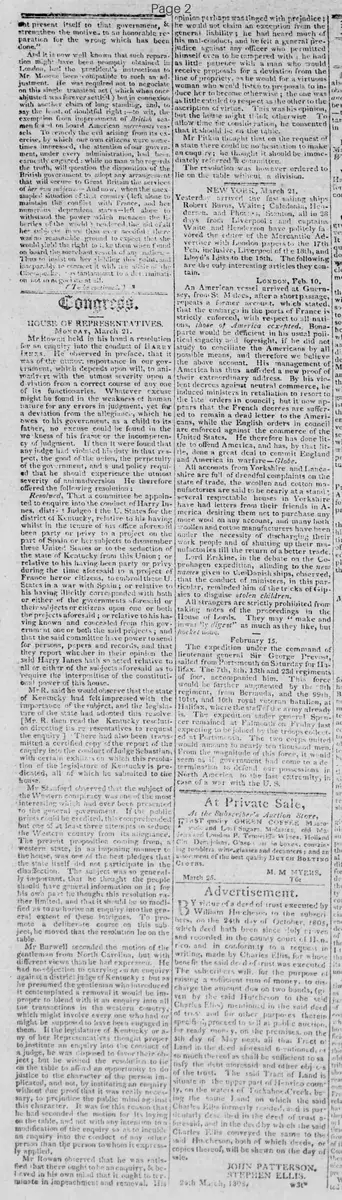
HOUSE OF REPRESENTATIVES.
Monday, March 21.
Mr. Rowan held in his hand a resolution for an enquiry into the conduct of Harry Innes. He observed in preface, that it was of the utmost importance in our government, which depends upon will, to animadvert with the utmost severity upon a deviation from a correct course of any one of its functionaries. Whatever excuse might be found in the weakness of human nature for any errors in judgment, yet for a deviation from the allegiance, which he owes to his government, as a child to its father, no excuse could be found in the weakness of his frame or the incompetency of judgment. If then it were found that any judge had violated his duty in that respect, the good of the union, the perpetuity of the government, and sound policy required that he should experience the utmost severity of animadversion. He therefore offered the following resolution:
Resolved, That a committee be appointed to enquire into the conduct of Harry Innes, district Judge of the U. States for the district of Kentucky, relative to his having whilst in the tenure of his office aforesaid been party or privy to a project on the part of Spain or her subjects to dismember these United States or to the seduction of the state of Kentucky from this Union; or relative to his having been party or privy during the time aforesaid to a project of France her or citizens, to embroil these U. States in a war with Spain; or relative to his having illicitly corresponded with both or either of the governments aforesaid or their subjects or citizens upon one or both the projects aforesaid: or relative to his having known and concealed from this government one or both the said projects; and that the said committee have power to send for persons, papers and records, and that they report whether in their opinion the said Harry Innes hath so acted relative to all or either of the subjects aforesaid as to require the interposition of the constitutional power of this house.
Mr. R. said he would observe that the state of Kentucky had felt impressed with the importance of the subject, and the legislature of the state had adopted this resolve. Mr. R. then read the Kentucky resolution directing its representatives to request the enquiry. There had also been transmitted a certified copy of the report of the enquiry into the conduct of Judge Sebastian, with certain exhibits on which this resolution of the legislature of Kentucky is predicated, all of which he submitted to the house.
Mr. Stanford observed that the subject of the Western conspiracy was one of the most interesting which had ever been presented to the general government. If the public prints could be credited, this comprehended but one of at least three attempts to seduce the Western country from its allegiance. The present proposition coming from a western state, in an imposing manner to the house, was one of the best pledges that the state itself did not participate in the disaffection. The subject was so generally important, that he thought the people should have general information on it; for his own part he thought this resolution rather limited, and that it should be so modified as to authorise an enquiry into the general extent of these intrigues. To promote a deliberate course on this subject, he moved that the resolution lie on the table.
Mr. Burwell seconded the motion of the gentleman from North Carolina, but with different views than he had expressed. He had no objection to carrying on an enquiry against a district judge of Kentucky: but as he presumed the gentleman who introduced it contemplated a removal it would be improper to blend with it an enquiry into all the transactions in the western Country, which might involve every one who had or might be supposed to have been engaged in them. If the legislature of Kentucky or any of her Representatives thought proper to institute an enquiry into the conduct of a judge, he was disposed to favor their object; but he wished the resolution to lie on the table to afford an opportunity to do justice to the character of the person implicated, and not, by instituting an enquiry without due proof that it was verily necessary, to prejudice the public mind against this character. It was for this reason that he had seconded the motion for its laying on the table, and not with any intention to modification of the enquiry so as to include an enquiry into the conduct of any other person than the person to whom it expressly applied.
Mr. Rowan observed that he was persuaded that there ought to be an enquiry, & believed in his own mind that it ought to terminate in impeachment and removal. His opinion perhaps was tinged with prejudice; he would not claim an exception from the general liability: he had heard much of his mal-conduct, and he felt a general prejudice against any officer who permitted himself even to be tampered with; he had as little patience with a man who would receive proposals for a deviation from the line of propriety, as he would for a virtuous woman who would listen to proposals to induce her to become otherwise: the one was as little entitled to respect as the other to the ascription of virtue. This was his opinion, but the house might think otherwise. To allow time for consideration, he consented that it should lie on the table.
Mr. Pitkin thought that on the request of a state there could be no hesitation to make an enquiry; he thought it should be immediately referred a committee.
The resolution was however ordered to lie on the table without a division.
What sub-type of article is it?
What keywords are associated?
What entities or persons were involved?
Where did it happen?
Domestic News Details
Primary Location
House Of Representatives
Event Date
Monday, March 21.
Key Persons
Outcome
the resolution was ordered to lie on the table without a division.
Event Details
Mr. Rowan proposed a resolution for a committee to inquire into the conduct of Harry Innes, district judge of Kentucky, regarding alleged involvement in Spanish or French plots to dismember the United States or embroil it in war with Spain, including possible illicit correspondence or concealment of such projects. The proposal was supported by a Kentucky legislative resolution and related documents on Judge Sebastian. Debate included calls to broaden the inquiry into Western conspiracies, concerns about prejudicing Innes' character, and support for immediate action, but it was ultimately tabled.