Thank you for visiting SNEWPapers!
Sign up free
Rhode Island American, Statesman And Providence Gazette
Providence, Providence County, Rhode Island
What is this article about?
Historical account of the potato's origins in North America and introduction to Ireland by Sir Walter Raleigh around 1610, its accidental discovery as edible, spread to England in 1650 via shipwreck, promotion by Royal Society in 1662, and later to Sweden in 1764.
Clipping
OCR Quality
Full Text
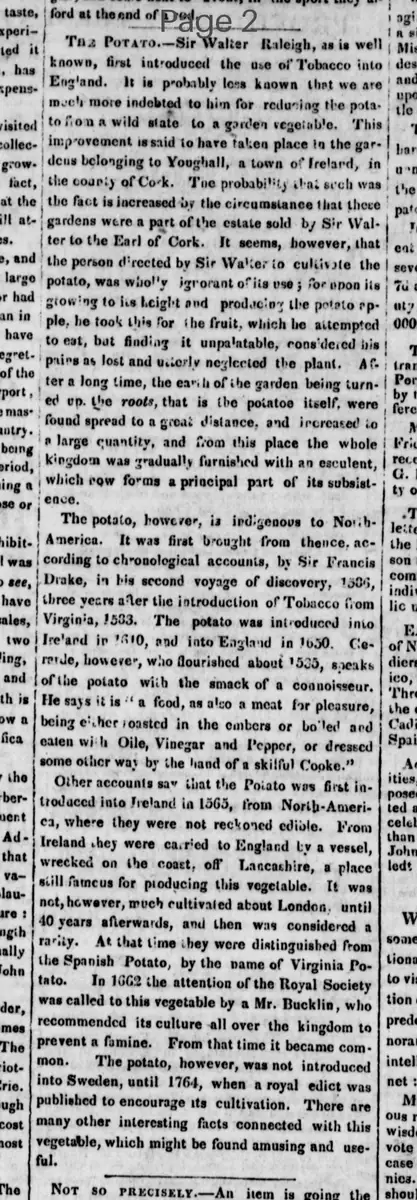
The potato, however, is indigenous to North America. It was first brought from thence, according to chronological accounts, by Sir Francis Drake, in his second voyage of discovery, 1585 three years after the introduction of Tobacco from Virginia, 1583. The potato was introduced into Ireland in 1610, and into England in 1650. Gerard, however, who flourished about 1595, speaks of the potato with the smack of a connoisseur. He says it is "a food, as also a meat for pleasure, being either roasted in the embers or boiled and eaten with oil, vinegar and pepper, or dressed some other way by the hand of a skilful Cooke."
Other accounts say that the Potato was first introduced into Ireland in 1565, from North-America, where they were not reckoned edible. From Ireland they were carried to England by a vessel, wrecked on the coast, off Lancashire, a place still famous for producing this vegetable. It was not, however, much cultivated about London, until 40 years afterwards, and then was considered a rarity. At that time they were distinguished from the Spanish Potato, by the name of Virginia Potato. In 1662 the attention of the Royal Society was called to this vegetable by a Mr. Bucklin, who recommended its culture all over the kingdom to prevent a famine. From that time it became common.
The potato, however, was not introduced into Sweden, until 1764, when a royal edict was published to encourage its cultivation. There are many other interesting facts connected with this vegetable, which might be found amusing and useful.
What sub-type of article is it?
What themes does it cover?
What keywords are associated?
What entities or persons were involved?
Where did it happen?
Story Details
Key Persons
Location
Youghall, Ireland; County Of Cork; North America; England; Lancashire; Sweden
Event Date
1585 1764
Story Details
The potato, native to North America, was brought to Europe by explorers like Drake in 1585. Raleigh cultivated it in Ireland around 1610, where its edible roots were accidentally discovered. It spread to England in 1650 via shipwreck, became common after Royal Society promotion in 1662, and reached Sweden in 1764.