Thank you for visiting SNEWPapers!
Sign up free
Foreign News
October 11, 1802
Jenks' Portland Gazette. Maine Advertiser
Portland, Cumberland County, Maine
What is this article about?
An English traveler describes observing Napoleon Bonaparte, First Consul of France, at a military parade in the Tuileries, detailing his appearance, the troops, and the event's proceedings during an excursion through France.
Clipping
OCR Quality
95%
Excellent
Full Text
Biographical.
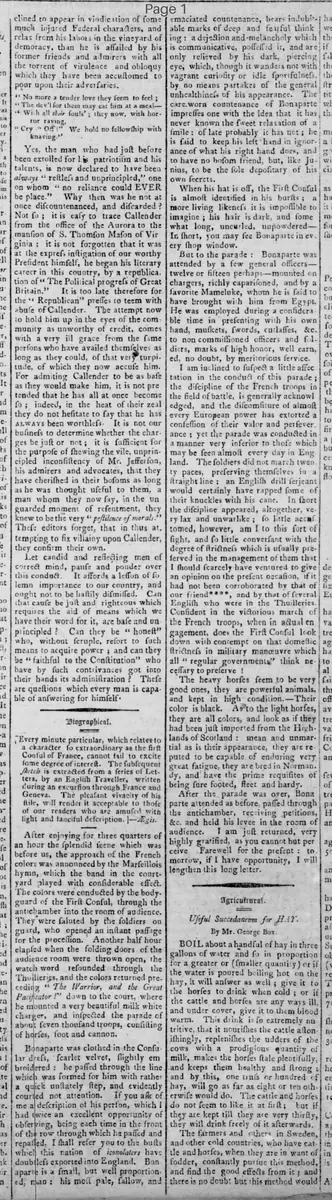
Every minute particular, which relates to a character so extraordinary as the First Consul of France, cannot fail to excite some degree of interest. The subsequent sketch is extracted from a series of Letters, by an English Traveller, written during an excursion through France and Geneva. The pleasant vivacity of his style, will render it acceptable to those of our readers who are amused with light and fanciful description. -Egis.
After enjoying for three quarters of an hour the splendid scene which was before us, the approach of the French colors was announced by the Marseillois hymn, which the band in the court-yard played with considerable effect. The colors were conducted by the body-guard of the First Consul, through the antichamber into the room of audience. They were saluted by the soldiers on guard, who opened an instant passage for the procession. Another half hour elapsed when the folding doors of the audience room were thrown open, the watch word resounded through the Thuilleries, and the colors returned preceding "The Warrior, and the Great Pacificator!" down to the court, where he mounted a very beautiful milk white charger, and inspected the parade of about seven thousand troops, consisting of horse, foot and cannon.
Bonaparte was clothed in the Consular dress, scarlet velvet, lightly embroidered: he passed through the line which was formed for him with rather a quick unstately step, and evidently courted no attention. If you ask of me a description of his person, which I had twice an excellent opportunity of observing, being each time in the front of the row through which he passed and repassed, I shall refer you to the busts which this nation of idolaters have doubled exported into England. Bonaparte is a small, but well proportioned man: his most pale, sallow, and emaciated countenance, bears indubitable marks of deep and fearful thinking: a dejection and melancholy which is communicative, possessed it, and are only relieved by his dark, piercing eye, which, though it wanders not with vagrant curiosity or idle portfulness, by no means partakes of the general unhealthiness of his appearance. The care-worn countenance of Bonaparte impresses one with the idea that it has never known the sweet relaxation of a smile: of late probably it has not: he is said to keep his left hand in ignorance of what his right hand does, and to have no bosom friend, but, like Julius, to be the sole depositary of his own secrets.
When his hat is off, the First Consul is almost identified in his busts; a more living likeness it is impossible to imagine; his hair is dark, and somewhat long, uncurled, unpowdered. In short, you may see Bonaparte in every shop window.
But to the parade: Bonaparte was attended by a few general officers- twelve or fifteen perhaps-mounted on chargers, richly caparisoned, and by a favorite Mameluke, whom he is said to have brought with him from Egypt. He was employed during a considerable time in presenting with his own hand, muskets, swords, cutlasses, &c. to non commissioned officers and soldiers, marks of high honor, well earned, no doubt, by meritorious service.
I am inclined to suspect a little affectation in the conduct of this parade: the discipline of the French troops in the field of battle, is generally acknowledged, and the discomfiture of almost every European power has extorted a confession of their valor and perseverance; yet the parade was conducted in a manner very inferior to those which may be seen almost every day in England. The soldiers did not march twenty paces, preserving themselves in a straight line: an English drill sergeant would certainly have rapped some of their knuckles with his cane. In short the discipline appeared, altogether, very lax and unwarlike; so little accustomed, however, am I to this sort of sight, and so little conversant with the degree of strictness which is usually preserved in the management of them that I should scarcely have ventured to give an opinion on the present occasion, if it had not been corroborated by that of our friend****, and by that of several English who were in the Thuilleries.
Confident in the victorious march of the French troops, when in actual engagement, does the First Consul look down with contempt on that domestic strictness in military manoeuvre which all "regular governments" think necessary to preserve!
The heavy horses seem to be very good ones, they are powerful animals, and kept in high condition. Their color is black. As to the light horses, they are all colors, and look as if they had been just imported from the Highlands of Scotland: mean and unmartial as is their appearance, they are reputed to be capable of enduring very great fatigue, they are bred in Normandy, and have the prime requisites of being sure footed, fleet and hardy.
After the parade was over, Bonaparte attended as before, passed through the antichamber, receiving petitions, &c. and held his levee in the room of audience. I am just returned, very highly gratified, as you cannot but perceive Farewell for the present: to morrow, if I have opportunity, I will lengthen this long letter.
Every minute particular, which relates to a character so extraordinary as the First Consul of France, cannot fail to excite some degree of interest. The subsequent sketch is extracted from a series of Letters, by an English Traveller, written during an excursion through France and Geneva. The pleasant vivacity of his style, will render it acceptable to those of our readers who are amused with light and fanciful description. -Egis.
After enjoying for three quarters of an hour the splendid scene which was before us, the approach of the French colors was announced by the Marseillois hymn, which the band in the court-yard played with considerable effect. The colors were conducted by the body-guard of the First Consul, through the antichamber into the room of audience. They were saluted by the soldiers on guard, who opened an instant passage for the procession. Another half hour elapsed when the folding doors of the audience room were thrown open, the watch word resounded through the Thuilleries, and the colors returned preceding "The Warrior, and the Great Pacificator!" down to the court, where he mounted a very beautiful milk white charger, and inspected the parade of about seven thousand troops, consisting of horse, foot and cannon.
Bonaparte was clothed in the Consular dress, scarlet velvet, lightly embroidered: he passed through the line which was formed for him with rather a quick unstately step, and evidently courted no attention. If you ask of me a description of his person, which I had twice an excellent opportunity of observing, being each time in the front of the row through which he passed and repassed, I shall refer you to the busts which this nation of idolaters have doubled exported into England. Bonaparte is a small, but well proportioned man: his most pale, sallow, and emaciated countenance, bears indubitable marks of deep and fearful thinking: a dejection and melancholy which is communicative, possessed it, and are only relieved by his dark, piercing eye, which, though it wanders not with vagrant curiosity or idle portfulness, by no means partakes of the general unhealthiness of his appearance. The care-worn countenance of Bonaparte impresses one with the idea that it has never known the sweet relaxation of a smile: of late probably it has not: he is said to keep his left hand in ignorance of what his right hand does, and to have no bosom friend, but, like Julius, to be the sole depositary of his own secrets.
When his hat is off, the First Consul is almost identified in his busts; a more living likeness it is impossible to imagine; his hair is dark, and somewhat long, uncurled, unpowdered. In short, you may see Bonaparte in every shop window.
But to the parade: Bonaparte was attended by a few general officers- twelve or fifteen perhaps-mounted on chargers, richly caparisoned, and by a favorite Mameluke, whom he is said to have brought with him from Egypt. He was employed during a considerable time in presenting with his own hand, muskets, swords, cutlasses, &c. to non commissioned officers and soldiers, marks of high honor, well earned, no doubt, by meritorious service.
I am inclined to suspect a little affectation in the conduct of this parade: the discipline of the French troops in the field of battle, is generally acknowledged, and the discomfiture of almost every European power has extorted a confession of their valor and perseverance; yet the parade was conducted in a manner very inferior to those which may be seen almost every day in England. The soldiers did not march twenty paces, preserving themselves in a straight line: an English drill sergeant would certainly have rapped some of their knuckles with his cane. In short the discipline appeared, altogether, very lax and unwarlike; so little accustomed, however, am I to this sort of sight, and so little conversant with the degree of strictness which is usually preserved in the management of them that I should scarcely have ventured to give an opinion on the present occasion, if it had not been corroborated by that of our friend****, and by that of several English who were in the Thuilleries.
Confident in the victorious march of the French troops, when in actual engagement, does the First Consul look down with contempt on that domestic strictness in military manoeuvre which all "regular governments" think necessary to preserve!
The heavy horses seem to be very good ones, they are powerful animals, and kept in high condition. Their color is black. As to the light horses, they are all colors, and look as if they had been just imported from the Highlands of Scotland: mean and unmartial as is their appearance, they are reputed to be capable of enduring very great fatigue, they are bred in Normandy, and have the prime requisites of being sure footed, fleet and hardy.
After the parade was over, Bonaparte attended as before, passed through the antichamber, receiving petitions, &c. and held his levee in the room of audience. I am just returned, very highly gratified, as you cannot but perceive Farewell for the present: to morrow, if I have opportunity, I will lengthen this long letter.
What sub-type of article is it?
Court News
Military Campaign
What keywords are associated?
Bonaparte
French Parade
Tuileries
First Consul
Military Inspection
What entities or persons were involved?
First Consul Of France
Bonaparte
Where did it happen?
Thuilleries
Foreign News Details
Primary Location
Thuilleries
Key Persons
First Consul Of France
Bonaparte
Event Details
An English traveler observes a military parade at the Thuilleries where the First Consul, Bonaparte, inspects seven thousand troops, presents awards to soldiers, and holds a levee, with descriptions of his appearance and the troops' discipline.