Thank you for visiting SNEWPapers!
Sign up free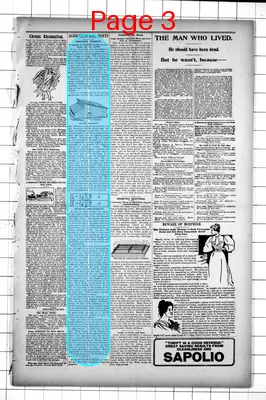
The Ely Miner
Ely, Saint Louis County, Minnesota
What is this article about?
Article advises on designing a sanitary piggery to maximize sunlight exposure, preventing hog diseases like cholera through dry, sunny quarters. Describes building layout with offset roof for north-side light, central alley, pens, and feeding arrangements. Emphasizes benefits of sunlight for health.
Merged-components note: Image (reading_order 51) spatially overlaps with the agricultural story (reading_order 50), indicating it is an illustration for the piggery article.
Clipping

OCR Quality
Full Text
SANITARY PIGGERY.
Arranged to Provide Plenty of Sunshine for the Inside.
It is a noticeable fact that disease of all kinds, and cholera in particular, is most prevalent where the greatest number of hogs are kept. The massing of those animals together and crowding them with so carbonaceous a food as corn is an invitation to disease to come and reap a rich harvest; and unless timely preparations are taken to thwart it, it is a harvest which is very liable to be gathered, and that successfully, too.
This is especially true where the piggery and its surroundings have become unsanitary. In such a case disease germs multiply fast, for disease loves dark and dampness, which soon tend to enfeeble the strongest and healthiest hog and pave the way to the most dire results.
Now, as sunlight is one of the best germicides known, this, together with dry quarters, is absolutely necessary to the continued health of any hog. Indeed, all animals should have the sunshine to bask in, and most emphatically does this hold true as regards young animals. Accordingly, when it comes to the housing of the hogs for winter it is imperative that the piggery be so arranged as to provide the requisite amount of sunshine inside. When building a large piggery, however, the problem is how to get the sun's rays to the north side of the building. It is simple enough to get the sunlight to stream in at the south side, but although it reaches the floor near the south side, it will not reach far back.
What then, is to be done? Why, use a little headwork and build in accordance with the following designs, the first of which is the perspective view. You will thus have the north side of the piggery made as warm and sunny, and often far more so, than the south side. For to obtain the desired results, the house should extend east and west, no matter what its size is, which should depend upon the magnitude of the herd that it is to accommodate, and nothing else.
MODEL PIGGERY.
INTERIOR ARRANGEMENT.
It will be observed that the “peak” of the roof is south of the center of the building, both sides of the roof being of the same pitch. This causes the roof of the north side to run higher than that of the south side in the place where the roofs meet, and so enables one to put in glass below the one roof and above the other, through which the sun will stream to the north side of the house and, killing disease germs by the million, tone up the system of the pigs and shotes and so make them thrifty and healthful, like those in the south part of the building.
Where the door opens, an alley should run through the center of the building, as shown in the second plan. Thus constructed, the central window is just over the south side of the alley, in consequence of which the sun will shine over the alley and into the pens north of it, the opposite pens being lighted sufficiently by the south window. From the alley between the feed troughs, doors, each two feet wide, should open from the pens into the alley. These have been omitted by our engraver. Gates working with a lever should also be suspended above the troughs, to shut the hogs away while putting in the feed. E, E, E, E, are the pens for the pigs, with a trough (A) in each. B is a bin for dry feed, in the middle of the alley, with a slop barrel (not lettered) on each side. DD are doors opening from either end of the alley.
If all these details are looked to and the location of the piggery is high and dry, the pens being made reasonably warm, so that close huddling of the swine is not necessary in order for them to be comfortable, albeit there is good ventilation, one will find such a building of great value, not only as a winter house, but also as a place in which to raise early pigs in spring.
Such are some of the benefits, indirectly speaking, that are to be derived from the sun, the actinic rays of which are one of nature's most powerful aids to good health. In what way, do you ask? Why, simply for the reason that they kill disease germs, promote circulation and digestion and, best of all, have a buoyant effect upon the spirits of both man and beast. We can therefore do nothing better when constructing a habitable building of any kind than to arrange it so that there can enter an abundance of sunlight. This is applicable to dwelling-houses, as well as to farm buildings.—Frederick O. Sibley, in N. Y. Tribune.
Breed the best flesh formers for market and then feed to as good a weight as possible.
What sub-type of article is it?
What keywords are associated?
What entities or persons were involved?
Story Details
Key Persons
Story Details
Advises constructing piggeries oriented east-west with offset roof peak to allow sunlight into north side via glass, preventing disease in hogs through germ-killing rays; includes central alley, pens, feeding troughs, and ventilation for healthy housing.