Thank you for visiting SNEWPapers!
Sign up free
Story
February 6, 1852
The Republic
Washington, District Of Columbia
What is this article about?
An article from the Richmond Republican praises printers at a festival for Franklin's birthday, satirizes public misconceptions about their luxurious lives, highlights their grueling labor and privations due to unpaid bills, and notes their strong moral character, exemplified by no New York printers imprisoned in 25 years.
Clipping
OCR Quality
100%
Excellent
Full Text
From the Richmond (Va.) Republican.
The Printer.
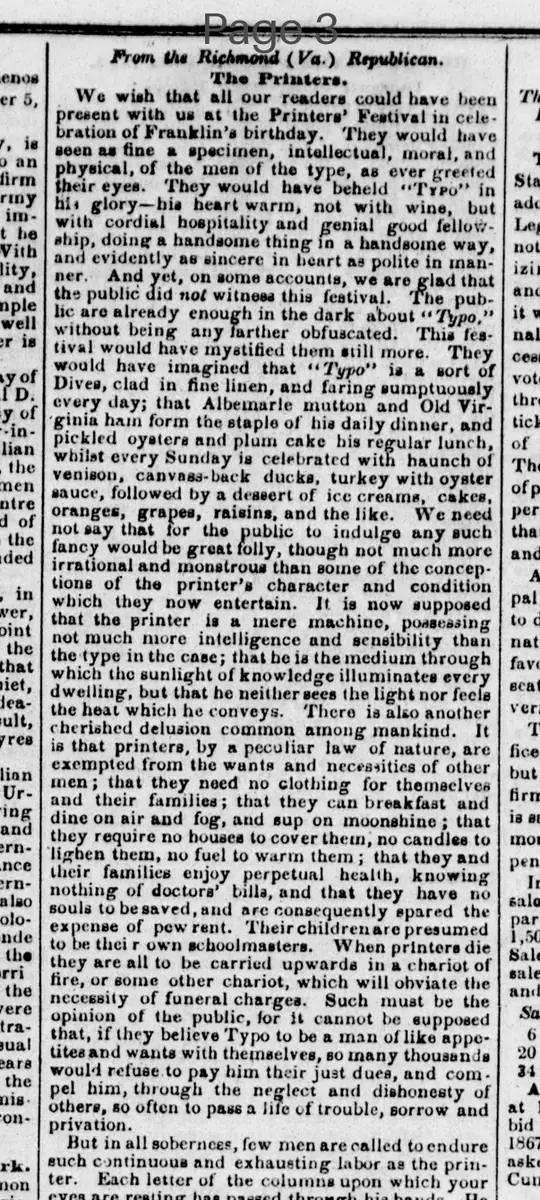
We wish that all our readers could have been present with us at the Printers' Festival in celebration of Franklin's birthday. They would have seen as fine a specimen, intellectual, moral, and physical, of the men of the type, as ever greeted their eyes. They would have beheld "Typo" in his glory-his heart warm, not with wine, but with cordial hospitality and genial good fellowship, doing a handsome thing in a handsome way, and evidently as sincere in heart as polite in manner. And yet, on some accounts, we are glad that the public did not witness this festival. The public are already enough in the dark about "Typo," without being any farther obfuscated. This festival would have mystified them still more. They would have imagined that "Typo" is a sort of Dives, clad in fine linen, and faring sumptuously every day; that Albemarle mutton and Old Virginia ham form the staple of his daily dinner, and pickled oysters and plum cake his regular lunch, whilst every Sunday is celebrated with haunch of venison, canvass-back ducks, turkey with oyster sauce, followed by a dessert of ice creams, cakes, oranges, grapes, raisins, and the like. We need not say that for the public to indulge any such fancy would be great folly, though not much more irrational and monstrous than some of the conceptions of the printer's character and condition which they now entertain. It is now supposed that the printer is a mere machine, possessing not much more intelligence and sensibility than the type in the case; that he is the medium through which the sunlight of knowledge illuminates every dwelling, but that he neither sees the light nor feels the heat which he conveys. There is also another cherished delusion common among mankind. It is that printers, by a peculiar law of nature, are exempted from the wants and necessities of other men; that they need no clothing for themselves and their families; that they can breakfast and dine on air and fog, and sup on moonshine; that they require no houses to cover them, no candles to lighten them, no fuel to warm them; that they and their families enjoy perpetual health, knowing nothing of doctors' bills, and that they have no souls to be saved, and are consequently spared the expense of pew rent. Their children are presumed to be their own schoolmasters. When printers die they are all to be carried upwards in a chariot of fire, or some other chariot, which will obviate the necessity of funeral charges. Such must be the opinion of the public, for it cannot be supposed that, if they believe Typo to be a man of like appetites and wants with themselves, so many thousands would refuse to pay him their just dues, and compel him, through the neglect and dishonesty of others, so often to pass a life of trouble, sorrow and privation.
But in all soberness, few men are called to endure such continuous and exhausting labor as the printer. Each letter of the columns upon which your eyes are resting has passed through his hands. He is at his post from early morn till midnight. Sun and storm, snow and ice, neither vary nor interrupt his duties. During the late bitter weather, the compositors of our own office, for example, have sometimes been up till one and even two o'clock, and then walked through the cold night and driving rain one and sometimes two miles to their respective homes, returning at an early hour in the morning. Such are the toils of the printer; and now let us say one word as to the moral character of the man. A single fact will speak volumes on that head. In the great State of New York, whose huge metropolis is becoming famous for the laxity of its morals as for its wealth and prosperity, not a single printer has been sent for a quarter of a century to the State prison at Sing Sing.
The Printer.
We wish that all our readers could have been present with us at the Printers' Festival in celebration of Franklin's birthday. They would have seen as fine a specimen, intellectual, moral, and physical, of the men of the type, as ever greeted their eyes. They would have beheld "Typo" in his glory-his heart warm, not with wine, but with cordial hospitality and genial good fellowship, doing a handsome thing in a handsome way, and evidently as sincere in heart as polite in manner. And yet, on some accounts, we are glad that the public did not witness this festival. The public are already enough in the dark about "Typo," without being any farther obfuscated. This festival would have mystified them still more. They would have imagined that "Typo" is a sort of Dives, clad in fine linen, and faring sumptuously every day; that Albemarle mutton and Old Virginia ham form the staple of his daily dinner, and pickled oysters and plum cake his regular lunch, whilst every Sunday is celebrated with haunch of venison, canvass-back ducks, turkey with oyster sauce, followed by a dessert of ice creams, cakes, oranges, grapes, raisins, and the like. We need not say that for the public to indulge any such fancy would be great folly, though not much more irrational and monstrous than some of the conceptions of the printer's character and condition which they now entertain. It is now supposed that the printer is a mere machine, possessing not much more intelligence and sensibility than the type in the case; that he is the medium through which the sunlight of knowledge illuminates every dwelling, but that he neither sees the light nor feels the heat which he conveys. There is also another cherished delusion common among mankind. It is that printers, by a peculiar law of nature, are exempted from the wants and necessities of other men; that they need no clothing for themselves and their families; that they can breakfast and dine on air and fog, and sup on moonshine; that they require no houses to cover them, no candles to lighten them, no fuel to warm them; that they and their families enjoy perpetual health, knowing nothing of doctors' bills, and that they have no souls to be saved, and are consequently spared the expense of pew rent. Their children are presumed to be their own schoolmasters. When printers die they are all to be carried upwards in a chariot of fire, or some other chariot, which will obviate the necessity of funeral charges. Such must be the opinion of the public, for it cannot be supposed that, if they believe Typo to be a man of like appetites and wants with themselves, so many thousands would refuse to pay him their just dues, and compel him, through the neglect and dishonesty of others, so often to pass a life of trouble, sorrow and privation.
But in all soberness, few men are called to endure such continuous and exhausting labor as the printer. Each letter of the columns upon which your eyes are resting has passed through his hands. He is at his post from early morn till midnight. Sun and storm, snow and ice, neither vary nor interrupt his duties. During the late bitter weather, the compositors of our own office, for example, have sometimes been up till one and even two o'clock, and then walked through the cold night and driving rain one and sometimes two miles to their respective homes, returning at an early hour in the morning. Such are the toils of the printer; and now let us say one word as to the moral character of the man. A single fact will speak volumes on that head. In the great State of New York, whose huge metropolis is becoming famous for the laxity of its morals as for its wealth and prosperity, not a single printer has been sent for a quarter of a century to the State prison at Sing Sing.
What sub-type of article is it?
Biography
Curiosity
What themes does it cover?
Moral Virtue
Misfortune
Justice
What keywords are associated?
Printers Festival
Franklin Birthday
Printer Hardships
Moral Character
Public Misconceptions
Labor Toils
What entities or persons were involved?
Typo
Franklin
Where did it happen?
Richmond (Va.)
Story Details
Key Persons
Typo
Franklin
Location
Richmond (Va.)
Event Date
Franklin's Birthday
Story Details
Description of Printers' Festival honoring Franklin, satire on public delusions of printers' easy lives, account of their exhaustive labor and privations from unpaid debts, praise of their moral integrity with no imprisonments in New York for 25 years.