Thank you for visiting SNEWPapers!
Sign up free
The Alaska Daily Empire
Juneau, Alaska
What is this article about?
P. E. Harris & Co. sues U.S. fisheries officials in Federal District Court to block new fish trap regulations, arguing they violate the law and would destroy the Alaskan salmon industry by making trap fishing impossible, affecting over 80% of canneries.
Merged-components note: Continued story across pages: Salmon Packers injunction.
Clippings
1 of 2
OCR Quality
Full Text
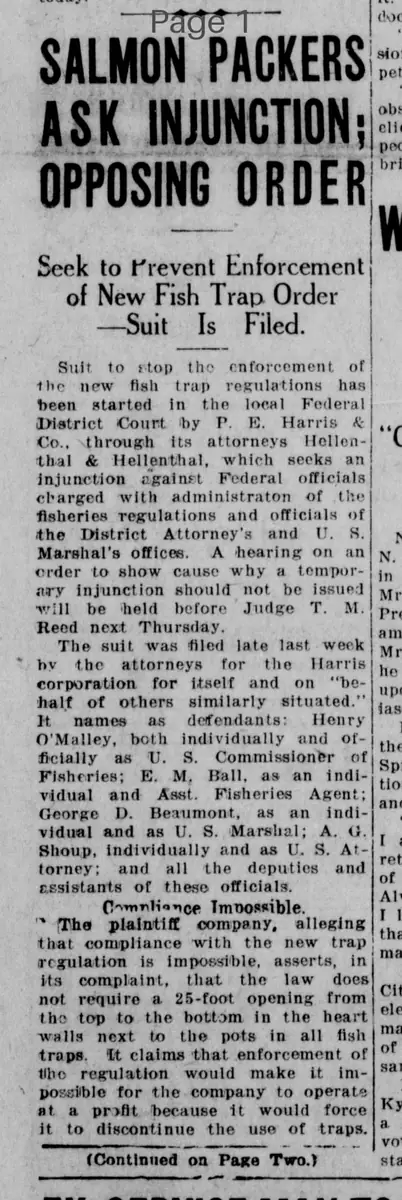
Seek to Prevent Enforcement of New Fish Trap Order
Suit Is Filed.
Suit to stop the enforcement of the new fish trap regulations has been started in the local Federal District Court by P. E. Harris & Co., through its attorneys Hellenthal & Hellenthal, which seeks an injunction against Federal officials charged with administration of the fisheries regulations and officials of the District Attorney's and U. S. Marshal's offices. A hearing on an order to show cause why a temporary injunction should not be issued will be held before Judge T. M. Reed next Thursday.
The suit was filed late last week by the attorneys for the Harris corporation for itself and on "behalf of others similarly situated." It names as defendants: Henry O'Malley, both individually and officially as U. S. Commissioner of Fisheries; E. M. Ball, as an individual and Asst. Fisheries Agent; George D. Beaumont, as an individual and as U. S. Marshal; A. G. Shoup, individually and as U. S. Attorney; and all the deputies and assistants of these officials.
Compliance Impossible.
The plaintiff company, alleging that compliance with the new trap regulation is impossible, asserts, in its complaint, that the law does not require a 25-foot opening from the top to the bottom in the heart walls next to the pots in all fish traps. It claims that enforcement of the regulation would make it impossible for the company to operate at a profit because it would force it to discontinue the use of traps.
It alleges that the traps are so constructed that the order cannot be complied with and that it is impossible to build a trap that can comply with it.
If the regulation should be carried out, according to the complaint it "would result in great and irreparable injury to the plaintiff by depriving it of its property without due process of law, in violation of the provisions of the Constitution of the United States. The company claims that the defendants officials have "placed an erroneous construction on the fisheries law relating to the opening of heart walls during the weekly closed season-the effect of which is to disregard the wish of Congress, to regulate the use of fish traps, and not to prevent their use."
Impossible to Operate.
Impending danger or prosecutions against employes, it is declared, "makes men unwilling to serve as watchmen on traps and the plaintiff will be unable to secure men to act in that capacity during the fishing season, or at all, and because of his inability to so employ labor for the reason stated, will be unable to fish his said traps or use them for any purpose whatever." It is pointed out that the company has no other means than the traps by which it can take salmon for its Hawk Inlet cannery, the claim being made that the plant is situated in a locality where salmon cannot be taken in commercial quantities except by using traps.
Continuing further the complaint declares:
"More than 80 per cent of the salmon canneries in Southeastern Alaska are so situated that they cannot be operated at a profit unless salmon can be supplied by the use of fish traps, and that of the order of the Bureau of Fisheries as construed by the defendants * * * is enforced and the threats of the defendants to arrest and prosecute all violators of the order as so construed are carried into effect, all the canneries so situated, which constitutes more than 80 per cent of the whole, will be compelled to suspend operations with a loss to the salmon industry of many millions of dollars and to the people of the United States of a valuable and cheap food product." It also declares that enforcement of the order would result in such a curtailment of the salmon packing for the year 1924 and all the years following that the Territory would receive practically no revenue from the fishing industry. Revenues from this source constitute nearly the whole gross revenue it receives from the collection of taxes, "so that public interest as well as private interest of the plaintiff and other salmon packers, calls for the issuance of an injunction to prevent the injury that would follow the carrying into execution of the matters and things threatened by the defendants."
Loss to Company.
The company sets forth that its investments threatened with destruction by the trap order aggregate $550,000. These represent the Hawk Inlet cannery valued at $250,000, supplies already purchased for the season $150,000, nine pile drivers and stationary traps, ranging in value from $5,000 to $25,000 each having an aggregate value of $159,000. Other companies similarly situated, it is reported, stand to lose amounts equally as large if, in fact, not much greater.
The suit is designed to test the validity of the new order. It is claimed that the old regulation, established under the law of 1906 and in force for 18 subsequent years, did carry out the will of Congress in that it assured free passage to salmon and other food fish during the weekly closed period. The new regulation, it is asserted, does not make any more for such unobstructed passage of fish through the traps, and would wipe out trap fishing.
Canners Confer.
The action was brought for the Harris concern by the Hellenthal firm after a series of conferences between company employees and officials and local counsel of many leading packers. These were held here last week and were attended by about 15 company officials and superintendents. Among those attending were: August Buschman, of the Deep Sea Salmon Co., Port Althorp; A. N. Herrold, Superintendent of the Excursion Inlet plant of the Pacific American Fisheries; Hanc Floe, Superintendent of the Harris plant at Hawk Inlet, who signed the complaint; P. H. McCue, General Manager of the Northwestern Fisheries operating ten canneries in Alaska; Oscar Bergseth, Assistant Superintendent for the same company; A. Nielson, Superintendent of the Dundas Bay cannery; A. L. Minard, Superintendent of the Loke cannery of the Sanborn Cutting Co.; A. Dano, Superintendent the Alaska Consolidated plant at Tee Harbor; Nick Bez, Outside Superintendent at Tenakee for the same company; Capt. Swenson, Assistant General Manager for Libby, McNeill & Libby; J. T. Barron, President and Manager of the Funter Bay cannery of the Thlinget Packing Co.; A. E. L. Bell, Superintendent of the Excursion Inlet cannery of the Astoria & Puget Sound Packing Co.; Ludvig and J. W. Carlson, of the Admiral Fish Co., trap operators in this district, and J. T. Tennyson, part owner and superintendent of the Superior Fisheries plant at Tenakee.
What sub-type of article is it?
What themes does it cover?
What keywords are associated?
What entities or persons were involved?
Where did it happen?
Story Details
Key Persons
Location
Southeastern Alaska, Federal District Court
Event Date
1924
Story Details
P. E. Harris & Co. files lawsuit to enjoin U.S. officials from enforcing new fish trap regulations requiring a 25-foot opening in heart walls, claiming impossibility of compliance, constitutional violation, and economic ruin to Alaskan salmon industry affecting over 80% of canneries.