Thank you for visiting SNEWPapers!
Sign up free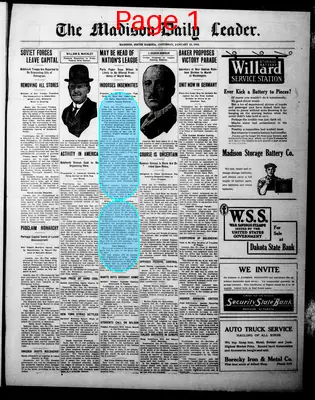
The Madison Daily Leader
Madison, Lake County, South Dakota
What is this article about?
Updates from the Paris Peace Conference on January 25, 1919: Formation of a committee on armistice forces led by Foch; Wilson likely to head League of Nations commission; Russian leaders oppose inviting Bolsheviks; Wilson endorses German indemnities and reparations; Discussions on disarmament; Conference to address labor legislation openly.
Merged-components note: Continuation of news on the peace conference and Wilson's stance on indemnities.
Clipping
OCR Quality
Full Text
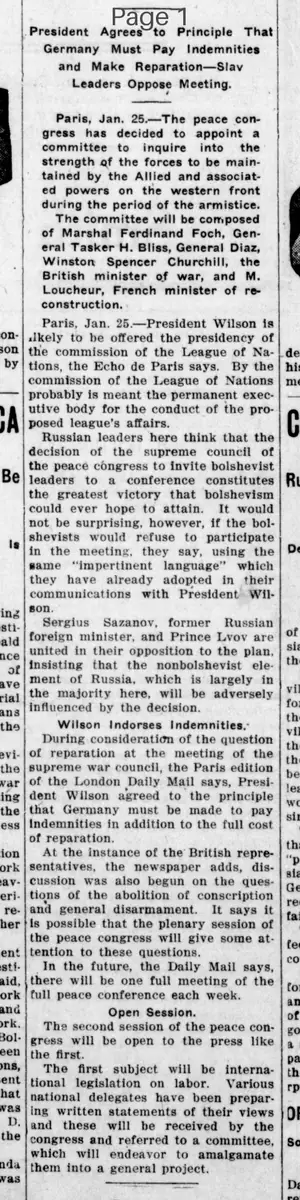
Paris, Jan. 25.-The peace congress has decided to appoint a committee to inquire into the strength of the forces to be maintained by the Allied and associated powers on the western front during the period of the armistice.
The committee will be composed of Marshal Ferdinand Foch, General Tasker H. Bliss, General Diaz, Winston Spencer Churchill, the British minister of war, and M. Loucheur, French minister of reconstruction.
Paris, Jan. 25.-President Wilson is likely to be offered the presidency of the commission of the League of Nations, the Echo de Paris says. By the commission of the League of Nations probably is meant the permanent executive body for the conduct of the proposed league's affairs.
Russian leaders here think that the decision of the supreme council of the peace congress to invite bolshevist leaders to a conference constitutes the greatest victory that bolshevism could ever hope to attain. It would not be surprising, however, if the bolshevist would refuse to participate in the meeting, they say, using the same "impertinent language" which they have already adopted in their communications with President Wilson.
Sergius Sazanov, former Russian foreign minister, and Prince Lvov are united in their opposition to the plan, insisting that the nonbolshevist element of Russia, which is largely in the majority here, will be adversely influenced by the decision.
Wilson Indorses Indemnities.
During consideration of the question of reparation at the meeting of the supreme war council, the Paris edition of the London Daily Mail says, President Wilson agreed to the principle that Germany must be made to pay indemnities in addition to the full cost of reparation.
At the instance of the British representatives, the newspaper adds, discussion was also begun on the questions of the abolition of conscription and general disarmament. It says it is possible that the plenary session of the peace congress will give some attention to these questions.
In the future, the Daily Mail says, there will be one full meeting of the full peace conference each week.
Open Session.
The second session of the peace congress will be open to the press like the first.
The first subject will be international legislation on labor. Various national delegates have been preparing written statements of their views and these will be received by the congress and referred to a committee, which will endeavor to amalgamate them into a general project.
What sub-type of article is it?
What keywords are associated?
What entities or persons were involved?
Where did it happen?
Foreign News Details
Primary Location
Paris
Event Date
Jan. 25
Key Persons
Outcome
germany to pay indemnities plus full reparation; invitation to bolshevik leaders opposed by russian non-bolsheviks; discussions on disarmament and labor legislation initiated; wilson likely to head league of nations commission; committee appointed for armistice forces.
Event Details
The peace congress appoints a committee including Foch, Bliss, Diaz, Churchill, and Loucheur to assess Allied forces on the western front during armistice. Wilson may lead the League of Nations executive body. Russian leaders view Bolshevik invitation as a major victory for Bolshevism and expect refusal; Sazanov and Lvov oppose it. Wilson agrees Germany must pay indemnities beyond reparations. British initiate talks on abolishing conscription and disarmament, possibly for plenary. Weekly full meetings planned. Second session open to press, starting with international labor legislation.