Thank you for visiting SNEWPapers!
Sign up free
Story
April 14, 1788
The Daily Advertiser
New York, New York County, New York
What is this article about?
A London commercial house falls victim to a sophisticated fraud involving a fake letter from Philadelphia announcing a corn shipment, leading them to accept a £700 bill for a nonexistent vessel and cargo, resulting in a loss of £400 cash and goods.
Clipping
OCR Quality
98%
Excellent
Full Text
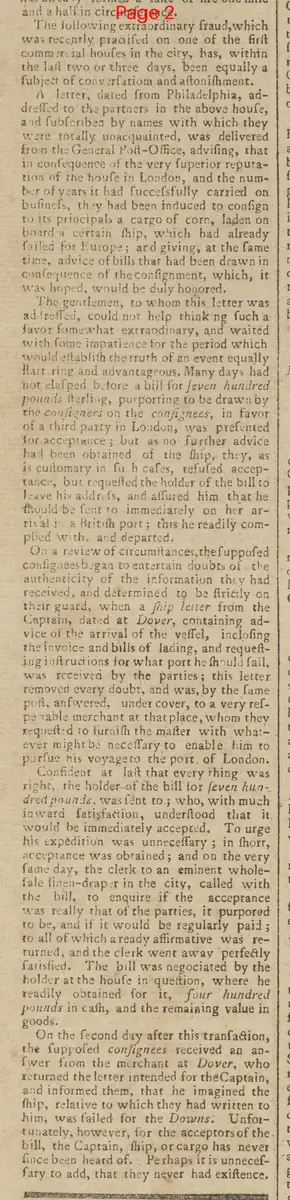
The following extraordinary fraud, which was recently practised on one of the first commercial houses in the city, has, within the last two or three days, been equally a subject of conversation and astonishment.
A letter, dated from Philadelphia, addressed to the partners in the above house, and subscribed by names with which they were totally unacquainted, was delivered from the General Post-Office, advising, that in consequence of the very superior reputation of the house in London, and the number of years it had successfully carried on business, they had been induced to consign to its principals a cargo of corn, laden on board a certain ship, which had already sailed for Europe; and giving, at the same time, advice of bills that had been drawn in consequence of the consignment, which, it was hoped, would be duly honored.
The gentlemen, to whom this letter was addressed, could not help thinking such a favor somewhat extraordinary, and waited with some impatience for the period which would establish the truth of an event equally flattering and advantageous. Many days had not elapsed before a bill for seven hundred pounds sterling, purporting to be drawn by the consigners on the consignees, in favor of a third party in London, was presented for acceptance: but as no further advice had been obtained of the ship, they, as is customary in such cases, refused acceptance, but requested the holder of the bill to leave his address, and assured him that he should be sent to immediately on her arrival in a British port; this he readily complied with, and departed.
On a review of circumstances, the supposed consignees began to entertain doubts of the authenticity of the information they had received, and determined to be strictly on their guard, when a ship letter from the Captain, dated at Dover, containing advice of the arrival of the vessel, enclosing the invoice and bills of lading, and requesting instructions for what port he should sail, was received by the parties; this letter removed every doubt, and was, by the same post, answered, under cover, to a very respectable merchant at that place, whom they requested to furnish the master with whatever might be necessary to enable him to pursue his voyage to the port of London.
Confident at last that everything was right, the holder of the bill for seven hundred pounds, was sent to; who, with much inward satisfaction, understood that it would be immediately accepted. To urge his expedition was unnecessary; in short, acceptance was obtained; and on the very same day, the clerk to an eminent wholesale linen-draper in the city, called with the bill, to enquire if the acceptance was really that of the parties, it purported to be, and if it would be regularly paid; to all of which a ready affirmative was returned, and the clerk went away perfectly satisfied. The bill was negotiated by the holder at the house in question, where he readily obtained for it, four hundred pounds in cash, and the remaining value in goods.
On the second day after this transaction, the supposed consignees received an answer from the merchant at Dover, who returned the letter intended for the Captain, and informed them, that he imagined the ship, relative to which they had written to him, was sailed for the Downs: Unfortunately, however, for the acceptors of the bill, the Captain, ship, or cargo has never since been heard of. Perhaps it is unnecessary to add, that they never had existence.
A letter, dated from Philadelphia, addressed to the partners in the above house, and subscribed by names with which they were totally unacquainted, was delivered from the General Post-Office, advising, that in consequence of the very superior reputation of the house in London, and the number of years it had successfully carried on business, they had been induced to consign to its principals a cargo of corn, laden on board a certain ship, which had already sailed for Europe; and giving, at the same time, advice of bills that had been drawn in consequence of the consignment, which, it was hoped, would be duly honored.
The gentlemen, to whom this letter was addressed, could not help thinking such a favor somewhat extraordinary, and waited with some impatience for the period which would establish the truth of an event equally flattering and advantageous. Many days had not elapsed before a bill for seven hundred pounds sterling, purporting to be drawn by the consigners on the consignees, in favor of a third party in London, was presented for acceptance: but as no further advice had been obtained of the ship, they, as is customary in such cases, refused acceptance, but requested the holder of the bill to leave his address, and assured him that he should be sent to immediately on her arrival in a British port; this he readily complied with, and departed.
On a review of circumstances, the supposed consignees began to entertain doubts of the authenticity of the information they had received, and determined to be strictly on their guard, when a ship letter from the Captain, dated at Dover, containing advice of the arrival of the vessel, enclosing the invoice and bills of lading, and requesting instructions for what port he should sail, was received by the parties; this letter removed every doubt, and was, by the same post, answered, under cover, to a very respectable merchant at that place, whom they requested to furnish the master with whatever might be necessary to enable him to pursue his voyage to the port of London.
Confident at last that everything was right, the holder of the bill for seven hundred pounds, was sent to; who, with much inward satisfaction, understood that it would be immediately accepted. To urge his expedition was unnecessary; in short, acceptance was obtained; and on the very same day, the clerk to an eminent wholesale linen-draper in the city, called with the bill, to enquire if the acceptance was really that of the parties, it purported to be, and if it would be regularly paid; to all of which a ready affirmative was returned, and the clerk went away perfectly satisfied. The bill was negotiated by the holder at the house in question, where he readily obtained for it, four hundred pounds in cash, and the remaining value in goods.
On the second day after this transaction, the supposed consignees received an answer from the merchant at Dover, who returned the letter intended for the Captain, and informed them, that he imagined the ship, relative to which they had written to him, was sailed for the Downs: Unfortunately, however, for the acceptors of the bill, the Captain, ship, or cargo has never since been heard of. Perhaps it is unnecessary to add, that they never had existence.
What sub-type of article is it?
Deception Fraud
Crime Story
What themes does it cover?
Deception
Misfortune
What keywords are associated?
Extraordinary Fraud
Consignment Scam
Fake Bill Acceptance
Nonexistent Ship
Commercial Deception
Philaadelphia Letter
What entities or persons were involved?
Partners Of The Commercial House
Bill Holder
Linendraper Clerk
Dover Merchant
Fictional Captain
Where did it happen?
London
Story Details
Key Persons
Partners Of The Commercial House
Bill Holder
Linendraper Clerk
Dover Merchant
Fictional Captain
Location
London
Event Date
Recently
Story Details
Fraudsters send a fake letter from Philadelphia announcing a corn consignment to a reputable London firm, followed by a forged bill for £700 and a deceptive captain's letter from Dover, tricking the firm into accepting and paying out on the bill for a nonexistent ship and cargo.