Thank you for visiting SNEWPapers!
Sign up free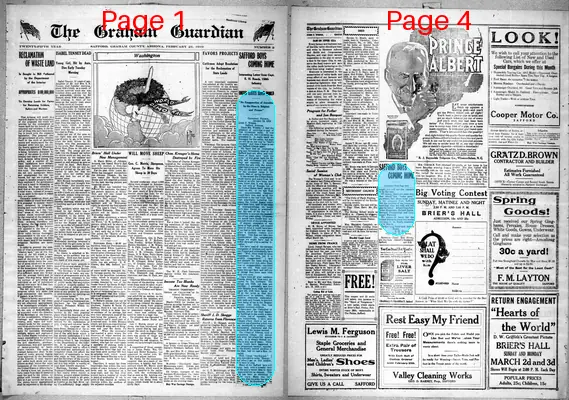
Graham Guardian
Safford, Graham County, Arizona
What is this article about?
Captain E. H. Roach writes from France to John F. Weber in Safford, Arizona, on Jan. 24, 1919, describing WWI German atrocities in Belgium and France, the vital US role in saving the world, and the safe return of Safford soldiers.
Merged-components note: Continuation of the letter from Capt. E. H. Roach 'UNITED STATES SAVED WORLD' across pages.
Clippings

1 of 2
OCR Quality
Full Text
"No Exaggeration of Atrocities by the Huns in Belgium and France"
Gadignau, France,
January 24, 1919.
John F. Weber,
Safford, Arizona.
Dear Mr. Weber: I had the pleasure of receiving a copy of THE GUARDIAN today. It was six weeks old, but I certainly appreciated it. It really made me homesick for the valley, but soon we will be on our way to "God's Country" and then I hope to see our Safford friends again.
We have had an interesting trip and fortunately most of our Safford boys are alive and well. Some of them have "paid the price" of this great fight for liberty and civilization, and while they are mourned, it should soften the pain with the knowledge that every one "made good." They all did their duty and died for the greatest cause in the world, that of saving humanity.
It has caused the United States much money and many lives, but those of us who have been over here, know that it was the saving not only of Europe, but of the United States itself going in when we did. If we had kept out, unquestionably Germany would have won, and as all the countries in the war were bankrupt practically, including Germany, the United States would have been next, and in our state of unpreparedness, we would have been forced to practically pay the cost of the war in indemnities to prevent the destruction of our coast cities. Of course, we would have finally won out but just think of the terrible cost.
If anyone complains of war taxes or high prices, just remind them of what it would have been if we had to fight the war alone after a German victory over Europe. This does not take into consideration the unspeakable things we might have had to suffer through even a partial invasion.
You have read of the German occupation of Belgium and northern France and undoubtedly have said: "Well, there must be some foundation for this, but it is greatly exaggerated." I said and thought the same thing before I came over; but, John, there was no exaggeration; one-third was not told. Wait until your home boys get back and tell you of things they have seen with their own eyes.
I have been all over northern France, along the lines once occupied by the Germans. The things you SEE, not hear, are horrible. I personally saw two little Belgian boys, eight and ten years old, with their hands cut off at the wrist, so that they could never be soldiers. Other children otherwise maltreated, both male and female, to prevent their being of use to the Belgian people. Just think, this was against innocent children.
I have seen the Cathedral of Rheims, one of the most beautiful buildings in the world, a mass of ruins, not of necessity, but pure wantonness. I have seen villages where there is not one stone on top of another which was not destroyed by artillery—was deliberately destroyed and the contents of the houses burned.
The village of Feisnes, once a prosperous village, you cannot now even tell where the streets were. It is simply blotted out. This is only one of many. Think what would have happened to our prosperous country, especially the thickly settled portions of the East, had we had a Hun invasion.
Well, I must "cut this out." I only intended to write "Howdy," but when I get on this subject, it is hard to stop.
Many of our Safford boys will come back with a broader view of life and a better idea of their responsibilities as citizens. This trip has been an education in many ways. Many may have thought that the army has taught the boys to be drunkards, to be
(Continued on Page Four)
SAFFORD BOYS COMING HOME
(Continued from Page One)
tough; you will see the opposite to be the case. Of course, there are some men that would not "make good" anywhere, but there were none in my company from Safford. Tell the families of the following boys that they are well and will soon be home: Albert Crawford, Teller Broshears, Delbert Smith, Bernard Freudenthal and Lieutenant Warnock. We expect to leave for the United States in about two weeks and hope to be finally mustered out in March. Pardon long letter and believe me,
Yours,
E. H. ROACH
Capt. Inf., U. S. Army.
What sub-type of article is it?
What themes does it cover?
What keywords are associated?
What entities or persons were involved?
Where did it happen?
Story Details
Key Persons
Location
Gadignau, France; Northern France; Belgium; Safford, Arizona
Event Date
January 24, 1919
Story Details
Captain Roach recounts WWI experiences, German atrocities against civilians and destruction in Belgium and France, the crucial US intervention preventing German victory and potential invasion of America, and the impending return of Safford soldiers.