Thank you for visiting SNEWPapers!
Sign up free
Story
October 7, 1886
Bridgeton Pioneer
Bridgeton, Cumberland County, New Jersey
What is this article about?
Hon. James G. Blaine delivers a speech at Chatauqua Camp in Fryeburg, Maine, on education, promoting universities with democratic equality based on talent and criticizing lengthy college courses that hinder practical success in professions and business.
Clipping
OCR Quality
98%
Excellent
Full Text
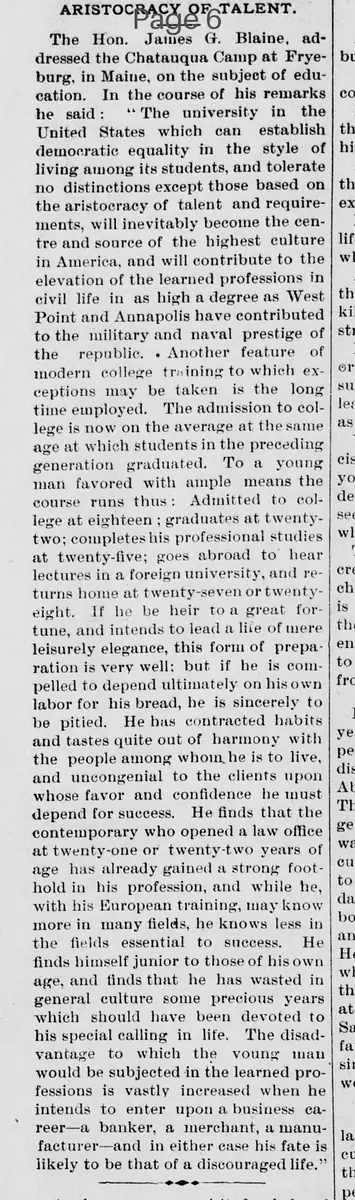
The Hon. James G. Blaine addressed the Chatauqua Camp at Fryeburg, in Maine, on the subject of education. In the course of his remarks he said: "The university in the United States which can establish democratic equality in the style of living among its students, and tolerate no distinctions except those based on the aristocracy of talent and requirements, will inevitably become the centre and source of the highest culture in America, and will contribute to the elevation of the learned professions in civil life in as high a degree as West Point and Annapolis have contributed to the military and naval prestige of the republic. Another feature of modern college training to which exceptions may be taken is the long time employed. The admission to college is now on the average at the same age at which students in the preceding generation graduated. To a young man favored with ample means the course runs thus: Admitted to college at eighteen; graduates at twenty-two; completes his professional studies at twenty-five; goes abroad to hear lectures in a foreign university, and returns home at twenty-seven or twenty-eight. If he be heir to a great fortune, and intends to lead a life of mere leisurely elegance, this form of preparation is very well; but if he is compelled to depend ultimately on his own labor for his bread, he is sincerely to be pitied. He has contracted habits and tastes quite out of harmony with the people among whom he is to live, and uncongenial to the clients upon whose favor and confidence he must depend for success. He finds that the contemporary who opened a law office at twenty-one or twenty-two years of age has already gained a strong foothold in his profession, and while he, with his European training, may know more in many fields, he knows less in the fields essential to success. He finds himself junior to those of his own age, and finds that he has wasted in general culture some precious years which should have been devoted to his special calling in life. The disadvantage to which the young man would be subjected in the learned professions is vastly increased when he intends to enter upon a business career-a banker, a merchant, a manufacturer-and in either case his fate is likely to be that of a discouraged life."
What sub-type of article is it?
Historical Event
What themes does it cover?
Social Manners
Moral Virtue
What keywords are associated?
Education
College Training
Democratic Equality
Prolonged Studies
Professional Success
What entities or persons were involved?
Hon. James G. Blaine
Where did it happen?
Chatauqua Camp At Fryeburg, In Maine
Story Details
Key Persons
Hon. James G. Blaine
Location
Chatauqua Camp At Fryeburg, In Maine
Story Details
Hon. James G. Blaine addresses the Chatauqua Camp on education, advocating for universities that promote democratic equality based on talent and critiquing the prolonged duration of college training that disadvantages young men entering professional or business careers by fostering habits out of harmony with practical life.