Thank you for visiting SNEWPapers!
Sign up free
Alexandria Daily Gazette, Commercial & Political
Alexandria, Virginia
What is this article about?
Opinion piece from the American Citizen analyzing Spain's resistance to Napoleon's invasion after Charles and Ferdinand's capture at Bayonne. Discusses Austrian diversion in Germany, comparisons to prior French conquests, and potential for Spanish popular revolution against French tyranny.
Clipping
OCR Quality
Full Text
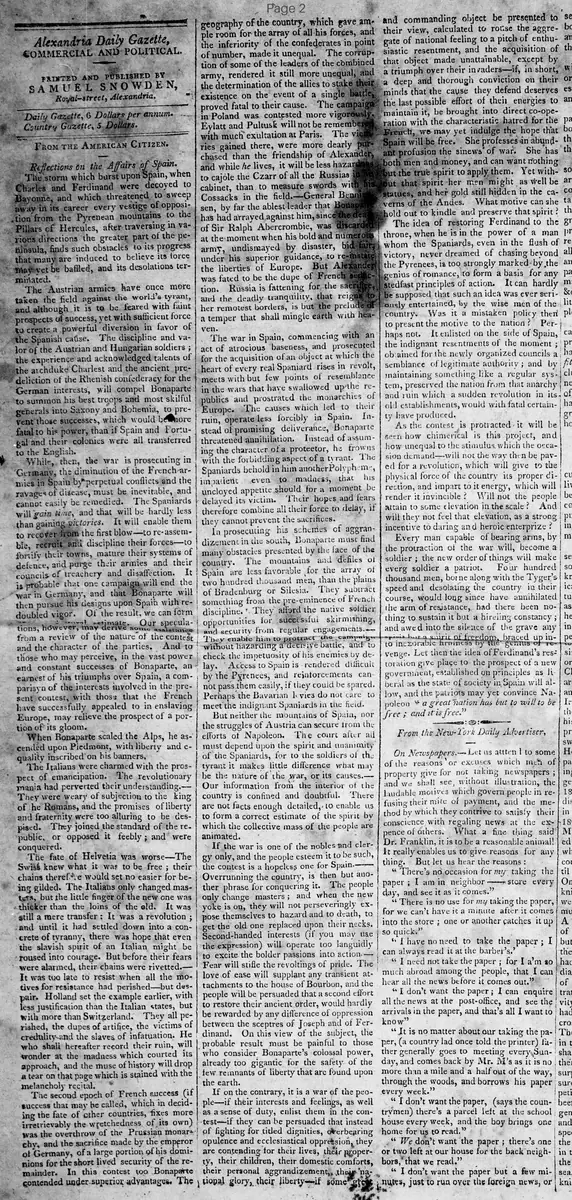
Reflections on the Affairs of Spain.
The storm which burst upon Spain, when Charles and Ferdinand were decoyed to Bayonne, and which threatened to sweep away in its career every vestige of opposition from the Pyrenean mountains to the Pillars of Hercules, after traversing in various directions the greater part of the peninsula, finds such obstacles to its progress that many are induced to believe its force may yet be baffled, and its desolations terminated.
The Austrian armies have once more taken the field against the world's tyrant, and although it is to be feared with faint prospects of success, yet with sufficient force to create a powerful diversion in favor of the Spanish cause. The discipline and valor of the Austrian and Hungarian soldiers; the experience and acknowledged talents of the archduke Charles and the ancient predilection of the Rhenish confederacy for the German interests, will compel Bonaparte to summon his best troops and most skilful generals into Saxony and Bohemia, to prevent those successes, which would be more fatal to his power, than if Spain and Portugal and their colonies were all transferred to the English.
While, then, the war is prosecuting in Germany, the diminution of the French armies in Spain by perpetual conflicts and the ravages of disease, must be inevitable, and cannot easily be remedied. The Spaniards will gain time, and that will be hardly less than gaining victories. It will enable them to recover from the first blow--to re-assemble, recruit and discipline their forces--to fortify their towns, mature their systems of defence, and purge their armies and their councils of treachery and disaffection. It is probable that one campaign will end the war in Germany, and that Bonaparte will then pursue his designs upon Spain with redoubled vigor. Of the result, we can form no certain estimate. Our speculations, however, may derive some assistance from a review of the nature of the contest and the character of the parties. And to those who may perceive, in the vast power and constant successes of Bonaparte, an earnest of his triumphs over Spain, a comparison of the interests involved in the present contest, with those that the French have successfully appealed to in enslaving Europe, may relieve the prospect of a portion of its gloom.
When Bonaparte scaled the Alps, he ascended upon Piedmont, with liberty and equality inscribed on his banners. The Italians were charmed with the prospect of emancipation. The revolutionary mania had perverted their understanding.-- They were weary of subjection to the king of the Romans, and the promises of liberty and fraternity were too alluring to be despised. They joined the standard of the republic, or opposed it feebly; and were conquered.
The fate of Helvetia was worse--The Swiss knew what it was to be free; their chains therefore would sit no easier for being gilded. The Italians only changed masters, but the little finger of the new one was thicker than the loins of the old. It was still a mere transfer: It was a revolution; and until it had settled down into a concrete of tyranny, there was hope that even the slavish spirit of an Italian might be roused into courage. But before their fears were alarmed, their chains were rivetted.-- It was too late to resist when all the motives for resistance had perished--but despair. Holland set the example earlier, with less justification than the Italian states, but with more than Switzerland. They all perished, the dupes of artifice, the victims of credulity and the slaves of infatuation. He who shall hereafter record their ruin, will wonder at the madness which courted its approach, and the muse of history will drop a tear on that page which is stained with the melancholy recital.
The second epoch of French success (if success that may be called, which in deciding the fate of other countries, fixes more irretrievably the wretchedness of its own) was the overthrow of the Prussian monarchy, and the sacrifice made by the emperor of Germany, of a large portion of his dominions for the short lived security of the remainder. In this contest too Bonaparte contended under superior advantages. The geography of the country, which gave ample room for the array of all his forces, and the inferiority of the confederates in point of number, made it unequal. The corruption of some of the leaders of the combined army, rendered it still more unequal, and the determination of the allies to stake their existence on the event of a single battle proved fatal to their cause. The campaign in Poland was contested more vigorously Eylau and Pultusk will not be remembered with much exultation at Paris. The victories gained there, were more dearly purchased than the friendship of Alexander. and while he lives, it will be less hazardous to cajole the Czar of all the Russias cabinet, than, to measure swords with Cossacks in the field. General Bennisen, by far the ablest leader that Bonaparte has had arrayed against him, since the death of Sir Ralph Abercrombie, was discarded at the moment when his bold and numerous army, undismayed by disaster, bid fair. under his superior guidance, to reinstate the liberties of Europe. But Alexander was fated to be the dupe of French seduction. Russia is fattening for the sacrifice., and the deadly tranquility, that reigns to her remotest borders, is but the prelude of a tempest that shall mingle earth with heaven.
The war in Spain, commencing with an act of atrocious baseness, and prosecuted for the acquisition of an object at which the heart of every real Spaniard rises in revolt, meets with but few points of resemblance in the wars that have swallowed up the republics and prostrated the monarchies of Europe. The causes which led to their ruin, operate less forcibly in Spain. Instead of promising deliverance, Bonaparte threatened annihilation. Instead of assuming the character of a protector, he frowns with the forbidding aspect of a tyrant. The Spaniards behold in him another Polypheme, impatient even to madness, that his uncloyed appetite should for a moment be delayed its victim. Their hopes and fears therefore combine all their force to delay, if they cannot prevent the sacrifices.
In prosecuting his schemes of aggrandizement in the south, Bonaparte must find many obstacles presented by the face of the country. The mountains and defiles of Spain are less favorable for the array of two hundred thousand men, than the plains of Brandenburg or Silesia. They subtract something from the pre-eminence of French discipline. They afford the native soldier opportunities for successful skirmishing, and security from regular engagements.-- They enable him to protract the campaign without hazarding a decisive battle, and to check the impetuosity of his enemies by delay. Access to Spain is rendered difficult by the Pyrenees, and reinforcements cannot pass them easily, if they could be spared. Perhaps the Bavarian allies do not care to meet the indignant Spaniards in the field. But neither the mountains of Spain, nor the struggles of Austria can secure from the efforts of Napoleon. The court after all must depend upon the spirit and unanimity of the Spaniards, for to the soldiers of the tyrant it makes little difference what may be the nature of the war, or its causes.-- Our information from the interior of the country is confined and doubtful. There are not facts enough detailed, to enable us to form a correct estimate of the spirit by which the collective mass of the people are animated.
If the war is one of the nobles and clergy only, and the people esteem it to be such, the contest is a hopeless one for Spain.-- Overrunning the country, is then but another phrase for conquering it. The people only change masters; and when the new yoke is on, they will not perseveringly expose themselves to hazard and to death, to get the old one replaced upon their necks. Second-handed interests (if you may use the expression) will operate too languidly to excite the bolder passions into action.--- Fear will stifle the revoltings of pride. The love of ease will supplant any transient attachments to the house of Bourbon, and the people will be persuaded that a second effort to restore their ancient order, would hardly be rewarded by any difference of oppression between the sceptres of Joseph and of Ferdinand. On this view of the subject, the probable result must be painful to those who consider Bonaparte's colossal power, already too gigantic for the safety of the few remnants of liberty that are found upon the earth.
If on the contrary, it is a war of the people--if their interests and feelings, as well as a sense of duty, enlist them in the contest -if they can be persuaded that instead of fighting for titled dignities, overbearing opulence and ecclesiastical oppression, they are contending for their lives, their property, their children, their domestic comforts, their personal aggrandizement, their national glory, their liberty if some great and commanding object be presented to their view, calculated to rouse the aggregate of national feeling to a pitch of enthusiastic resentment, and the acquisition of that object made unattainable, except by a triumph over their invaders-if, in short. a deep and thorough conviction on their minds that the cause they defend deserves the last possible effort of their energies to maintain it, be brought into direct co-operation with the characteristic hatred for the French, we may yet indulge the hope that Spain will be free. She professes in abundant profusion the sinews of war. She has both men and money, and can want nothing but the true spirit to apply them. Yet without that spirit her men might as well be statues, and her gold still hidden in the caverns of the Andes. What motive can she hold out to kindle and preserve that spirit? The idea of restoring Ferdinand to the throne, when he is in the power of a man whom the Spaniards, even in the flush of victory, never dreamed of chasing beyond the Pyrenees, is too strongly marked by the genius of romance, to form a basis for any stedfast principles of action. It can hardly be supposed that such an idea was ever seriously entertained, by the wise men of the country.. Was it a mistaken policy then to present the motive to the nation? Perhaps not. It enlisted on the side of Spain, the indignant resentments of the moment; obtained for the newly organized councils a semblance of legitimate authority; and by maintaining something like a regular system, preserved the nation from that anarchy and ruin which a sudden revolution in its old establishments, would with fatal certainty have produced.
As the contest is protracted-it will be seen how chimerical is this project, and how unequal to the stimulus which the occasion demands---will not the way then be paved for a revolution, which will give to the physical force of the country its proper direction, and impart to it energy, which will render it invincible? Will not the people attain to some elevation in the scale? And will they not feel that elevation, as a strong incentive to daring and heroic enterprize?
Every man capable of bearing arms, by the protraction of the war will, become a soldier; the new order of things will make every soldier a patriot. Four hundred thousand men, borne along with the Tyger's speed and desolating the country in their course, would long since have annihilated the arm of resistance, had there been nothing to sustain it but a hireling constancy; and awed into the silence of the grave any rising spirit of freedom. braced up into inexorable firmness by the genius of vengeance. Let then the idea of Ferdinand's restoration give place to- the prospect of a new government, established on principles as liberal as the state of society in Spain will allow, and the patriots may yet convince Napoleon that a great nation has but to will to be free; and it is free.
What sub-type of article is it?
What keywords are associated?
What entities or persons were involved?
Where did it happen?
Foreign News Details
Primary Location
Spain
Key Persons
Event Details
Reflections on Napoleon's invasion of Spain following the decoying of Charles and Ferdinand to Bayonne, highlighting Austrian diversion in Germany, geographical advantages for Spanish resistance, comparisons to French conquests in Italy, Switzerland, Holland, Prussia, and Poland, and speculation on potential popular Spanish revolution against French tyranny for liberty and a new government.