Thank you for visiting SNEWPapers!
Sign up free
Gazette Of The United States, & Philadelphia Daily Advertiser
Philadelphia, Philadelphia County, Pennsylvania
What is this article about?
This editorial, addressed to Pennsylvania electors and signed 'MILO,' rebuts a pro-M'Kean election committee's address. It accuses M'Kean of political inconsistency, pro-French bias, personal vices, and omitting key charges, while defending the federal government against claims of pro-British treachery and foreign influence.
Merged-components note: Continuation of the editorial address 'To the Electors of Pennsylvania' across columns.
Clipping
OCR Quality
Full Text
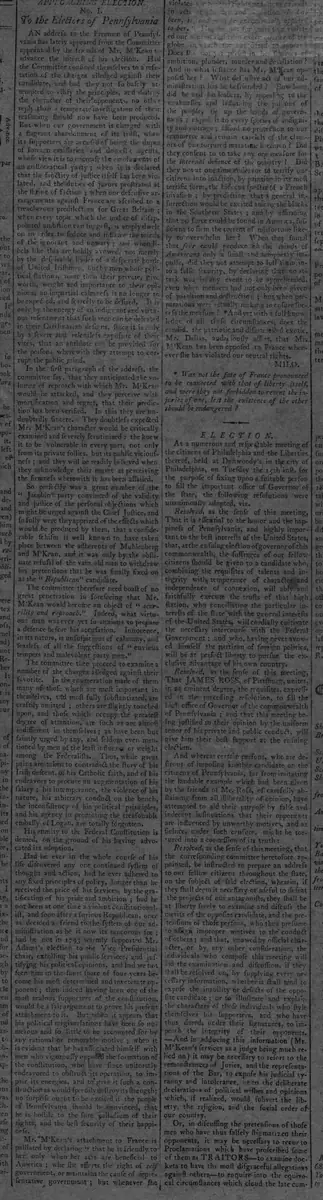
AN address to the Freemen of Pennsylvania has lately appeared from the Committee appointed by the friends of Mr. M'Kean to advance the interest of his election. Had the Committee confined themselves to a refutation of the charges alledged against their candidate, and had they not so basely attempted to vilify the principles, and destroy the character of their opponents, no other reply than a temperate investigation of their reasoning should now have been produced.
But when our government is charged with a flagrant abandonment of its trust, when its supporters are accused of being the dupes of foreign emissaries and domestic agents, whose view it is to increase the emoluments of an aristocratical party; when it is declared that the sanctity of justice itself has been violated, and the duties of jurors prostrated at the shrine of faction; when our defensive arrangements against France are ascribed to a treacherous predilection for Great Britain; when every topic which the malice of disappointed ambition can suggest, is amply dwelt on in order to seduce and inflame the minds of the ignorant and unwary; and when libels like this are boldly avowed, not merely by the despicable leader of a desperate horde of United Irishmen, but by men whose political stations, more than their private, give worth, weight and importance to their opinions, an impartial calmness is no longer to be expected, and scarcely to be desired. It is only by the energy of an indignant and virtuous resentment that such men can be defeated in their Catilinarian designs, since it is only by a severe and relentless exposure of their vices, that an antidote can be provided for the poisons wherewith they attempt to corrupt the public mind.
In the first paragraph of the address, the committee say, that they anticipated the volumes of reproach with which Mr. M'Kean would be attacked, and they perceive with mortification and regret, that their prediction has been verified. In this they are undoubtedly sincere. They doubtless expected Mr. M'Kean's character would be critically examined and severely scrutinized: they knew it to be vulnerable in every part, not only from its private follies, but its public viciousness; and they will be readily believed when they acknowledge their regret at perceiving the firmness wherewith it has been assailed.
So perfectly was a great number of the "Jacobin" party convinced of the validity and justice of the personal objections which might be urged against the Chief Justice, and so fully were they apprized of the effects which would be produced by them, that a considerable schism is well known to have taken place between the adherents of Muhlenberg and M'Kean, and it was only by the obstinate refusal of the vain old man to withdraw his pretensions that he was finally fixed on as the "Republican" candidate.
The committee therefore need boast of no great penetration in foreseeing that Mr. M'Kean would become an object of "scurrility and reproach." Indeed, what virtuous man was ever yet so anxious to prepare a defence before his accusation. Innocence, in its nature, is unsuspicious of calumny, and fearless of all the suggestions of "envious tempers and malevolent party men."
The committee then proceed to examine a number of the charges alledged against their favorite. In the enumeration made of them many of those which are most important in themselves, and most fully substantiated, are craftily omitted; others are slightly touched upon, and those which occupy the greatest degree of attention, are such as are almost indifferent in themselves; as have been but faintly urged by any, and seldom even mentioned by men of the least influence or weight among the Federalists. Thus, while great pains are taken to contradict the story of his Irish descent, of his Catholic faith, and of his endeavors to procure an augmentation of his salary; his intemperance, the violence of his nature, his arbitrary conduct on the bench, the inconsistency of his political principles, and his agency in promoting the treasonable embassy of Logan, are totally forgotten.
His enmity to the Federal Constitution is denied, on the ground of his having advocated its adoption.
Had he ever in the whole course of his life discovered any one continued system of thought and action, had he ever adhered to any fixed principles of policy, longer than he received the price of his services, by the gratification of his pride and ambition; had he not been at one time a violent constitutionalist, and soon after a furious Republican, once as decided a friend to the system of our administration as he is now its rancorous foe; had he not in 1793 warmly supported Mr. Adams's election to the Vice Presidential chair, extolling his public services, and justifying his political opinions, and had we not seen him in the short space of four years become his most determined and inveterate opponent; then indeed having been one of the most zealous supporters of the constitution, would be a fair argument to prove his present attachment to it. But when it appears that his political tergiversations have been so numerous and so little to be accounted for by any rational or honorable motive; when it is evident that he has associated himself with men who vigorously opposed the formation of the constitution, who have since uniformly endeavored to obstruct its operation, to impair its energies, and to give it such a construction as would speedily destroy its strength; no surprise ought to be excited if the people of Pennsylvania should be convinced, that he is hostile to the sure palladium of their rights, and the best security of their happiness.
Mr. M'Kean's attachment to France is palliated by declaring "that he is friendly to her only when her acts are beneficial to America; when he asserts the right of self-government, or maintains the cause of representative government; but whenever he violates our neutral rights, he has been, is and will be—untiringly opposed."
Is there any spot on the globe in which the standard of France has appeared but ambition, plunder, murder and devastation?
And in what instance has Mr. M'Kean opposed her? What defensive act of our administration has he befriended? How long did he and his leaders, by appealing to the weakness and inflaming the passions of the people, tie up the hands of government; expose it to every species of indignity and outrage; afford no protection to our commerce and remain careless of the claims of our tortured maritime brethren? Did they consent to take any one measure for the internal defence of the country? Did they not at one time endeavor to terrify our citizens into inaction, by painting in its most terrific form, the hideous spectre of a French invasion; by predicting that a general insurrection would be excited among the blacks in the Southern States; and by affirming that no force could be found in America, sufficient to stem the torrent of misfortune likely to overwhelm her? When they found that fear could produce on the minds of Americans only a small and temporary impulse, did they not attempt to lull them into a false security, by declaring that no attack was in any event to be apprehended, even when menaces had not only been given of partition and destruction; but when preparations were actually making to ensure success the measure? *And yet with a full knowledge of all these circumstances, does the candid, the patriotic and disinterested exotic, Mr. Dallas, audaciously assert, that Mr. M'Kean has been opposed to France whenever she has violated our neutral rights.
MILO.
* Was not the fate of France pronounced to be connected with that of liberty itself, and were they not forbidden to resent the injuries of one, lest the existence of the other should be endangered?
What sub-type of article is it?
What keywords are associated?
What entities or persons were involved?
Editorial Details
Primary Topic
Criticism Of Thomas M'kean's Gubernatorial Candidacy And Defense Of Federal Policies
Stance / Tone
Strongly Anti M'kean And Pro Federalist, Indignant And Accusatory
Key Figures
Key Arguments