Thank you for visiting SNEWPapers!
Sign up free
Constitutional Whig
Richmond, Virginia
What is this article about?
In 1832, a U.S. House committee investigated the Bank of the United States for charter violations (usury, branch drafts, coin/stock sales, donations, buildings) and mismanagement, including loans to editors influencing the press. Report by Mr. Clayton details findings and history.
Merged-components note: Continuation of the report on the Bank of the United States; relabeled from 'commercial' and 'story' to 'domestic_news' as it is political and economic news content.
Clippings
1 of 2
OCR Quality
Full Text
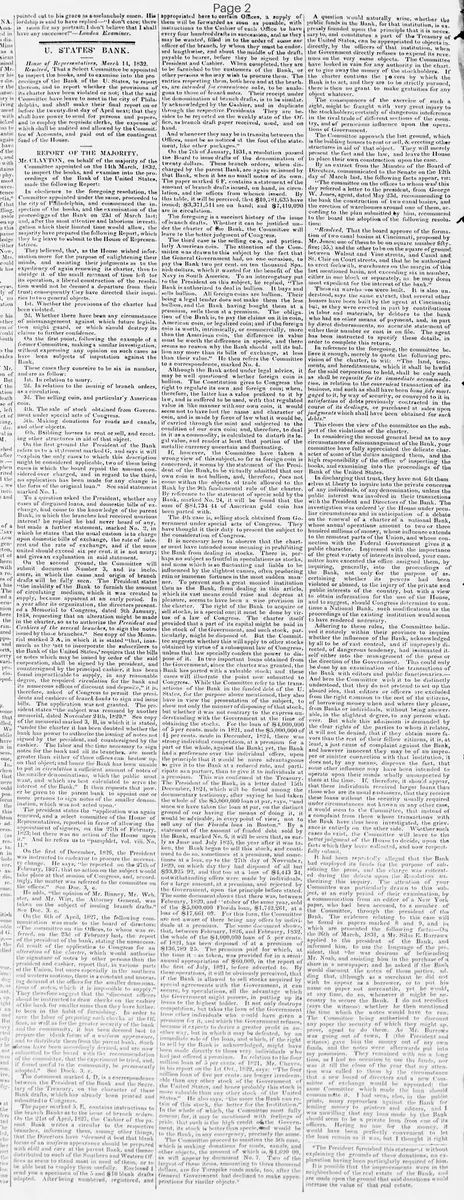
House of Representatives, March 14, 1832.
Resolved, That a Select Committee be appointed to inspect the books, and to examine into the proceedings of the Bank of the U. States, to report thereon, and to report whether the provisions of its charter have been violated or not; that the said Committee have leave to meet in the city of Philadelphia, and shall make their final report on or before the twenty-first day of April next; that they shall have power to send for persons and papers, and to employ the requisite clerks, the expense of which shall be audited and allowed by the Committee of Accounts, and paid out of the contingent fund of the House.
REPORT OF THE MAJORITY.
Mr. CLAYTON, on behalf of the majority of the Committee appointed on the 14th March, 1832, to inspect the books, and examine into the proceedings of the Bank of the United States, made the following Report:
In obedience to the foregoing resolution, the Committee appointed under the same, proceeded to the city of Philadelphia, and commenced the inspection of the books, and the examination of the proceedings of the Bank on 23d of March last; and, after the most attentive and laborious investigation which their limited time would allow, the majority have prepared the following Report, which they beg leave to submit to the House of Representatives.
They believed, that as the House wished information more for the purpose of enlightening their minds, and assisting their judgments as to the expediency of again renewing its charter, than to abridge it of the small remnant of time left for its operation, a liberal construction of the resolution would not be deemed a departure from their trust; consequently they have directed their inquiries to two general objects.
1st. Whether the provisions of the charter had been violated.
2d. Whether there have been any circumstances of mismanagement against which future legislation might guard, or which should destroy its claims to further confidence.
On the first point, following the example of a former Committee, making a similar investigation, without expressing any opinion on such cases as have been subjects of imputation against the Bank,
These cases they conceive to be six in number, and are as follow:
1st. In relation to usury.
2d. In relation to the issuing of branch orders, as a circulation.
3d. The selling coin, and particularly American coin.
4th. The sale of stock obtained from Government under special acts of Congress.
5th. Making donations for roads and canals, and other objects.
6th. Building houses to rent or sell, and erecting other structures in aid of that object.
On the first ground the President of the Bank refers us to a statement marked G, and says it will "explain the only cases to which this description might be considered applicable, two of them being cases in which the board repaid the amount considered over charged, and in regard to the third, no application has been made for any change in the form of the original loan." See said statement marked No. 1.
To a question asked the President, whether any cases of disguised loans, and domestic bills of exchange, had come to the knowledge of the parent Bank, in which the branches had received usurious interest? he replied he had never heard of any, but made a further statement, marked No. 2. in which he states that the usual custom is to charge upon domestic bills of exchange, the rate of interest and the rate of exchange, and if the sums united should exceed six per cent. it is not usury; and gives an explanation in said statement.
On the second ground, the Committee will submit document Number 3, and its enclosures, in which the cause and origin of branch drafts will be fully seen. The President states "the inability of the Bank to furnish the amount of circulating medium, which it was created to supply, became apparent at an early period. In a year after its organization, the directors presented a Memorial to Congress, dated 9th January, 1818, requesting that an alteration might be made in the charter, so as to authorize the President and Cashiers of the several branches, to sign the notes issued by those branches." See copy of the Memorial marked 3 A, in which it is stated "that, inasmuch as the 'act to incorporate the subscribers to the Bank of the United States,' requires that the bills or notes which may be issued by order of the said corporation, shall be signed by the president, and countersigned by the principal cashier, it has been found impracticable to supply, in any reasonable degree, the required circulation for the bank and its numerous offices of discount and deposite," it is, therefore, asked of Congress to permit the presidents and cashiers of branch banks to sign and issue bills. The application was not granted. The president states "the subject was resumed by another memorial, dated November 24th, 1820." See copy of the memorial marked 3, B, in which it is stated, "under the charter it has been doubted whether the bank has power to authorize the issuing of notes not signed by the president, and countersigned by the cashier. The labor and the time necessary to sign notes for the bank and all its branches, are much greater than either of those offices can bestow upon that object; and hence the Bank has been unable to put in circulation a sufficient amount of notes of the smaller denominations, which the public most want, and which are best calculated to serve the interest of the Bank." It then requests that power be given to the parent bank to appoint one or more persons to sign notes of the smaller denomination, which was not acted upon."
The president states the "application was again renewed, and a select committee of the House of Representatives, reported in favor of allowing the appointment of signers, on the 27th of February, 1823; but there was no action of the House upon it." And he refers us to "pamphlet, vol. viii. No. 11."
On the first of December, 1826, the President was instructed to endeavor to procure the necessary change. He says, "he reported on the 27th of February, 1827, that no action on the subject would take place at that session of Congress, and, accordingly, the matter was referred to the committee on the offices." See Doc. 3, c.
He adds, "the opinion of Mr. Binney, Mr. Webster, and Mr. Wirt, the Attorney General, was taken on the subject of issuing branch drafts." See Doc. 3. c.
On the 6th of April, 1827, the following communication was made to the board of directors:
"The committee on the Offices, to whom was referred, on the 23d of February last, the report of the president of the bank, stating the unsuccessful result of the application to Congress for an alteration of the charter, which would authorise the signature of notes by other persons than the president and cashier, report that, in various parts of the Union, but more especially in the southern and western sections, there is a constant and unceasing demand at the offices for the smaller denominations of notes, which it is impossible to supply."
They therefore suggest that the "discount officers should be instructed to draw checks on the cashier of the bank for smaller sums than they have hitherto been in the habit of furnishing." In order to save the labor of preparing such checks at the Offices, as well as for the greater security of the bank and the community, it has been deemed best to prepare the blank forms of a uniform appearance, and to distribute them from the parent bank. Such forms have been accordingly devised, and are now submitted to the board with the recommendation of the committee, that the experiment be tried, and, if found useful to the community, be permanently adopted." See Doc. 3. c.
The document marked 4, D, is a correspondence between the President of the Bank and the Secretary of the Treasury, on the character of these Bank drafts, which has already been printed and submitted to Congress.
The paper marked 5, E, contains instructions to the branch Banks as to the issue of branch orders.
On the 21st of April, 1827, the Cashier of the parent Bank writes a circular to the respective branches, informing them, among other things, that the Directors have "deemed it best that blank forms of an uniform appearance should be prepared with skill and care at the parent Bank, and thence distributed to such of the Southern and Western Offices as seem to stand most in need of them, or to be able best to employ them usefully. Enclosed I send you a specimen of the 5 and $10 blank drafts adopted. After being numbered, registered, and appropriated here to certain Offices, a supply of them will be forwarded as soon as possible, "with instructions to the Cashier of each Office to have every four hundred drafts in succession, and as they may be wanted, filled in to the order of some one officer of the branch, by whom they must be endorsed lengthwise, and about the middle of the draft, payable to bearer, before they be signed by the President and Cashier. When completed, they are to be furnished to the customers of the Bank, or other persons who may wish to procure them. The entries respecting them, both here and at the branches, are intended for convenience sake, to be analogous to those of branch notes. Their receipt under the denomination of branch drafts, is to be similarly acknowledged by the Cashier, and in duplicate through the respective Presidents They are besides to be reported on the weekly state of the Office, as branch draft paper received, used, and on hand.
And whenever they may be in transitu between the Offices, must be so noticed at the foot of the statement, like other packages."
On the 7th of January, 1831, a resolution passed the Board to issue drafts of the denomination of twenty dollars. These branch orders, when discharged by the parent Bank, are again re-issued by that Bank, when it has no small notes of its own.
The paper marked 6 F, contains a statement of the amount of branch drafts issued, on hand, in circulation, and the offices from whence issued. By this table, it will be perceived, that $10,781,635 have issued; $3,371,541 are on hand; and $7,410,090 are in circulation.
The foregoing is a succinct history of the issue of branch drafts. Whether it can be justified under the charter of the Bank, the Committee will leave to the better judgment of Congress.
The third case is the selling coin, and particularly American coin. The attention of the Committee was drawn to this subject by the fact that the General Government had, on one occasion, to pay the Bank two per cent. on ten thousand Spanish dollars, which it wanted for the benefit of the Navy in South America. To an interrogatory put to the President on this subject, he replied, "The Bank is authorized to deal in bullion. It buys and sells bullion. All foreign coins are bullion. Their being a legal tender does not make them the less bullion, and the Bank having bought them at a premium, sells them at a premium. The obligation of the Bank is, to pay the claims on it in coin, American coin, or legalized coin; and if the foreign coin is worth, intrinsically, or commercially, more than the American coin, the difference in value must be worth the difference in specie, and there seems no reason why the Bank should sell its bullion any more than its bills of exchange, at less than their value." He then refers the Committee to a correspondence, marked No. 4.
Although the Bank acted under legal advice, it may be well questioned whether foreign coin is bullion. The Constitution gives to Congress the right to regulate its own and foreign coin; when, therefore, the latter has a value prefixed to it by law, and is suffered to be used, with that regulated value in like manner with our own coin, it would seem not to have lost the name and character of coin, and is made by force of law what it would be, if carried through the mint and subjected to the condition of our own coin; and, therefore, to deal in it as a commodity, is calculated to disturb its legal value, and render at least that portion of the metallic currency uncertain and fluctuating.
If, however, the Committee have taken a wrong view of this subject, so far as foreign coin is concerned, it seems by the statement of the President of the Bank, to be virtually admitted that our own coin is not bullion, and, therefore, does not come within the objects of trade allowed to the Bank by the 9th fundamental rule of the charter.
By reference to the statement of specie sold by the Bank, marked No. 24, it will be found that the sum of $84,734 44 of American gold coin has been parted with.
The 4th case is, selling stock obtained from Government under special acts of Congress. They have thought it their duty to present the subject to the consideration of Congress.
It is necessary here to observe that the charter must have intended some meaning in prohibiting the Bank from dealing in stocks. There is, perhaps no subject so fruitful in speculations as stocks, and none which is so fluctuating and liable to be influenced by the slightest causes, often producing ruin or immense fortunes in the most sudden manner. To prevent such a great monied institution then as the Bank, from dealing in this article, which its vast means could raise and depress at pleasure, seems to have been a wise provision in the charter. The right of the Bank to acquire or sell stocks, is a special one; it must be done by virtue of a law of Congress. The charter itself provided that a part of its capital might be paid in the stock of the Government, and such stock, particularly, might be disposed of. But the Committee suggests whether this will apply to other stocks obtained by virtue of a subsequent law of Congress, unless that law specially confers the power to dispose of it. In two important loans obtained from the Government, since the charter was granted, the Bank has parted with a valuable stock; and these cases will illustrate the point now submitted to Congress. While the Committee refer to the transactions of the Bank in the funded debt of the U. States, for the purpose above mentioned, they also have in view the presentation of the subject, to show not only the manner of disposing of that stock, but whether it was not contrary to the express understanding with the Government at the time of obtaining the stocks. For the loan of $4,000,000 of 5 per cents. made in 1821, and the $5,000,000 of 4 per cents. made in December, 1824, there was strong individual competition, at a premium for a part or the whole, against the Bank; yet, the Bank had a preference over the individual offers, upon the principle that it would be more advantageous to give it to the Bank at a reduced rate, and participate as a partner, than to give it to individuals at a premium. This was confirmed at the Treasury. The President of the Bank, in a letter dated 15th December, 1824, which will be found among the documentary testimony, after saying he had taken the whole of the $5,000,000 loan at par, says, "and since we have taken the loan at par, on the distinct ground of our having the means of doing it, it would be advisable, in every point of view, not to sell any of the Florida loan in Boston." By a statement of the amount of funded debt sold by the Bank, marked No. 6, it will be seen that, as early as June and July 1825, the year after it was taken, the Bank began to sell this stock, and continued to do so, sometimes at a premium, and sometimes at a loss, up to the 27th day of November, 1829, on which day they had disposed of all but $93,925 92, and that too at a loss of $4,443 34, notwithstanding offers were made by individuals, for a large amount, at a premium, and rejected by the Government, upon the principle before stated. The same document shows that there was, between February, 1829, and October of the same year, sold of the $5,000,000 Florida loan, $1,742,261, at a loss of $17,661 09. For this loan, the Committee are not aware of there being any offers by individuals at a premium. The same document shows, that, between February, 1826, and February, 1832, the whole of the 4,000,000 loan of 5 per cents. of 1821, has been disposed of at a premium of $136,789 25. The premium paid for which, at the time it was taken, was provided for in a semi-annual appropriation of 60,000, in the report of the first of July, 1821, before adverted to. By these operations, it will be obviously perceived, that if the Bank is allowed to sell stocks acquired by special agreements with the Government, it can secure, by speculations, all the advantage which the Government might possess, in putting up its loans to the highest bidder. It not only destroys competition, but takes the loan of the Government from other individuals who would have given a premium for it, and which the Government refuses, because it expects to derive a greater profit in another way, but in which it may be defeated, by an immediate sale of the loan, and which, if the right to sell by the Bank is acknowledged, might have been made directly to those very individuals who had just offered a premium. In relation to the four million loan of 5 per cents. of 1821, Mr. Cheves, in his report on the 1st Oct., 1822, says: "The four million loan of five per cents. are longer irredeemable than any other stock of the Government of the United States, and hence probably this stock is more valuable than any other stock of the United States." He also says, "the more the Bank can retain of this stock, the better for the Institution." In the whole of which, the Committee most fully concur; for, it may be mentioned with feelings of pride, that such is the high credit of the Government. its stock is better than specie, and would be to the Bank, in any emergency, precisely the same.
The Committee proceed to mention the 5th case, which is making donations for roads, canals, and other objects. the amount of which is, $4,620 00, as will appear by document No. 7. Two of the largest of these items, amounting to three thousand dollars. are for Turnpike roads made, too, after the General Government had declined to make appropriations for them.*
A question would naturally, arise, whether the public funds in the Bank, for that institution, is expressly founded upon the principle that it is necessary to, and constitutes a part of the Treasury of the United States, can be appropriated to objects indirectly, by the officers of that institution, when the Government directly refuses to expend its revenues on the very same objects. The Committee have looked in vain for any authority in the charter to give away the money of the stockholders. If the charter contains the laws by which the Bank is to act, and they are to be strictly pursued, there is then no grant to make gratuities for any object whatever.
The consequences of the exercise of such a right, might be fraught with very great injury to the stockholders; certainly of dangerous interference in the rival trade of different sections of the country, and of pernicious influence upon the operations of Government.
The Committee approach the last ground, which is the building houses to rent or sell, & erecting other structures in aid of that object. They will merely present the fact and the law, and leave the House to place their own construction upon the case.
By an extract from the Minutes of the Board of Directors, communicated to the Senate on the 12th day of March last, the following facts appear, viz:
"The committee on the offices to whom was this day referred a letter to the president, from George W. Jones, agent, dated May 23d, recommending to the bank the construction of two canal basins, and the erection of warehouses around one of them, according to the plan submitted by him, recommend to the board the adoption of the following resolution:
"Resolved, That the board approve of the formation of two canal basins at Cincinnati, proposed by Mr. Jones; one of them to be on square number fifty- five; (55,) and the other to be on the square of ground between Walnut and Vine streets, and Canal and St. Clair on Court streets, and that he be authorised to erect forthwith, warehouses on the margin of this last mentioned basin, not exceeding six in number, either in one block or separately, as he may deem most expedient for the interest of the bank."
These six warehouses were built. It is also understood, says the same extract, that several other houses have been built by the agent at Cincinnati; but, as they were erected in part by contributions in labor and materials, by debtors to the bank who had no other means of payment, and, in part by direct disbursements, no accurate statement of either their number or cost is on file. The agent has been instructed to specify these details, in order to complete this return.
In reference to the foregoing, the committee believe it enough, merely to quote the following provision of the charter, to wit: "The land, tenements, and hereditaments, which it shall be lawful for the said corporation to hold, shall be only such as shall be requisite for its immediate accommodation, in relation to the convenient transaction of its business, and such as shall have been bona fide mortgaged to it, by way of security, or conveyed to it in satisfaction of debts previously contracted in the course of its dealings, or purchased at sales upon judgments which shall have been obtained for such debts."
This closes the view of the committee on the subject of the violations of the charter.
In considering the second general head as to any circumstances of mismanagement of the Bank, your committee have fully appreciated the delicate character of some of the duties assigned them, and the high responsibility of the office of inspecting the books, and examining into the proceedings of the Bank of the United States.
In discharging that trust, they have not felt themselves at liberty to inquire into the private concerns of any individuals, of any denomination, unless the public interest was involved in their transactions with the President and Directors of the Bank. The investigation was ordered 'y the House under peculiar circumstances and in anticipation of a debate on the renewal of a charter of a national Bank, whose annual operations amount to two or three hundred millions of money, whose influence extends to the remotest parts of the Union, and whose connection with the Federal Government gives it a public character. Impressed with the importance of the great variety of interests involved, your committee have executed the office assigned them, by inquiring, generally, into the proceedings of the Bank, not only for the purpose of ascertaining whether its powers had been violated or abused, to the injury of the private and public interests of the country, but with a view to obtain information for the use of the House, and to suggest, should Congress determine to continue a National Bank, such modifications as the proceedings of the existing institution would seem to have rendered necessary.
Adhering to these rules, the Committee believed it entirely within their province to inquire whether the influence of the Bank, acknowledged by all to be of vast control, and if improperly directed, of dangerous tendency, had insinuated itself either into the management of the press or the direction of the Government. This could only be done by an examination of the transactions of the Bank with editors and public functionaries.- And here the Committee wish it to be distinctly understood, that they do not pretend to set up the absurd idea, that editors or officers are excluded from the right common to the rest of the citizens, of borrowing money when and where they please, from Banks or individuals, without being answerable, in the slightest degree, to any person whatever. But while this admission is demanded by the clear rights of the parties to whom it relates, it will not be denied, that if they obtain more favors than the rest of their fellow citizens, it is, at least, a just cause of complaint against the Bank, and however innocent they may be of an improper or sinister connection with that institution, it does not, by any means, disprove the fact, that some other influence may have been intended to operate upon their minds wholly unsuspected by them at the time. If, therefore, it should appear, that these individuals received larger loans than those who are its usual customers, that they receive these loans without the security usually required under circumstances not known in any other case, it would seem to the Committee, that instead of a complaint from those whose transactions with the Bank have thus been investigated, the grievance is entirely on the other side. Whether such cases do exist, the Committee will leave to the better judgment of the House to decide, upon the facts which they have collected, and now respectfully submit,
It had been repeatedly alleged that the Bank had employed its funds for the purpose of subsidizing the press, and the charge was reiterated during the debate upon the Resolution authorizing this inquiry. The attention of your Committee was particularly drawn to this subject, at an early period of their examination, by a communication from an editor of a New York paper, who had been accused, to a member of the Committee, through the president of the Bank. The evidence relating to this case will be found in papers marked 8 and 9, and in which are presented the following facts:—On the 26th of March, 1831, a Mr. Silas E. Burrows applied to the president of the Bank, and informed him, to use the language of the president, that "he was desirous of befriending Mr. Noah, and assisting him in the purchase of a share in a newspaper: and he asked if the Bank would discount the notes of these parties, adding that, although as a merchant he did not wish to appear as a borrower, or to put his name on paper not mercantile, yet he would, at any time, do so, whenever it might be necessary to secure the Bank. I do not recollect (says the witness) whether he then mentioned the time which the notes would have to run. The Committee being authorized to discount any paper the security of which they might approve, agreed to do them. As Mr. Burrows was going out of town, I (the President and witness) gave him the money out of my own funds, and the notes were afterwards put into my possession. They remained with me a long time, as I had no occasion to use the funds, nor was it till the close of the year that my attention was called to them by the circumstance that a new board of directors and a new Committee of exchange would be appointed: the same Committee which made the loan should consummate it. I had seen, also, in the public prints, many reproaches against the Bank for lending money to printers and editors, and I was unwilling that any loan made by the Bank should seem to be a private loan from one of its officers. Having no use for the money, it would have been perfectly convenient to let the loan remain as it was, but I thought it right
that every thing done by the bank should always be distinctly known and avowed, and, therefore, gave the notes to the chairman of the committee, Mr. Thomas P. Cope, who entered them on the books." This is the account given by the president himself of the transaction in its origin. "The money, $15,000, was advanced on the 26th of March, the notes bear date on the 1st of April thereafter, & were 10 in number for fifteen hundred dollars each, with the interest added on as they respectively became due, which was on the 1st of April and October of the years 1832, '33, '34, '35, '36, and amounted, with the interest thus added, to $17,975. At the time they were entered on the books of the bank, on the 2d of January last, the president received the money for them. These notes were placed on the books of the Bank at this time, and it will be seen on the 2d of March they were withdrawn, as will appear hereafter. On the 9th of August last, after the foregoing transaction had taken place, J. W. Webb and M. M. Noah made an application to the bank for a loan of $20,000, accompanied by a letter from a gentleman formerly a director of the Bank of the United States, to the president of the Bank, in the following words: "I cheerfully forward the enclosed as requested. I see no reason against this application being treated as a fair business transaction." This was accompanied with sundry letters of Webb and Noah, and the depositions of persons in their service as to their solvency and ability to pay the loan requested, all of which will be found marked No. 9. This loan, at six months, was granted, with no other security but that which is just mentioned, the largest loan made on that day." On the 16th of December following, another application was made, by these same parties, for a loan of $15,000, which was granted, for six months, by the exchange committee, without any additional security or recommendation. At this time, there was a considerable pressure in the money market, and many notes of the citizens of Philadelphia were rejected. It was one among the largest loans of the day. These loans, together with the loan made in March to Burrows, amounted to the sum of $52,975, which consisted of notes drawn and endorsed by the editors only.
The committee will now submit the facts in relation to the manner in which this loan has been disposed of, first premising that the resolution for inquiring into the affairs of the Bank was introduced into the House on or about the 17th of February. The loan of August was reduced $2,000 at its maturity, on the 10th of February last. On the 2d of March last, Mr. Silas E. Burrows obtained from the exchange committee discounts to the amount of thirty two thousand four hundred and forty-six dollars, being the largest sum loaned on that day, and while many notes of citizens of Philadelphia were rejected." That the notes for $17,975, payable in 1832, '33, '34, '35, and '36, were paid and withdrawn by him on the 2d of March, without the knowledge of Webb and Noah, as they state. On the 14th of the same month, Burrows obtained another discount from the bank of $14,150, and on the 15th of the same month the note of Webb and Noah for $15,000, loaned them on the 16th of December previously, and not due till June next, was paid off by two drafts from Webb, obtained at the United States Branch Bank at New York, accompanied with the following remarks, contained in a letter to the President of the Bank, dated New York, March 11th, 1832, and found in No. 9, viz: "Although the loans to us by the Bank of the United States are purely of a business character, and made upon statements showing the necessity of the accommodation to our establishment, and of our ability to meet our payments, there can be no doubt but that the enemies of the Bank, as also our political opponents, will endeavor to give a false coloring to the whole transaction. The loan, though strictly defensible, is a large one, and the amount may give rise to the charge of indiscretion on the part of the directors. This, it is not only our duty, but our desire, to prevent, if possible; and, therefore, with some little inconvenience to ourselves, we have made arrangements to pay the note of $15,000 in the course of a few days."
The evidence of the President of the Bank explains the character of these various loans, and the circumstances which induced him to be satisfied with the security; and to make these advances; which, together with all the testimony and correspondence on this subject, will be found in the papers marked No. 9.
In that evidence it is stated, by the testimony of Webb and Noah, that they knew nothing of the first $15,000 dollar loan made by the President of the Bank to Burrows; that Burrows made them believe the $15,000 were loaned to Noah by his father, and that he had his father present to carry on that transaction, and for which loan Noah allowed Burrows 2 per cent., and did not receive it all for some months after giving his notes; that the notes were discounted by the Bank, in their names, without their knowledge, and paid off in the same way.
It will appear by the testimony of Mr. Webb, that the paper of which he is the editor, made two publications in the latter part of 1829, favorable to the establishment of branches; that shortly thereafter it commenced its opposition to the Bank, and was, for sixteen months warmly opposed to it; and that, on or about the 8th of April, 1831, it changed its course in favor of the Bank. Connected with this fact, is an admission on the part of one of the editors, that before the first loan was negotiated he held a conversation with a gentleman, through whom the loan was then negotiating, (who the Committee know to be Burrows,) in which he, Burrows, urged the editors, one of whom, Webb, had expressed himself in favor of a modified re-charter, to advocate an unconditional renewal, "but expressed great satisfaction at learning that [one] was in favor of a charter under any circumstances."
The Committee will state they were anxious to obtain the testimony of Burrows, but were unable to do it. A subpoena was issued for him and sent to New York, to which the Marshal returned he was not to be found. It was then sent to Washington city, and the Sergeant-at-Arms made the same return. The Marshal of Pennsylvania was directed, by the Chairman, to make and continue a search for the witness in Philadelphia, having heard of his expected arrival in that place; that the Marshal reported to the Chairman that he ascertained that the witness had arrived in that place, on Thursday, the 5th instant; but he was not able to serve the process because he could not be found.
[TO BE CONCLUDED.]
What sub-type of article is it?
What keywords are associated?
What entities or persons were involved?
Where did it happen?
Domestic News Details
Primary Location
Philadelphia
Event Date
March 14, 1832
Key Persons
Outcome
committee identifies potential charter violations in six areas and examines mismanagement via loans to editors; report submitted for house consideration on bank charter renewal; no direct casualties.
Event Details
House of Representatives appoints select committee on March 14, 1832, to inspect Bank of the United States books in Philadelphia starting March 23, reporting by April 21 on charter violations (usury, branch orders, coin sales, stock sales, donations, buildings) and mismanagement, including suspicious loans to New York editors Webb and Noah via Burrows totaling $52,975, potentially to influence press; details historical attempts to amend charter for branch notes and legal opinions.