Thank you for visiting SNEWPapers!
Sign up free
Story
May 27, 1829
Republican Herald
Providence, Providence County, Rhode Island
What is this article about?
Newspaper article contrasts U.S. criticism of President Jackson's inaugural address as feeble with praise from London papers for its moderation, brevity, focus on peace, economy, debt extinction, and republican tone.
Clipping
OCR Quality
95%
Excellent
Full Text
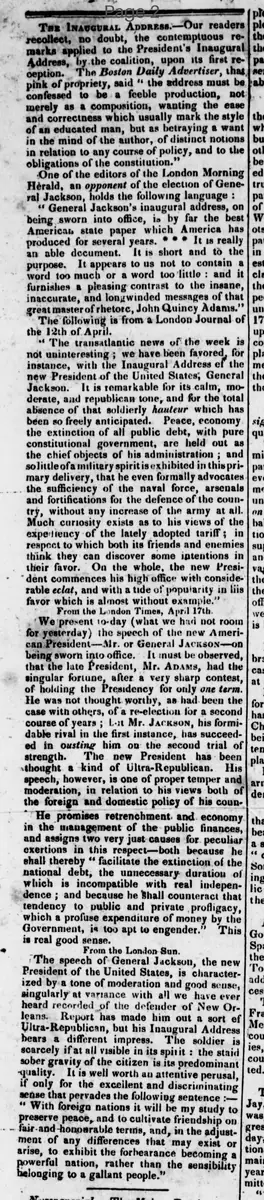
The Inaugural Address. - Our readers recollect, no doubt, the contemptuous remarks applied to the President's Inaugural Address, by the coalition, upon its first reception. The Boston Daily Advertiser, that pink of propriety, said 'the address must be confessed to be a feeble production, not merely as a composition, wanting the ease and correctness which usually mark the style of an educated man, but as betraying a want in the mind of the author, of distinct notions in relation to any course of policy, and to the obligations of the constitution.'
One of the editors of the London Morning Herald, an opponent of the election of General Jackson, holds the following language: 'General Jackson's inaugural address, on being sworn into office, is by far the best American state paper which America has produced for several years. * * * It is really an able document. It is short and to the purpose. It appears to us not to contain a word too much or a word too little: and it furnishes a pleasing contrast to the insane, inaccurate, and longwinded messages of that great master of rhetoric, John Quincy Adams.'
The following is from a London Journal of the 12th of April. 'The transatlantic news of the week is not uninteresting; we have been favored, for instance, with the Inaugural Address of the new President of the United States; General Jackson. It is remarkable for its calm, moderate, and republican tone, and for the total absence of that soldierly hauteur which has been so freely anticipated. Peace, economy the extinction of all public debt, with pure constitutional government, are held out as the chief objects of his administration; and so little of a military spirit is exhibited in this primary delivery, that he even formally advocates the sufficiency of the naval force, arsenals and fortifications for the defence of the country, without any increase of the army at all. Much curiosity exists as to his views of the expediency of the lately adopted tariff; in respect to which both its friends and enemies think they can discover some intentions in their favor. On the whole, the new President commences his high office with considerable eclat, and with a tide of popularity in his favor which is almost without example.'
From the London Times, April 17th. 'We present to-day (what we had not room or yesterday) the speech of the new American President -- Mr. or General Jackson -- on being sworn into office. It must be observed, that the late President, Mr. Adams, had the singular fortune, after a very sharp contest, of holding the Presidency for only one term. He was not thought worthy, as had been the case with others, of a re-election for a second course of years; but Mr. Jackson, his formidable rival in the first instance, has succeeded in ousting him on the second trial of strength. The new President has been thought a kind of Ultra-Republican. His speech, however, is one of proper temper and moderation, in relation to his views both of the foreign and domestic policy of his country. He promises retrenchment and economy in the management of the public finances, and assigns two very just causes for peculiar exertions in this respect -- both because he shall thereby facilitate the extinction of the national debt, the unnecessary duration of which is incompatible with real independence; and because he shall counteract that tendency to public and private profligacy, which a profuse expenditure of money by the Government, is too apt to engender.'
This is real good sense.
From the London Sun. 'The speech of General Jackson, the new President of the United States, is characterized by a tone of moderation and good sense, singularly at variance with all we have ever heard recorded of the defender of New Orleans. Report has made him out a sort of Ultra-Republican, but his Inaugural Address bears a different impress. The soldier is scarcely if at all visible in its spirit: the staid sober gravity of the citizen is its predominant quality. It is well worth an attentive perusal, if only for the excellent and discriminating sense that pervades the following sentence: -- "With foreign nations it will be my study to preserve peace, and to cultivate friendship on fair and honourable terms, and, in the adjustment of any differences that may exist or arise, to exhibit the forbearance becoming a powerful nation, rather than the sensibility belonging to a gallant people."'
One of the editors of the London Morning Herald, an opponent of the election of General Jackson, holds the following language: 'General Jackson's inaugural address, on being sworn into office, is by far the best American state paper which America has produced for several years. * * * It is really an able document. It is short and to the purpose. It appears to us not to contain a word too much or a word too little: and it furnishes a pleasing contrast to the insane, inaccurate, and longwinded messages of that great master of rhetoric, John Quincy Adams.'
The following is from a London Journal of the 12th of April. 'The transatlantic news of the week is not uninteresting; we have been favored, for instance, with the Inaugural Address of the new President of the United States; General Jackson. It is remarkable for its calm, moderate, and republican tone, and for the total absence of that soldierly hauteur which has been so freely anticipated. Peace, economy the extinction of all public debt, with pure constitutional government, are held out as the chief objects of his administration; and so little of a military spirit is exhibited in this primary delivery, that he even formally advocates the sufficiency of the naval force, arsenals and fortifications for the defence of the country, without any increase of the army at all. Much curiosity exists as to his views of the expediency of the lately adopted tariff; in respect to which both its friends and enemies think they can discover some intentions in their favor. On the whole, the new President commences his high office with considerable eclat, and with a tide of popularity in his favor which is almost without example.'
From the London Times, April 17th. 'We present to-day (what we had not room or yesterday) the speech of the new American President -- Mr. or General Jackson -- on being sworn into office. It must be observed, that the late President, Mr. Adams, had the singular fortune, after a very sharp contest, of holding the Presidency for only one term. He was not thought worthy, as had been the case with others, of a re-election for a second course of years; but Mr. Jackson, his formidable rival in the first instance, has succeeded in ousting him on the second trial of strength. The new President has been thought a kind of Ultra-Republican. His speech, however, is one of proper temper and moderation, in relation to his views both of the foreign and domestic policy of his country. He promises retrenchment and economy in the management of the public finances, and assigns two very just causes for peculiar exertions in this respect -- both because he shall thereby facilitate the extinction of the national debt, the unnecessary duration of which is incompatible with real independence; and because he shall counteract that tendency to public and private profligacy, which a profuse expenditure of money by the Government, is too apt to engender.'
This is real good sense.
From the London Sun. 'The speech of General Jackson, the new President of the United States, is characterized by a tone of moderation and good sense, singularly at variance with all we have ever heard recorded of the defender of New Orleans. Report has made him out a sort of Ultra-Republican, but his Inaugural Address bears a different impress. The soldier is scarcely if at all visible in its spirit: the staid sober gravity of the citizen is its predominant quality. It is well worth an attentive perusal, if only for the excellent and discriminating sense that pervades the following sentence: -- "With foreign nations it will be my study to preserve peace, and to cultivate friendship on fair and honourable terms, and, in the adjustment of any differences that may exist or arise, to exhibit the forbearance becoming a powerful nation, rather than the sensibility belonging to a gallant people."'
What sub-type of article is it?
Historical Event
What themes does it cover?
Triumph
Moral Virtue
What keywords are associated?
Inaugural Address
General Jackson
London Press
Political Moderation
Economy
Public Debt
What entities or persons were involved?
General Jackson
John Quincy Adams
Where did it happen?
United States
Story Details
Key Persons
General Jackson
John Quincy Adams
Location
United States
Story Details
American newspaper criticizes President Jackson's inaugural address as feeble and lacking policy clarity, while London papers praise it for moderation, brevity, focus on peace, economy, debt extinction, and absence of military tone.