Thank you for visiting SNEWPapers!
Sign up free
Story
October 25, 1862
The Shasta Courier
Shasta, Shasta County, California
What is this article about?
Archaeologists uncover skeletons of three fugitives, including a young girl with jewels, and a loyal dog in Pompeii ruins, illustrating the tragic flight from the volcanic eruption that buried the city.
Clipping
OCR Quality
95%
Excellent
Full Text
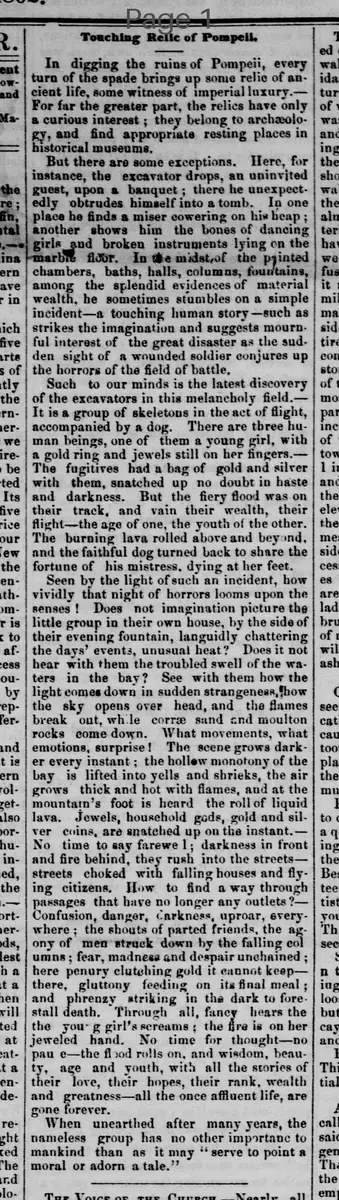
Touching Relic of Pompeii.
In digging the ruins of Pompeii, every turn of the spade brings up some relic of ancient life, some witness of imperial luxury.— For far the greater part, the relics have only a curious interest; they belong to archaeology, and find appropriate resting places in historical museums.
But there are some exceptions. Here, for instance, the excavator drops, an uninvited guest, upon a banquet; there he unexpectedly obtrudes himself into a tomb. In one place he finds a miser cowering on his heap; another shows him the bones of dancing girls and broken instruments lying on the marble floor. In the midst of the painted chambers, baths, halls, columns, fountains, among the splendid evidences of material wealth, he sometimes stumbles on a simple incident—a touching human story—such as strikes the imagination and suggests mournful interest of the great disaster as the sudden sight of a wounded soldier conjures up the horrors of the field of battle.
Such to our minds is the latest discovery of the excavators in this melancholy field.— It is a group of skeletons in the act of flight, accompanied by a dog. There are three human beings, one of them a young girl, with a gold ring and jewels still on her fingers.— The fugitives had a bag of gold and silver with them, snatched up no doubt in haste and darkness. But the fiery flood was on their track, and vain their wealth, their flight—the age of one, the youth of the other. The burning lava rolled above and beyond. and the faithful dog turned back to share the fortune of his mistress, dying at her feet.
Seen by the light of such an incident, how vividly that night of horrors looms upon the senses! Does not imagination picture the little group in their own house, by the side of their evening fountain, languidly chattering the day's events, unusual heat? Does it not hear with them the troubled swell of the waters in the bay? See with them how the light comes down in sudden strangeness, how the sky opens over head, and the flames break out, while cinders and molten rocks come down. What movements, what emotions, surprise! The scene grows darker every instant; the hollow monotony of the bay is lifted into yells and shrieks, the air grows thick and hot with flames, and at the mountain's foot is heard the roll of liquid lava. Jewels, household gods, gold and silver coins, are snatched up on the instant.— No time to say farewell! : darkness in front and fire behind. they rush into the streets— streets choked with falling houses and flying citizens. How to find a way through passages that have no longer any outlets? Confusion, danger, darkness, uproar, everywhere; the shouts of parted friends, the agony of men struck down by the falling columns; fear, madness and despair unchained here penury clutching gold it cannot keep— there, gluttony feeding on its last meal; and phrenzy striking in the dark to forestall death, Through all, fancy hears the young girl's screams : the fire is on her jeweled hand. No time for thought—no pause—the flood rolls on, and wisdom, beauty, age and youth, with all the stories of their love, their hopes, their rank, wealth and greatness—all the once affluent life, are gone forever.
When unearthed after many years, the nameless group has no other importance to mankind than as it may "serve to point a moral or adorn a tale."
In digging the ruins of Pompeii, every turn of the spade brings up some relic of ancient life, some witness of imperial luxury.— For far the greater part, the relics have only a curious interest; they belong to archaeology, and find appropriate resting places in historical museums.
But there are some exceptions. Here, for instance, the excavator drops, an uninvited guest, upon a banquet; there he unexpectedly obtrudes himself into a tomb. In one place he finds a miser cowering on his heap; another shows him the bones of dancing girls and broken instruments lying on the marble floor. In the midst of the painted chambers, baths, halls, columns, fountains, among the splendid evidences of material wealth, he sometimes stumbles on a simple incident—a touching human story—such as strikes the imagination and suggests mournful interest of the great disaster as the sudden sight of a wounded soldier conjures up the horrors of the field of battle.
Such to our minds is the latest discovery of the excavators in this melancholy field.— It is a group of skeletons in the act of flight, accompanied by a dog. There are three human beings, one of them a young girl, with a gold ring and jewels still on her fingers.— The fugitives had a bag of gold and silver with them, snatched up no doubt in haste and darkness. But the fiery flood was on their track, and vain their wealth, their flight—the age of one, the youth of the other. The burning lava rolled above and beyond. and the faithful dog turned back to share the fortune of his mistress, dying at her feet.
Seen by the light of such an incident, how vividly that night of horrors looms upon the senses! Does not imagination picture the little group in their own house, by the side of their evening fountain, languidly chattering the day's events, unusual heat? Does it not hear with them the troubled swell of the waters in the bay? See with them how the light comes down in sudden strangeness, how the sky opens over head, and the flames break out, while cinders and molten rocks come down. What movements, what emotions, surprise! The scene grows darker every instant; the hollow monotony of the bay is lifted into yells and shrieks, the air grows thick and hot with flames, and at the mountain's foot is heard the roll of liquid lava. Jewels, household gods, gold and silver coins, are snatched up on the instant.— No time to say farewell! : darkness in front and fire behind. they rush into the streets— streets choked with falling houses and flying citizens. How to find a way through passages that have no longer any outlets? Confusion, danger, darkness, uproar, everywhere; the shouts of parted friends, the agony of men struck down by the falling columns; fear, madness and despair unchained here penury clutching gold it cannot keep— there, gluttony feeding on its last meal; and phrenzy striking in the dark to forestall death, Through all, fancy hears the young girl's screams : the fire is on her jeweled hand. No time for thought—no pause—the flood rolls on, and wisdom, beauty, age and youth, with all the stories of their love, their hopes, their rank, wealth and greatness—all the once affluent life, are gone forever.
When unearthed after many years, the nameless group has no other importance to mankind than as it may "serve to point a moral or adorn a tale."
What sub-type of article is it?
Historical Event
Disaster
Curiosity
What themes does it cover?
Catastrophe
Tragedy
Misfortune
What keywords are associated?
Pompeii
Skeletons
Eruption
Fugitives
Dog
Lava
Disaster
Ancient Relics
What entities or persons were involved?
Young Girl
Two Companions
Faithful Dog
Where did it happen?
Ruins Of Pompeii
Story Details
Key Persons
Young Girl
Two Companions
Faithful Dog
Location
Ruins Of Pompeii
Story Details
Excavators discover skeletons of three fugitives including a young girl with gold ring and jewels, carrying a bag of gold and silver, accompanied by a dog that died at her feet, fleeing the volcanic eruption that buried them in lava.