Thank you for visiting SNEWPapers!
Sign up free
Virginia Argus
Richmond, Virginia
What is this article about?
London papers up to May 6, 1809, report the outbreak of war between Austria and France. Austrians under Archduke Charles advance into Bavaria, crossing the Inn River on April 9. Napoleon moves to join French forces, issuing decrees against traitors. Diplomatic efforts include British subsidies to Austria and Russian alignment with France. No major battles yet.
Merged-components note: Continuation of the 'Latest Foreign News' article across page 1 and 2, with sequential reading order.
Clippings
1 of 2
OCR Quality
Full Text
RICHMOND.
FRIDAY, JUNE 23, 1809.
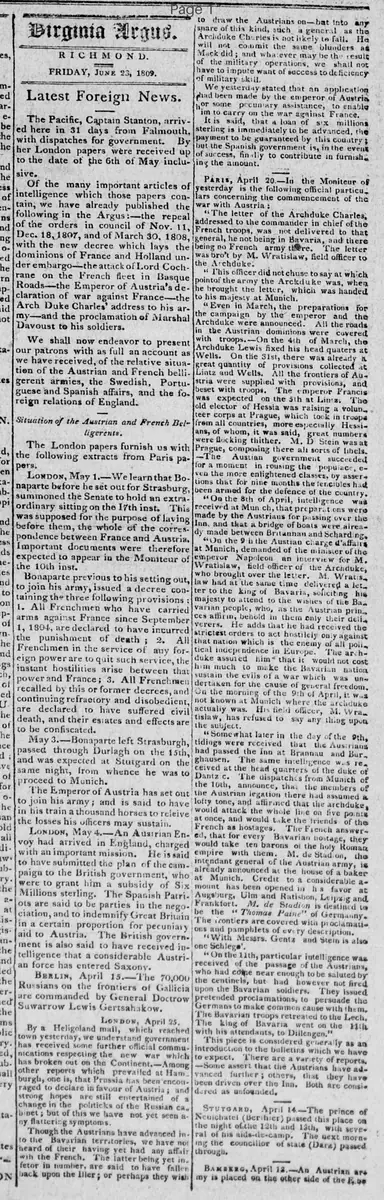
Latest Foreign News.
The Pacific, Captain Stanton, arrived here in 31 days from Falmouth, with dispatches for government. By her London papers were received up to the date of the 6th of May inclusive.
Of the many important articles of intelligence which those papers contain; we have already published the following in the Argus:--the repeal of the orders in council of Nov. 11, Dec. 18, 1807, and of March 30, 1808, with the new decree which lays the dominions of France and Holland under embargo--the attack of Lord Cochrane on the French fleet in Basque Roads--the Emperor of Austria's declaration of war against France--the Arch Duke Charles' address to his army--and the proclamation of Marshal Davoust to his soldiers.
We shall now endeavor to present our patrons with as full an account as we have received, of the relative situation of the Austrian and French belligerent armies, the Swedish, Portuguese and Spanish affairs, and the foreign relations of England.
Situation of the Austrian and French Belligerents.
The London papers furnish us with the following extracts from Paris papers.
London, May 1.--We learn that Bonaparte before he set out for Strasburg, summoned the Senate to hold an extraordinary sitting on the 17th inst. This was supposed for the purpose of laying before them, the whole of the correspondence between France and Austria. Important documents were therefore expected to appear in the Moniteur of the 10th inst.
Bonaparte previous to his setting out, to join his army, issued a decree containing the three following provisions: 1. All Frenchmen who have carried arms against France since September 1, 1804, are declared to have incurred the punishment of death; 2. All Frenchmen in the service of any foreign power are to quit such service, the instant hostilities arise between that power and France; 3. All Frenchmen recalled by this or former decrees, and continuing refractory and disobedient, are declared to have suffered civil death, and their estates and effects are to be confiscated.
May 3.--Bonaparte left Strasburg, passed through Donauworth on the 15th, and was expected at Stutgard on the same night, from whence he was to proceed to Munich.
The Emperor of Austria has set out to join his army; and is said to have in his train a thousand horses to relieve the losses his officers may sustain.
London, May 4. An Austrian Envoy had arrived in England, charged with an important mission. He is said to have submitted the plan of the campaign to the British government, who were to grant him a subsidy of Six Millions sterling. The Spanish Patriots are said to be parties in the negotiation, and to indemnify Great Britain in a certain proportion for pecuniary aid to Austria. The British government is also said to have received intelligence that a considerable Austrian force has entered Saxony.
Berlin, April 15. The 70,000 Russians on the frontiers of Gallicia are commanded by General Doctrow Suwarrow Lewis Gertschakow.
London, April 25.
By a Heligoland mail, which reached town yesterday, we understand government has received some further official communications respecting the new war which has broken out on the Continent. Among other reports which prevailed at Hamburg, one is, that Prussia has been encouraged to declare in favour of Austria; and strong hopes are still entertained of a change in the politicks of the Russian cabinet; but of this we have not yet seen any flattering symptoms.
Though the Austrians have advanced into the Bavarian territories, we have not heard of their having yet had any affair with the French. The latter being yet inferior in number, are said to have fallen back upon the Iller; or perhaps they wish to draw the Austrians on--but into any snare of this kind, such a general as the Archduke Charles is not likely to fall. He will not commit the same blunders as Mack did: and whatever may be the result of the military operations, we shall not have to impute want of success to deficiency of military skill.
We yesterday stated that an application had been made by the emperor of Austria for some pecuniary assistance, to enable him to carry on the war against France. It is said, that a loan of six millions sterling is immediately to be advanced, the payment to be guaranteed by this country; but the Spanish government is, in the event of success, finally to contribute in furnishing the amount.
Paris, April 20.--In the Moniteur of yesterday is the following official particulars concerning the commencement of the war with Austria:
"The letter of the Archduke Charles, addressed to the commander in chief of the French troops, was not delivered to that general, he not being in Bavaria, and there being no French army there. The letter was bro't by M. Wratislaw, field officer to the Archduke:
"This officer did not choose to say at which point of the army the Archduke was, when he brought the letter, which was handed to his majesty at Munich.
"Even in March, the preparations for the campaign by the emperor and the Archduke were announced. All the roads in the Austrian dominions were covered with troops.--On the 4th of March, the Archduke Lewis fixed his head quarters at Ulm. On the 31st, there was already a great quantity of provisions collected at Lintz and Ulm. All the frontiers of Austria were supplied with provisions, and beset with troops. The emperor Francis was expected on the 5th at Lintz. The old elector of Hessia was raising a volunteer corps at Prague, which took in troops from all countries, more especially Hessians, of whom, it was said, great numbers were flocking thither. M. De Stein was at Prague, composing there all sorts of libels.
-The Austrian government succeeded for a moment in rousing the populace, even the more enlightened classes, by assertions that for nine months the fencibles had been armed for the defence of the country.
"On the 8th of April, intelligence was received at Munich, that preparations were made by the Austrians for passing over the Inn, and that a bridge of boats were already made between Braunau and Scharding.
"On the 9th the Austrian charge d'affaires at Munich, demanded of the minister of the emperor Napoleon an interview for M. Wratislaw, field officer of the Archduke, who brought over the letter. M. Wratislaw had at the same time delivered a letter to the king of Bavaria, soliciting his majesty to attend to the wishes of the Bavarian people, who, as the Austrian princes affirm, behold in them only their deliverers. He adds that he had received the strictest orders to act hostilely only against that nation which is the enemy of all political independence in Europe.' The archduke assured him 'that it would not cost him much to make the Bavarian nation sustain the evils of a war which was undertaken for the cause of general freedom.'
On the morning of the 9th of April, it was not known at Munich where the archduke actually was. His field officer, M. Wratislaw, has refused to say any thing upon the subject.
"Somewhat later in the day of the 9th, tidings were received that the Austrians had passed the Inn at Braunau and Burghausen. The same intelligence was received at the head quarters of the duke of Dantzic. The dispatches from Munich of the 10th, announce, that the members of the Austrian legation there had assumed a lofty tone, and affirmed that the archduke would attack the whole line on five points at once, and would take the friends of the French as hostages. The French answered, that for every Bavarian hostage, they would take ten barons of the holy Roman empire with them. M. de Stadion, the intendant general of the Austrian army, is already announced at the house of a baker at Munich. Credit to a considerable amount has been opened in his favor at Augsburg, Ulm and Ratisbon, Leipzig and Frankfort. M. de Stadion is destined to be the "Thomas Paine" of Germany--The frontiers are covered with proclamations and pamphlets of every description.
"With Messrs. Gentz and Stein is also one Schlegel.
"On the 11th, particular intelligence was received of the passage of the Austrians, who had come near enough to be saluted by the sentinels, but had however not fired upon the Bavarian soldiers. They issued pretended proclamations, to persuade the Germans to make common cause with them. The Bavarian troops retreated to the Lech. The king of Bavaria went on the 11th with his attendants, to Donauworth."
This piece is considered generally as an introduction to the bulletins which we have to expect. There are a variety of reports.--Some assert that the Austrians have advanced further; others, that they have been driven over the Inn, Both are considered as unfounded.
Stutgard, April 14.--The prince of Neufchatel (Berthier) passed this place on the night of the 12th and 13th, with several of his aids-de-camp. The next morning the councillor of state (Dara) passed through.
Bamberg, April 13.--An Austrian army is placed on the other side of the Elbe
Towards the Saxon frontiers, on which the van was in Tischen, and also another corps, of which the main body was placed in the environs of Tobliz. Towards the frontiers of Franconia, two corps were cantoned, the one by Eibogen, the other by Plassen. The latter, which is the most numerous, has already advanced in the field, and appears disposed to advance toward Ratisbon. Many of the new raised fencibles are among these troops, which are daily exercised to the use of arms.
Every thing here at present is in repose. The right wing of the French army, which is in Franconia, stands at Amberg, and stretches itself to Ratisbon. The centre stands near Forcheim, and the left wing advanced towards the territory of Bayreuth. The advanced posts of the left wing advance to Hof, and this wing has been reinforced by a number of troops from Saxony. Betwixt the centre and the right wing stand some contingents belonging to the princes of the confederation of the Rhine.
AMSTERDAM, April 24. His majesty the emperor of France arrived at Ludwigsburg on the night of the 15th and 16th, and proceeded to Dillingen at 12 o'clock at noon. M. Duroc, the marshal of the palace, was with him. His majesty has ordered the Bavarian troops to take their ancient position by Strasburg, that the army may soon be in a condition to commence offensive operations with the greatest effect. The French headquarters are to be removed from Donauwerth to Ingolstadt, and so proceed forwards.
The Austrians appear, since they have crossed the Inn, to have daily fortified themselves, and to be desirous to advance slowly. Some blow cannot fail to be struck before long. Nothing of the kind had taken place on the departure of the last couriers, because the allied troops had elected to retreat on the approach of the enemy.
Dresden, April 16. We understand that a Russian army has assembled on the frontiers of Galicia, which is to enter that province on the commencement of war, to make common cause with France.
Munich, April 7. Early this morning, an express arrived from the army, with intelligence that the Austrians were advancing against Muhldorff and Wasserburg. A second express, this evening, states, that the Austrians are only making strong reconnoitring parties, upon which the departure of the court has been delayed.
Augsbourg, April 8. The headquarters of the duke of Rivoli were yesterday at Ulm.
HAMBURG, April 18. We stopped the Press yesterday afternoon to announce the arrival of Hamburg papers to the 20th inst. The only important intelligence they contain is, that the Russian Charge d'affaires at Vienna has declared, that the Emperor of Russia was determined, in the event of a war between Austria and France, to take part with the latter. We fear there is too much foundation for this statement, though its appearance in a paper so directly under French influence is certainly calculated to excite some doubts upon the subject.
May 3. Some more Dutch papers have been received, which contain interesting intelligence, but no account of any blow having been struck. The archduke Charles, according to the confession of the enemy, proceeds with great caution and deliberation, and appears to be strengthening his position between the Inn and the Iser. But the French seem to be very imperfectly acquainted with his movements or intentions. Of the positions of the French army we are furnished with more ample information. The main body of the enemy is on the left bank of the Danube, and it should seem as if they would endeavour this war to push forward in that direction. The Bavarians and Oudinot's corps were in Bavaria when the archduke crossed the Inn, but they fell back immediately to the Lech on purpose to draw the archduke on, in which case the French force on the north bank of the Danube would immediately have thrown itself in his rear. But his royal highness had too much sagacity to fall into the snare. The French force on the north bank of the Danube occupies a line from Bayreuth to Ratisbon. Bonaparte set off on the 16th for Dillingen, to which place the king of Bavaria had repaired on the 11th. He was to proceed from thence to Donauwerth and Ingolstadt.
One important circumstance we collect from these papers, that the Austrian government are not only acting with vigour in their military preparations, but that the appeal they have made to the people of Germany have produced a considerable impression.
FRANKFORT, April 18. Concerning the number of troops which have entered Bavaria the accounts are very different indeed. Some say that 60,000 passed the Inn at Braunau; but it is not said whether this was the whole or only part of the Austrian army.
Banks of the Lech, April 19. The army of the duke of Auerstadt (marshal Davoust) has concentrated itself in the environs of Donawerth, Ingolstadt, and Eichstadt, it is composed of about 70,000 choice troops, 20,000 of which are cavalry.
May 3. Letters from Heligoland of the 17th ult. state that the cause of Austria is extremely popular throughout the north of Germany. It does not appear, that up to the 16th a general action had taken place; yet a strong opinion was prevalent, in consequence of accounts from the Weser, that some important advantage had been gained by the Austrians about that time on the Lech. An argument in support of the opinion was the conduct of the gens d'armes and French custom-house officers on the coast opposite to Heligoland, who had packed up all their papers and moveable property. A number of them had abandoned their stations, and the others were in readiness to follow them.
London, April 25. A private letter from Holland, communicates some very interesting particulars respecting the detection of treachery on the part of some of the officers in the Austrian service. They state that a General Officer of Artillery, entrusted with the care of an extensive magazine, established near the frontiers of Bavaria, having corrupted several of the officers under his command, had formed a plan of delivering up that valuable depot, in which stores of all kinds were collected, to the enemy. A letter, fortunately intercepted, led to the discovery of the plot, and the traitor and his accomplices were secured and thrown into prison.
What sub-type of article is it?
What keywords are associated?
What entities or persons were involved?
Where did it happen?
Foreign News Details
Primary Location
Bavaria
Event Date
April May 1809
Key Persons
Outcome
no major battles reported; austrians advance into bavaria without significant engagements; french and bavarian forces retreat to the lech river; plot against austrian magazine uncovered and thwarted.
Event Details
Austria declares war on France; Archduke Charles leads Austrian forces across the Inn River into Bavaria on April 9, 1809, prompting Bavarian retreat. Napoleon issues decrees punishing French traitors and moves to join army in Germany. French forces under Davoust concentrate near Donauworth. British provide subsidy to Austria; Russia aligns with France; Prussian support for Austria rumored but uncertain. Austrian preparations and appeals to German people noted.