Thank you for visiting SNEWPapers!
Sign up free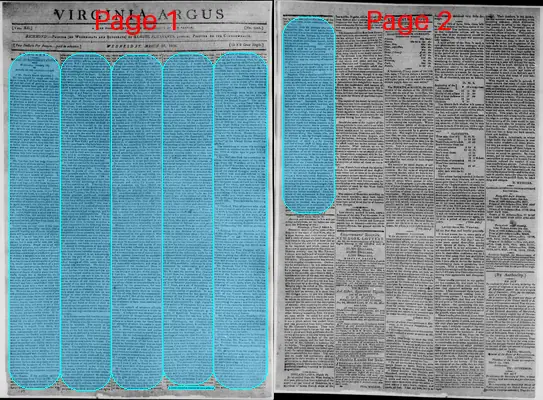
Virginia Argus
Richmond, Virginia
What is this article about?
In the U.S. House of Representatives on January 30, debate continues on the Georgia land claims. Mr. Clark argues against the claims due to fraud and speculation. Mr. Eustis defends the claimants as innocent purchasers without knowledge of fraud, advocating for equitable compromise from reserved funds. Mr. Jackson supports the committee report, refuting fraud allegations and citing historical context from 1795 proceedings.
Merged-components note: These components form a continuous narrative report of a congressional debate on the Georgia claims, spanning pages 1 and 2. The content is national political news, best classified as domestic_news rather than story.
Clippings
1 of 2
OCR Quality
Full Text
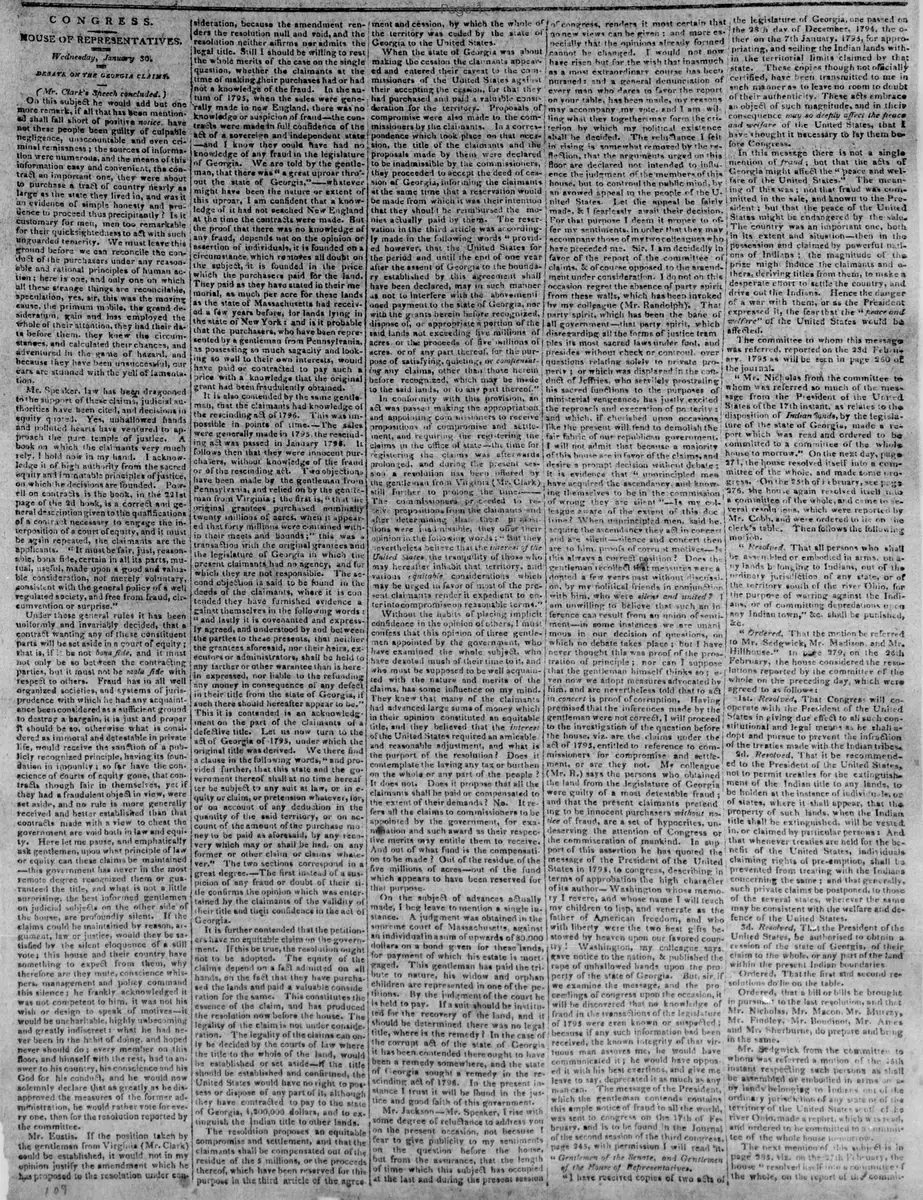
HOUSE OF REPRESENTATIVES
Wednesday, January 30.
DEBATE ON THE GEORGIA CLAIMS
(Mr. Clark's Speech concluded.)
On this subject he would add but one more remark, if all that has been mentioned shall fall short of positive notice, have not these people been guilty of culpable negligence, unaccountable and even criminal remissness; the sources of information were numerous, and the means of this information easy and convenient, the contract an important one, they were about to purchase a tract of country nearly as large as the state they lived in, and was it an evidence of simple honesty and prudence to proceed thus precipitantly? Is it customary for men, men too remarkable for their quicksightedness to act with such unguarded temerity. We must leave this ground before we can reconcile the conduct of the purchasers under any reasonable and rational principles of human action; here is one, and only one on which all these strange things are reconcilable, speculation, yes, sir, this was the moving cause, the primum mobile, the grand desideratum, gain and loss employed the whole of their attention, they had their data before them, they knew the circumstances, and calculated their chances, and adventured in the game of hazard, and because they have been unsuccessful, our ears are stunned with the yell of lamentation.
Mr. Speaker, law has been dragooned to the support of these claims, judicial authorities have been cited, and decisions in equity quoted. Yes, unhallowed hands and polluted hearts have ventured to approach the pure temple of justice. A book on which the claimants very much rely, I hold now in my hand. I acknowledge it of high authority from the sacred equity and immutable principles of justice, on which its decisions are founded. Powell on Contracts is the book, in the 221st page of the 2d book, is a correct and general description given to the qualifications of a contract necessary to engage the interposition of a court of equity, and it must be again repeated, the claimants are the applicants. "It must be fair, just, reasonable, bona fide, certain in all its parts, mutual, useful, made upon a good and valuable consideration, not merely voluntary, consistent with the general policy of a well regulated society, and free from fraud, circumvention or surprise."
Under those general rules it has been uniformly and invariably decided, that a contract wanting any of these constituent parts will be set aside in a court of equity: that is, if it be not bona fide, and it must not only be so between the contracting parties, but it must not be mala fide with respect to others. Fraud has in all well organized societies, and systems of jurisprudence with which he had any acquaintance been considered as a sufficient ground to destroy a bargain, it is just and proper it should be so, otherwise what is considered as immoral and detestable in private life, would receive the sanction of a publicly recognized principle, having its foundation in impunity: so far have the consciences of courts of equity gone, that contracts though fair in themselves, yet if they had a fraudulent object in view, were set aside, and no rule is more generally received and better established than that contracts made with a view to cheat the government are void both in law and equity. Here let me pause, and emphatically ask gentlemen, upon what principle of law or equity can these claims be maintained -this government has never in the most remote degree recognized them or guaranteed the title, and what is not a little surprising, the best informed gentlemen on judicial subject, on the other side of the house, are profoundly silent. If the claims could be maintained by reason, argument, law or justice, would they be satisfied by the silent eloquence of a still vote; this house and their country have something to expect from them, why therefore are they mute, conscience whispers, management and policy command this silence; he frankly acknowledged it was not competent to him, it was not his wish or design to speak of motives-it would be uncharitable, highly unbecoming and greatly indiscreet: what he had never been in the habit of doing, and hoped never should do; every member on this floor, and himself with the rest, had to answer to his country, his conscience and his God for his conduct, and he would now solemnly declare that as greatly as he disapproved the measures of the former administration, he would rather vote for every one, than for the resolution reported by the committee.
Mr. Eustis. If the position taken by the gentleman from Virginia (Mr. Clark) could be established, it would not in my opinion justify the amendment which he has proposed to the resolution under consideration, because the amendment renders the resolution null and void, and the resolution neither affirms nor admits the legal title. Still I should be willing to rest the whole merits of the case on the single question, whether the claimants at the time of making their purchases had or had not a knowledge of the fraud. In the autumn of 1795, when the sales were generally made in New England, there was no knowledge or suspicion of fraud the contracts were made in full confidence of the act of a sovereign and independent state —and I know there could have had no knowledge of any fraud in the legislature of Georgia. We are told by the gentleman, that there was "a great uproar through out the state of Georgia," -whatever might have been the nature or extent of this uproar, I am confident that a knowledge of it had not reached New England at the time the contracts were made. But the proof that there was no knowledge of any fraud, depends not on the opinion or assertion of individuals, it is founded on a circumstance, which removes all doubt on the subject, it is founded in the price which the purchasers paid for the land. They paid as they have stated in their memorial, as much per acre for these lands as the state of Massachusetts had received a few years before, for lands lying in the state of New York: and is it probable that the purchasers, who have been represented by a gentleman from Pennsylvania, as possessing so much sagacity and looking so well to their own interests, would have paid or contracted to pay such a price with a knowledge that the original grant had been fraudulently obtained.
It is also contended by the same gentleman, that the claimants had knowledge of the rescinding act of 1796. This was impossible in points of time. The sales were generally made in 1795, the rescinding act was passed in January 1796. It follows then that they were innocent purchasers, without knowledge of the fraud or of the rescinding act. Two objections have been made by the gentleman from Pennsylvania, and relied on by the gentleman from Virginia; the first is, "that the original grantees purchased nominally twenty millions of acres, when it appeared that forty millions were contained within their meets and bounds;" this was a transaction with the original grantees and the legislature of Georgia in which the present claimants had no agency, and for which they are not responsible. The second objection is said to be found in the deeds of the claimants, where it is contended they have furnished evidence against themselves in the following words: "and lastly it is covenanted and expressly agreed, and understood by and between the parties to these presents, that neither the grantees aforesaid, nor their heirs, executors or administrators, shall be held to any farther or other warranty than is herein expressed, nor liable to the refunding any money in consequence of any defect in their title from the state of Georgia, if such there should hereafter appear to be."
This it is contended is an acknowledgment on the part of the claimants of a defective title. Let us now turn to the act of Georgia of 1795, under which the original title was derived. We there find a clause in the following words, "and provided further, that this state and the government thereof shall at no time hereafter be subject to any suit at law, or in equity or claim, or pretension whatever, for, or on account of any deduction in the quantity of the said territory, or on account of the amount of the purchase money to be paid as aforesaid, by any recovery which may or shall be had, on any former or other claim or claims whatever." The two sections correspond in a great degree.--The first instead of a suspicion of any fraud or doubt of their title confirms the opinion which was entertained by the claimants of the validity of their title and their confidence in the act of Georgia.
It is further contended that the petitioners have no equitable claim on the government. If this be true, the resolution ought not to be adopted. The equity of the claims depend on a fact admitted on all hands, on the fact that they have purchased the lands and paid a valuable consideration for the same. This constitutes the essence of the claim, and has produced the resolution now before the house. The legality of the claim is not under consideration. The legality of the claims can only be decided by the courts of law where the title to the whole of the land, would be established or set aside-if the title should be established and confirmed, the United States would have no right to possess or dispose of any part of it, although they have contracted to pay to the state of Georgia, 1,200,000 dollars, and to extinguish the Indian title to other lands. The resolution proposes an equitable compromise and settlement, and that the claimants shall be compensated out of the residue of the 5 millions, or the proceeds thereof, which have been reserved for this purpose in the third article of the agreement and cession, by which the whole or the territory was ceded by the state of Georgia to the United States.
When the state of Georgia was about making the cession the claimants appeared and entered their caveat to the commissioners of the United States against their accepting the cession, or that they had purchased and paid a valuable consideration for the territory. Proposals of compromise were also made to the commissioners by the claimants. In a correspondence which took place on that occasion, the title of the claimants and the proposals made by them were declared to be inadmissible by the commissioners, they proceeded to accept the deed of cession of Georgia, informing the claimants at the same time that a reservation would be made from which it was their intention that they should be reimbursed the moneys actually paid by them. The reservation in the third article was accordingly made in the following words "provided however, that the United States for the period and until the end of one year after the assent of Georgia to the boundary established by this agreement shall have been declared, may in such manner as not to interfere with the- abovementioned payment to the state of Georgia, nor with the grants herein before recognized, dispose of, or appropriate a portion of the said lands not exceeding five millions of acres. or the proceeds of five millions of acres. or of any part thereof, for the purpose of satisfying, quieting, or compensating any claims, other than those herein before recognized, which may be made to the said lands, or to any part thereof."
In conformity with this provision, an act was passed making the appropriation and appointing Commissioners to receive propositions of compromise and settlement, and requiring the registering the claims in the office of state-the time for registering the claims was afterwards prolonged, and during the present session a resolution has been offered by the gentleman from Virginia (Mr. Clark) still further to prolong the time.--- The commissioners proceeded to receive propositions from the claimants and after determining that their propositions were inadmissible, they offer their opinion in the following words; "But they nevertheless believe that the interest of the United States, the tranquility of those who may hereafter inhabit that territory. and various equitable considerations which may be urged in favor of most of the present claimants render it expedient to enter into compromise on reasonable terms."
Without the habit of placing implicit confidence in the opinion of others, I must confess that this opinion of three gentlemen appointed by the government, who have examined the whole subject, who have devoted much of their time to it, and who must be supposed to be well acquainted with the nature and merits of the claims, has some influence on my mind. They knew that many of the claimants had advanced large sums of money which in their opinion constituted an equitable title, and they believed that the interest of the United States required an amicable and reasonable adjustment, and what is the purport of the resolution? Does it contemplate the laying any tax or burthen on the whole or any part of the people? It does not. Does it propose that all the claimants shall be paid or compensated to the extent of their demands? No. It refers all the claims to commissioners to be appointed by the government, for examination and such award as their respective merits may entitle them to receive. And out of what fund is the compensation to be made? Out of the residue of the five millions of acres-out of the fund which appears to have been reserved for that purpose.
On the subject of advances actually made, I beg leave to mention a single instance. A judgment was obtained in the supreme court of Massachusetts, against an individual in a sum of upwards of 50,000 dollars on a bond given for these lands, for payment of which his estate is mortgaged. This gentleman has paid the tribute to nature, his widow and orphan children are represented in one of the petitions. By the judgment of the court he is held to pay. If a suit should be instituted for the recovery of the land, and it should be determined there was no legal title, where is the remedy? In the case of the corrupt act of the state of Georgia it has been contended there ought to have been a remedy somewhere, and the state of Georgia sought a remedy in the rescinding act of 1796. In the present instance I trust it will be found in the justice and good faith of this government.
Mr. Jackson--Mr. Speaker, I rise with some degree of reluctance to address you on the present occasion, not because I fear to give publicity to my sentiments on the question before the house, but from the assurance, that the length of time which this subject has occupied at the last and during the present session of congress, renders it most certain that no new views can be given: and more especially that the opinions already formed cannot be changed. I would not now have risen but for the wish that inasmuch as a most extraordinary course has been pursued: and a general denunciation of every man who dares to favor the report on your table, has been made, my reasons may accompany my vote. and I am willing what they together may form the criterion by which my political existence shall be decided. The reluctance I felt in rising is somewhat removed by the reflection, that the arguments urged on this floor are declared not intended to influence the judgment of the members of this house, but to control the public mind, by an avowed appeal to the people of the United States. Let the appeal be fairly made. & I fearlessly await their decision. For that purpose I deem it proper to offer my sentiments. in order that they may accompany those of my two colleagues who have preceded me. Sir, I am decidedly in favor of the report of the committee of claims. & of course opposed to the amendment under consideration. I do not on this occasion regret the absence of party spirit from these walls, which has been invoked by my colleague (Mr. Randolph). That party spirit, which has been the bane of all government--that party spirit. which disregarding all the forms of justice tramples its most sacred laws under foot, and presides without check or control. over questions relating solely to private property ; or which was displayed in the conduct of Jeffries, who servilely prostrating his sacred functions to the purposes of ministerial vengeance. has justly excited the reproach and execration of posterity : and which, if cherished upon occasions like the present will. tend to demolish the fair fabric of our republican government.
I will not admit that because a majority of this house are in favor of the claims. and desire a prompt decision without debate; it is evidence that" unprincipled men have acquired the ascendancy. and knowing themselves to be in the commission of wrong they are silent "Is my colleague aware of the' extent of this doctrine? When unprincipled men. said he. acquire the ascendancy they act in concert and are silent--silence and concert then are to him. proofs of corrupt motives-r-is this always a correct position? Does the gentleman recollect that measures were adopted a few years past without discussion. by my political friends in conjunction with him, who were silent and united ? I am unwilling to believe that such an inference can result from an union of sentiment-.in some instances we are unanimous in our decision of questions, on which no debate takes place : but I have never thought this was proof of the prostration of principle; nor can I suppose that the gentleman himself thinks so; even now we adopt measures advocated by him, and are nevertheless told that to act in concert is proof of corruption. Having premised that the inferences made by the gentleman were not correct, I will proceed to the investigation of the question before the house. viz. are the claims under the act of 1795, entitled to reference to commissioners for compromise and settlement, or are they not. My colleague (Mr, R.) says the persons who obtained the land from the legislature of Georgia were guilty of a most detestable fraud : and that the present claimants pretending to be innocent purchasers without notice of fraud, are a set of hypocrites. undeserving the attention of Congress or the commiseration of mankind. In support of this assertion he has quoted the message of the President of the United States in 1795, to congress, describing in terms of approbation the high character of its author- Washington whose memory I revere, and whose name I will teach my children to lisp, and venerate as the father of American freedom, and who with liberty were the two best gifts bestowed by heaven upon our favored country! Washington, my colleague says. gave notice to the nation, & published the rape of unhallowed hands upon the property of the state of Georgia. But, sir, if we examine the message, and the proceedings of congress upon the occasion, it will be discovered that no knowledge of fraud in the transactions of the legislature of 1795 were even known or suspected; because if any such information had been received, the known integrity of that virtuous man assures me, he would have communicated it; he would have opposed it with his best exertions, and give me leave to say, deprecated it as much as any man can. The message of the President, which the gentleman contends contains this ample notice of fraud to all the world, was sent to congress on the 17th of February, and is to be found in the Journal of the second session of the third congress. page 255, with permission I will read it.
"Gentlemen of the Senate, and Gentlemen
I have received copies of two acts of the legislature of Georgia, one passed on the 28th day of December, 1794. the other on the 7th January, 1795, for appropriating. and selling the Indian lands within the territorial limits claimed by that state. These copies though not official certified, have been transmitted to me in such manner as to leave no room to doubt of their authenticity. These acts embrace an object of such magnitude. and in their consequence may so deeply affect the peace and welfare of the United States, that I have thought it necessary to lay them before Congress.
In this message there is not a single mention of fraud : but that the acts of Georgia might affect the "peace and welfare of the United States." The meaning of this was; not that fraud was committed in the sale, and known to the President : but that the peace of the United States might be endangered by the sale. The country was an important one, both in its extent and situation--then in the possession and claimed by powerful nations of Indians ; the magnitude of the prize might induce the claimants and others, deriving titles from them, to make a desperate effort to settle the country, and drive out the Indians. Hence the danger of a war with them, or as the President expressed it, the fear that the "peace and welfare" of the United States would be affected.
The committee to whom this message was referred, reported on the 23d February. 1795 as will be seen in page 260 of the journal.
"Mr. Nicholas from the committee to whom was referred so much of the message from the President of the United States of the 17th instant. as relates to the disposition of Indian Lands, by the legislature of the state of Georgia, made a report which was read and ordered to be committed to a committee of the whole house to morrow." On the next day, page 271, the house resolved itself into a committee of the whole, and made some progress. On the 25th of February, see page 376. the house again resolved itself into a committee of the whole, and came to several resolutions, which were reported by Mr. Cobb, and were ordered to lie on the clerk's table. Then follows the following motion.
"Resolved, That all persons who shall be assembled or embodied in arms. on any lands belonging to Indians, out of the ordinary jurisdiction of any state, or of the territory south of the river Ohio, for the purpose of warring against the Indians, or of committing depredations upon any Indian town," &c. shall be punished, &c.
"Ordered, That the motion be referred to Mr. Sedgwick, Mr. Madison, and Mr. Hillhouse." in page 279, on the 26th February, the house considered the resolutions reported by the committee of the whole on the preceding day, which were agreed to as follows:
1st. Resolved, That Congress will co-operate with the President of the United States in giving due effect to all such constitutional and legal means as he shall adopt and pursue to prevent the infraction of the treaties made with the Indian tribes.
2d. Resolved, That it be recommended to the President of the United States, not to permit treaties for the extinguishment of the Indian title to any lands, to be holden at the instance of individuals, or of states, where it shall appear, that the property of such lands, when the Indian title shall be extinguished, will be vested in, or claimed by particular persons : And that whenever treaties are held for the benefit of the United States, individuals claiming rights of pre-emption, shall be prevented from treating with the Indians concerning the same; and that generally, such private claims be postponed, to those of the several states, wherever the same may be consistent with the welfare and defence of the United States.
3d. Resolved, That the President of the United States, be authorised to obtain a cession of the state of Georgia, of their claim to the whole, or any part of the land within the present Indian boundaries.
Ordered, That the first and second resolutions do lie on the table.
Ordered, that a bill or bills be brought in pursuant to the last resolution, and that Mr. Nicholas, Mr. Macon, Mr. Murray, Mr. Findley. Mr. Boudinot, Mr. Ames and Mr. Sherburne, do prepare and bring in the same.
Mr. Sedgwick from the committee: to whom was referred a motion of the 25th instant respecting such persons as shall be assembled or embodied in arms on any lands belonging to Indians out of the ordinary jurisdiction of any state or of the territory of the United States south of the river Ohio, made a report, which was read, and ordered to be committed to a committee of the whole house to-morrow.
The next mention of this subject is in page 285, viz. on the 27th February, the house resolved itself into a committee of the whole, on the report of the committee.
Free to whom was referred a motion of the 25th, and came to the resolution contained in page 391.
Resolved, That all persons who unauthorized by law, and with hostile intent, may be found in arms on any lands allotted or secured to the Indians by treaties between the United States and any Indian tribes, shall on conviction thereof, forfeit a sum not exceeding dollars, and be imprisoned not exceeding months, unless it shall be in continuation of a pursuit to a distance not exceeding miles beyond the line of the particular Indians who shall have recently committed murder, or may be carrying off captives or plunder.
The second resolution being again read, and amended at the clerk's table, was on the question put thereupon agreed to by the house as followeth:
Resolved, That it shall be lawful for the military force of the United States to apprehend every person or persons found in arms, as aforesaid, and him or them to convey to the civil authority of the United States, within some one of the states, who shall, by such authority, be secured to be tried in manner and form as is provided in and by the act, intituled, 'An act to regulate trade and intercourse with the Indian tribes.' Provided, That no person shall be confined after his arrest, and before his removal, more than days.
Here then is a faithful abstract of the whole proceedings, evincive of the intention of the President and congress, and it most clearly appears, that these proceedings had no reference to any fraud. The primary object and whole intention to be collected from them, was to prevent the settlement of the country by individuals, either by waging war against the Indians, or extinguishing the Indian title, and to prevent a sale by Georgia, except to the United States, of their remaining undisposed of territory; for Georgia still had a large tract of land, after the passage of the act of 1795. But says my colleague, Congress resolved to apply for the purchase of all the territory in question, and this is notice to the claimants who now are before us. Sir, the gentleman mistakes the resolution. It is 'that the President of the United States be authorized to obtain a cession from the state of Georgia, of (mark the expressions) their claim to the whole, or any part of the land within the Indian boundaries;' here is a most substantial distinction between the case put by my colleague, and the one stated in the resolve, it is not authorizing the purchase from Georgia of all, or part of the territory in question; but of their claim to all or any part of the land within the Indian boundaries. From the whole of the documents it does appear that neither the President, nor Congress, knew there was fraud, or that any notice express or implied was given, that the measure originated in corruption; and it does not by any means appear that the present claimants had such notice.
(Speech to be continued.)
What sub-type of article is it?
What keywords are associated?
What entities or persons were involved?
Where did it happen?
Domestic News Details
Primary Location
United States House Of Representatives
Event Date
Wednesday, January 30.
Key Persons
Outcome
ongoing debate on resolution for equitable compromise of georgia land claims; no final decision reported.
Event Details
Debate in the House of Representatives on the Georgia Claims, involving arguments about fraud in 1795 land sales, innocence of purchasers, equity for compensation from reserved funds, and historical context from 1795 congressional proceedings.