Thank you for visiting SNEWPapers!
Sign up free
Editorial
September 9, 1808
Norfolk Gazette And Publick Ledger
Norfolk, Virginia
What is this article about?
Editorial argues that administration's war rhetoric against Britain is a ploy to counter growing opposition to the embargo, dismissing Chesapeake, Orders in Council, and impressment as insufficient new causes for war.
Clipping
OCR Quality
95%
Excellent
Full Text
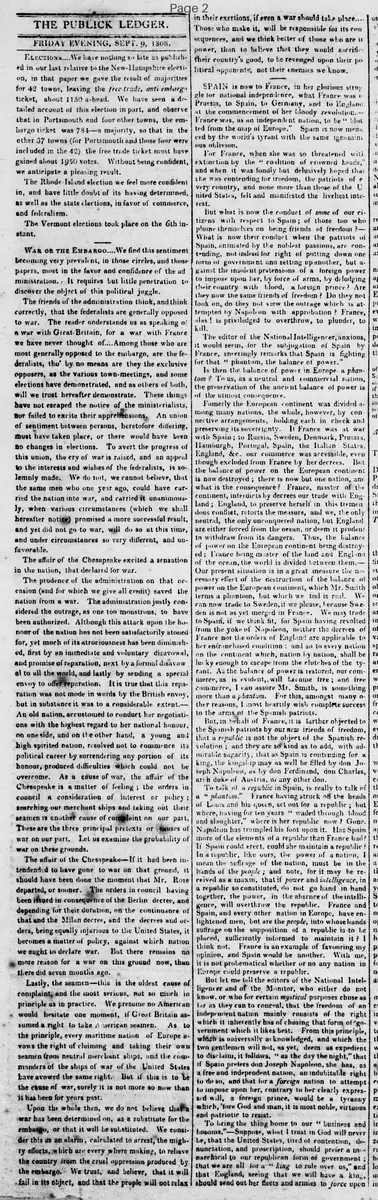
War on The Embargo.—We find this sentiment becoming very prevalent, in those circles, and those papers, most in the favor and confidence of the administration. It requires but little preparation to discover the object of this political juggle.
The friends of the administration think, and think correctly, that the federalists are generally opposed to war. The reader understands us as speaking of a war with Great-Britain, for a war with France we have never thought of....Among those who are most generally opposed to the embargo, are the federalists, tho' by no means are they the exclusive opposers, as the various town-meetings, and some elections have demonstrated, and as others of both, will we trust hereafter demonstrate. These things have not escaped the notice of the ministerialists. Nor failed to excite their apprehensions. An union of sentiment between persons, heretofore differing, must have taken place, or there would have been no changes in elections. To avert the progress of this union, the cry of war is raised, and an appeal to the interests and wishes of the federalists, is solemnly made. We do not, we cannot believe, that the same men who one year ago, could have carried the nation into war, and carried it unanimously, when various circumstances (which we shall hereafter notice) promised a more successful result and yet did not go to war, will do so at this time, and under circumstances so very different, and unfavorable.
The affair of the Chesapeake excited a sensation in the nation, that declared for war. The prudence of the administration on that occasion (and for which we give all credit) saved the nation from a war. The administration justly considered the outrage, as one too monstrous, to have been authorized. Although this attack upon the honour of the nation has not been satisfactorily atoned for, yet much of its atrociousness has been diminished, first by an immediate and voluntary disavowal, and promise of reparation, next by a formal disavowal to all the world, and lastly by sending a special envoy to offer reparation. It is true that this reparation was not made in words by the British envoy, but in substance it was to a considerable extent.— An old nation, accustomed to conduct her negotiations with the highest regard to her national honour, on one side, and on the other hand, a young and high spirited nation, resolved not to commence its political career by surrendering any portion of its honour, produced difficulties which could not be overcome. As a cause of war, the affair of the Chesapeake is a matter of feeling; the orders in council a consideration of interest or policy; searching our merchant ships and taking out their seamen is another cause of complaint on our part. These are the three principal pretexts or causes of war on our part. Let us examine the probability of war on these grounds.
The affair of the Chesapeake—If it had been intended to have gone to war on that ground, it should have been done the moment that Mr. Rose departed, or sooner. The orders in council having been issued in consequence of the Berlin decree, and depending on their duration, on the continuance of that and the Milan decree, and the decrees and orders, being equally injurious to the United States, it becomes a matter of policy, against which nation we ought to declare war. But there remains no more reason for a war on this ground now, than there did seven months ago.
Lastly, the seamen—this is the oldest cause of complaint, and the most serious, not so much in principle as in practice. We presume no American would hesitate one moment, if Great Britain assumed a right to take American seamen. As to the principle, every maritime nation of Europe avows the right of claiming and taking their own seamen from neutral merchant ships, and the commanders of the ships of war of the United States have avowed the same right. But if this is to be the cause of war, surely it is not more so now than it has been for years past.
Upon the whole then, we do not believe that a war has been determined on, as a substitute for the embargo, or that it will be substituted. We consider this as an alarm, calculated to arrest, the mighty efforts, which are every where making, to relieve the country from the cruel oppression produced by the embargo. We trust, and believe, that it will fail in its object, and that the people will not relax in their exertions. If even a war should take place.... Those who make it, will be responsible for its consequences, and we think better of those who are in power, than to believe that they would sacrifice their country's good, to be revenged upon their political opponents, not their enemies we know.
The friends of the administration think, and think correctly, that the federalists are generally opposed to war. The reader understands us as speaking of a war with Great-Britain, for a war with France we have never thought of....Among those who are most generally opposed to the embargo, are the federalists, tho' by no means are they the exclusive opposers, as the various town-meetings, and some elections have demonstrated, and as others of both, will we trust hereafter demonstrate. These things have not escaped the notice of the ministerialists. Nor failed to excite their apprehensions. An union of sentiment between persons, heretofore differing, must have taken place, or there would have been no changes in elections. To avert the progress of this union, the cry of war is raised, and an appeal to the interests and wishes of the federalists, is solemnly made. We do not, we cannot believe, that the same men who one year ago, could have carried the nation into war, and carried it unanimously, when various circumstances (which we shall hereafter notice) promised a more successful result and yet did not go to war, will do so at this time, and under circumstances so very different, and unfavorable.
The affair of the Chesapeake excited a sensation in the nation, that declared for war. The prudence of the administration on that occasion (and for which we give all credit) saved the nation from a war. The administration justly considered the outrage, as one too monstrous, to have been authorized. Although this attack upon the honour of the nation has not been satisfactorily atoned for, yet much of its atrociousness has been diminished, first by an immediate and voluntary disavowal, and promise of reparation, next by a formal disavowal to all the world, and lastly by sending a special envoy to offer reparation. It is true that this reparation was not made in words by the British envoy, but in substance it was to a considerable extent.— An old nation, accustomed to conduct her negotiations with the highest regard to her national honour, on one side, and on the other hand, a young and high spirited nation, resolved not to commence its political career by surrendering any portion of its honour, produced difficulties which could not be overcome. As a cause of war, the affair of the Chesapeake is a matter of feeling; the orders in council a consideration of interest or policy; searching our merchant ships and taking out their seamen is another cause of complaint on our part. These are the three principal pretexts or causes of war on our part. Let us examine the probability of war on these grounds.
The affair of the Chesapeake—If it had been intended to have gone to war on that ground, it should have been done the moment that Mr. Rose departed, or sooner. The orders in council having been issued in consequence of the Berlin decree, and depending on their duration, on the continuance of that and the Milan decree, and the decrees and orders, being equally injurious to the United States, it becomes a matter of policy, against which nation we ought to declare war. But there remains no more reason for a war on this ground now, than there did seven months ago.
Lastly, the seamen—this is the oldest cause of complaint, and the most serious, not so much in principle as in practice. We presume no American would hesitate one moment, if Great Britain assumed a right to take American seamen. As to the principle, every maritime nation of Europe avows the right of claiming and taking their own seamen from neutral merchant ships, and the commanders of the ships of war of the United States have avowed the same right. But if this is to be the cause of war, surely it is not more so now than it has been for years past.
Upon the whole then, we do not believe that a war has been determined on, as a substitute for the embargo, or that it will be substituted. We consider this as an alarm, calculated to arrest, the mighty efforts, which are every where making, to relieve the country from the cruel oppression produced by the embargo. We trust, and believe, that it will fail in its object, and that the people will not relax in their exertions. If even a war should take place.... Those who make it, will be responsible for its consequences, and we think better of those who are in power, than to believe that they would sacrifice their country's good, to be revenged upon their political opponents, not their enemies we know.
What sub-type of article is it?
War Or Peace
Foreign Affairs
Economic Policy
What keywords are associated?
Embargo
War With Britain
Chesapeake Affair
Federalists
Impressment
Orders In Council
What entities or persons were involved?
Administration
Federalists
Great Britain
Mr. Rose
Editorial Details
Primary Topic
Skepticism Toward War As Substitute For Embargo
Stance / Tone
Opposed To War, Critical Of Administration's Tactics
Key Figures
Administration
Federalists
Great Britain
Mr. Rose
Key Arguments
Federalists Generally Opposed To War With Great Britain
Embargo Opposition Unites Differing Groups, Alarming Administration
Chesapeake Affair Diminished In Severity Due To British Disavowals And Offers Of Reparation
Orders In Council And French Decrees Equally Injurious, No New Reason For War Now
Impressment Of Seamen Longstanding Issue, Not More Pressing Currently
War Cry Raised To Halt Anti Embargo Efforts, But Unlikely To Succeed