Thank you for visiting SNEWPapers!
Sign up free
Portage Sentinel
Ravenna, Portage County, Ohio
What is this article about?
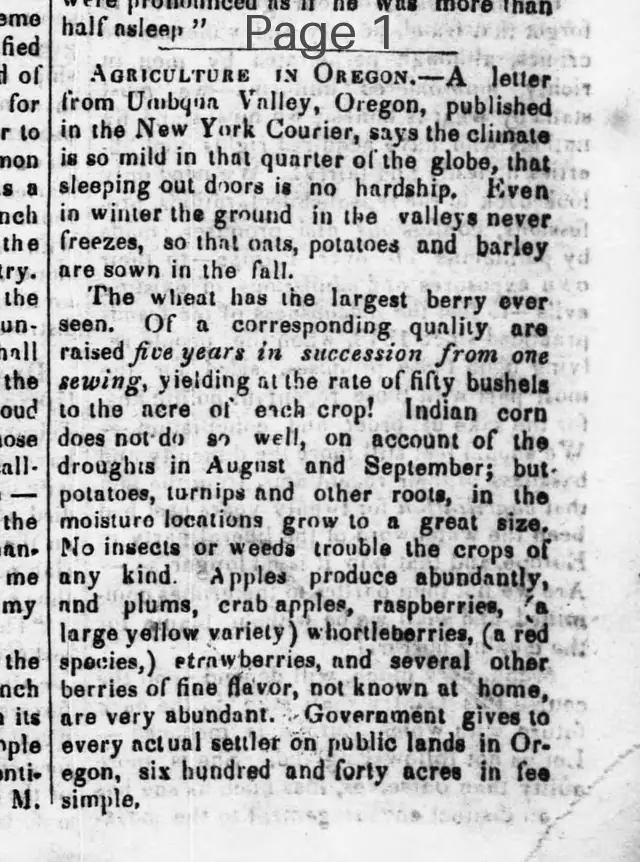
Letter from Umpqua Valley, Oregon, highlights mild climate for year-round farming, exceptional wheat yields of 50 bushels/acre for five years from one seeding, large root crops, abundant fruits with no pests, and U.S. government granting 640 acres to settlers on public lands.
Clipping
OCR Quality
Full Text
The wheat has the largest berry ever seen. Of a corresponding quality are raised five years in succession from one seeding, yielding at the rate of fifty bushels to the acre of each crop! Indian corn does not do so well, on account of the droughts in August and September; but potatoes, turnips and other roots, in the moisture locations grow to a great size. No insects or weeds trouble the crops of any kind. Apples produce abundantly, and plums, crab apples, raspberries (large yellow variety), whortleberries (a red species), strawberries, and several other berries of fine flavor, not known at home, are very abundant. Government gives to every actual settler on public lands in Oregon, six hundred and forty acres in fee simple.
What sub-type of article is it?
What keywords are associated?
Where did it happen?
Domestic News Details
Primary Location
Umpqua Valley, Oregon
Outcome
wheat yields fifty bushels to the acre for five years from one seeding; potatoes, turnips, and roots grow to great size; apples, plums, crab apples, raspberries, whortleberries, strawberries, and other berries abundant; no insects or weeds; government grants 640 acres to actual settlers on public lands in fee simple.
Event Details
A letter from Umpqua Valley, Oregon, published in the New York Courier, describes the mild climate where sleeping outdoors is no hardship, ground never freezes in winter, allowing fall sowing of oats, potatoes, and barley; wheat has largest berry ever seen and can be raised five years in succession from one seeding; Indian corn affected by droughts in August and September; potatoes, turnips, and other roots grow large in moist locations; no insects or weeds trouble crops; apples produce abundantly; plums, crab apples, raspberries (large yellow variety), whortleberries (a red species), strawberries, and other fine-flavored berries not known at home are very abundant; government gives 640 acres to every actual settler on public lands in Oregon.