Thank you for visiting SNEWPapers!
Sign up free
Story
June 12, 1958
The Republican
Oakland, Garrett County, Maryland
What is this article about?
Maryland forest fire fighters completed a three-day training exercise in June for detecting and controlling ionized fallout from atomic explosions in rural areas, involving Civil Defense and military specialists at Swallow Falls State Forest.
Clipping
OCR Quality
98%
Excellent
Full Text
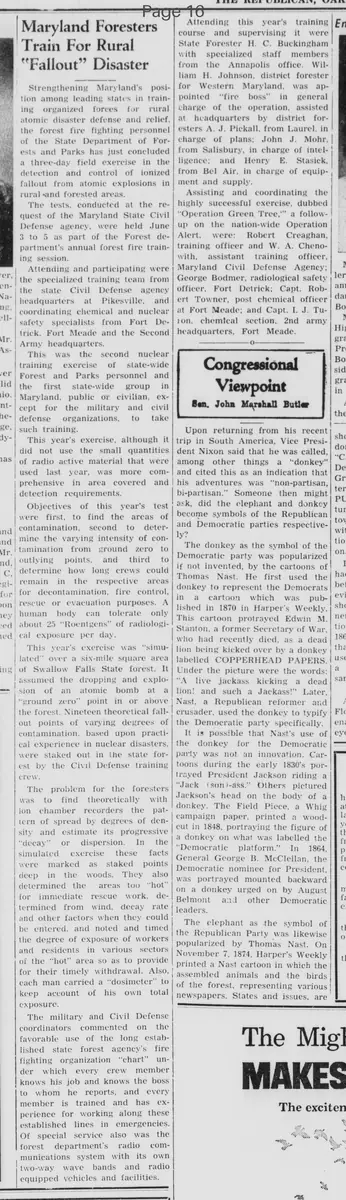
Maryland Foresters Train For Rural "Fallout" Disaster
Strengthening Maryland's position among leading states in training organized forces for rural atomic disaster defense and relief, the forest fire fighting personnel of the State Department of Forests and Parks has just concluded a three-day field exercise in the detection and control of ionized fallout from atomic explosions in rural and forested areas.
The tests, conducted at the request of the Maryland State Civil Defense agency, were held June 3 to 5 as part of the Forest department's annual forest fire training session.
Attending and participating were the specialized training team from the state Civil Defense agency headquarters at Pikesville, and coordinating chemical and nuclear safety specialists from Fort Detrick, Fort Meade and the Second Army headquarters.
This was the second nuclear training exercise of state-wide Forest and Parks personnel and the first state-wide group in Maryland, public or civilian, except for the military and civil defense organizations, to take such training.
This year's exercise, although it did not use the small quantities of radioactive material that were used last year, was more comprehensive in area covered and detection requirements.
Objectives of this year's test were first, to find the areas of contamination, second to determine the varying intensity of contamination from ground zero to outlying points, and third to determine how long crews could remain in the respective areas for decontamination, fire control, rescue or evacuation purposes. A human body can tolerate only about 25 "Roentgens" of radiological exposure per day.
This year's exercise was "simulated" over a six-mile square area of Swallow Falls State forest. It assumed the dropping and explosion of an atomic bomb at a "ground zero" point in or above the forest. Nineteen theoretical fallout points of varying degrees of contamination, based upon practical experience in nuclear disasters, were staked out in the state forest by the Civil Defense training crew.
The problem for the foresters was to find theoretically with ion chamber recorders the pattern of spread by degrees of density and estimate its progressive "decay" or dispersion. In the simulated exercise these facts were marked as staked points deep in the woods. They also determined the areas too "hot" for immediate rescue work, determined from wind, decay rate and other factors when they could be entered, and noted and timed the degree of exposure of workers and residents in various sectors of the "hot" area so as to provide for their timely withdrawal. Also, each man carried a "dosimeter" to keep account of his own total exposure.
The military and Civil Defense coordinators commented on the favorable use of the long established state forest agency's fire fighting organization "chart" under which every crew member knows his job and knows the boss to whom he reports, and every member is trained and has experience for working along these established lines in emergencies.
Of special service also was the forest department's radio communications system with its own two-way wave bands and radio equipped vehicles and facilities.
Attending this year's training course and supervising it were State Forester H. C. Buckingham with specialized staff members from the Annapolis office. William H. Johnson, district forester for Western Maryland, was appointed "fire boss" in general charge of the operation, assisted at headquarters by district foresters A. J. Pickall, from Laurel, in charge of plans; John J. Mohr from Salisbury, in charge of intelligence; and Henry E. Stasick, from Bel Air, in charge of equipment and supply.
Assisting and coordinating the highly successful exercise, dubbed "Operation Green Tree," a follow-up on the nation-wide Operation Alert, were: Robert Creaghan, training officer and W. A. Chenowith, assistant training officer, Maryland Civil Defense Agency; George Bodmer, radiological safety officer, Fort Detrick; Capt. Robert Towner, post chemical officer at Fort Meade; and Capt. I. J. Tuon, chemical section, 2nd army headquarters, Fort Meade.
Strengthening Maryland's position among leading states in training organized forces for rural atomic disaster defense and relief, the forest fire fighting personnel of the State Department of Forests and Parks has just concluded a three-day field exercise in the detection and control of ionized fallout from atomic explosions in rural and forested areas.
The tests, conducted at the request of the Maryland State Civil Defense agency, were held June 3 to 5 as part of the Forest department's annual forest fire training session.
Attending and participating were the specialized training team from the state Civil Defense agency headquarters at Pikesville, and coordinating chemical and nuclear safety specialists from Fort Detrick, Fort Meade and the Second Army headquarters.
This was the second nuclear training exercise of state-wide Forest and Parks personnel and the first state-wide group in Maryland, public or civilian, except for the military and civil defense organizations, to take such training.
This year's exercise, although it did not use the small quantities of radioactive material that were used last year, was more comprehensive in area covered and detection requirements.
Objectives of this year's test were first, to find the areas of contamination, second to determine the varying intensity of contamination from ground zero to outlying points, and third to determine how long crews could remain in the respective areas for decontamination, fire control, rescue or evacuation purposes. A human body can tolerate only about 25 "Roentgens" of radiological exposure per day.
This year's exercise was "simulated" over a six-mile square area of Swallow Falls State forest. It assumed the dropping and explosion of an atomic bomb at a "ground zero" point in or above the forest. Nineteen theoretical fallout points of varying degrees of contamination, based upon practical experience in nuclear disasters, were staked out in the state forest by the Civil Defense training crew.
The problem for the foresters was to find theoretically with ion chamber recorders the pattern of spread by degrees of density and estimate its progressive "decay" or dispersion. In the simulated exercise these facts were marked as staked points deep in the woods. They also determined the areas too "hot" for immediate rescue work, determined from wind, decay rate and other factors when they could be entered, and noted and timed the degree of exposure of workers and residents in various sectors of the "hot" area so as to provide for their timely withdrawal. Also, each man carried a "dosimeter" to keep account of his own total exposure.
The military and Civil Defense coordinators commented on the favorable use of the long established state forest agency's fire fighting organization "chart" under which every crew member knows his job and knows the boss to whom he reports, and every member is trained and has experience for working along these established lines in emergencies.
Of special service also was the forest department's radio communications system with its own two-way wave bands and radio equipped vehicles and facilities.
Attending this year's training course and supervising it were State Forester H. C. Buckingham with specialized staff members from the Annapolis office. William H. Johnson, district forester for Western Maryland, was appointed "fire boss" in general charge of the operation, assisted at headquarters by district foresters A. J. Pickall, from Laurel, in charge of plans; John J. Mohr from Salisbury, in charge of intelligence; and Henry E. Stasick, from Bel Air, in charge of equipment and supply.
Assisting and coordinating the highly successful exercise, dubbed "Operation Green Tree," a follow-up on the nation-wide Operation Alert, were: Robert Creaghan, training officer and W. A. Chenowith, assistant training officer, Maryland Civil Defense Agency; George Bodmer, radiological safety officer, Fort Detrick; Capt. Robert Towner, post chemical officer at Fort Meade; and Capt. I. J. Tuon, chemical section, 2nd army headquarters, Fort Meade.
What sub-type of article is it?
Historical Event
Disaster
Survival
What themes does it cover?
Survival
Triumph
Moral Virtue
What keywords are associated?
Nuclear Training
Fallout Detection
Civil Defense
Forest Fire Fighters
Operation Green Tree
Atomic Disaster Preparedness
What entities or persons were involved?
H. C. Buckingham
William H. Johnson
A. J. Pickall
John J. Mohr
Henry E. Stasick
Robert Creaghan
W. A. Chenowith
George Bodmer
Capt. Robert Towner
Capt. I. J. Tuon
Where did it happen?
Swallow Falls State Forest, Maryland
Story Details
Key Persons
H. C. Buckingham
William H. Johnson
A. J. Pickall
John J. Mohr
Henry E. Stasick
Robert Creaghan
W. A. Chenowith
George Bodmer
Capt. Robert Towner
Capt. I. J. Tuon
Location
Swallow Falls State Forest, Maryland
Event Date
June 3 To 5
Story Details
Maryland foresters conducted a simulated three-day exercise to detect and control atomic fallout in forested areas, marking contamination points, assessing exposure limits, and planning decontamination and evacuation, coordinated with Civil Defense and military experts.