Thank you for visiting SNEWPapers!
Sign up free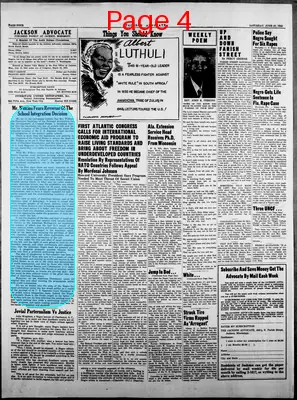
Editorial
June 27, 1959
Jackson Advocate
Jackson, Hinds County, Mississippi
What is this article about?
Editorial expresses concern over potential reversal of Supreme Court school integration ruling, citing Wilkins' fears, Eisenhower and Nixon statements, and pending bills. Argues reversal would align with American history of separate institutions under equal protection, benefiting Negro progress and countering communism. (248 characters)
Clipping
OCR Quality
98%
Excellent
Full Text
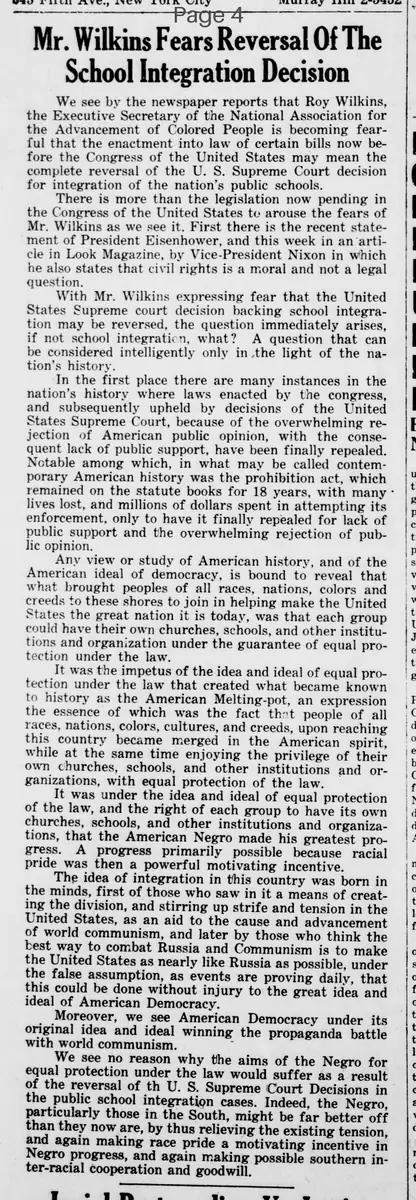
Mr. Wilkins Fears Reversal Of The School Integration Decision
We see by the newspaper reports that Roy Wilkins, the Executive Secretary of the National Association for the Advancement of Colored People is becoming fearful that the enactment into law of certain bills now before the Congress of the United States may mean the complete reversal of the U. S. Supreme Court decision for integration of the nation's public schools.
There is more than the legislation now pending in the Congress of the United States to arouse the fears of Mr. Wilkins as we see it. First there is the recent statement of President Eisenhower, and this week in an article in Look Magazine by Vice-President Nixon in which he also states that civil rights is a moral and not a legal question.
With Mr. Wilkins expressing fear that the United States Supreme court decision backing school integration may be reversed, the question immediately arises, if not school integration, what? A question that can be considered intelligently only in the light of the nation's history.
In the first place there are many instances in the nation's history where laws enacted by the congress, and subsequently upheld by decisions of the United States Supreme Court, because of the overwhelming rejection of American public opinion, with the consequent lack of public support, have been finally repealed.
Notable among which, in what may be called contemporary American history was the prohibition act, which remained on the statute books for 18 years, with many lives lost, and millions of dollars spent in attempting its enforcement, only to have it finally repealed for lack of public support and the overwhelming rejection of public opinion.
Any view or study of American history, and of the American ideal of democracy, is bound to reveal that what brought peoples of all races, nations, colors and creeds to these shores to join in helping make the United States the great nation it is today, was that each group could have their own churches, schools, and other institutions and organization under the guarantee of equal protection under the law.
It was the impetus of the idea and ideal of equal protection under the law that created what became known to history as the American Melting-pot, an expression the essence of which was the fact that people of all races, nations, colors, cultures, and creeds, upon reaching this country became merged in the American spirit, while at the same time enjoying the privilege of their own churches, schools, and other institutions and organizations, with equal protection of the law.
It was under the idea and ideal of equal protection of the law, and the right of each group to have its own churches, schools, and other institutions and organizations, that the American Negro made his greatest progress. A progress primarily possible because racial pride was then a powerful motivating incentive.
The idea of integration in this country was born in the minds, first of those who saw in it a means of creating the division, and stirring up strife and tension in the United States, as an aid to the cause and advancement of world communism, and later by those who think the best way to combat Russia and Communism is to make the United States as nearly like Russia as possible, under the false assumption, as events are proving daily, that this could be done without injury to the great idea and ideal of American Democracy.
Moreover, we see American Democracy under its original idea and ideal winning the propaganda battle with world communism.
We see no reason why the aims of the Negro for equal protection under the law would suffer as a result of the reversal of the U. S. Supreme Court Decisions in the public school integration cases. Indeed, the Negro, particularly those in the South, might be far better off than they now are, by thus relieving the existing tension, and again making race pride a motivating incentive in Negro progress, and again making possible southern inter-racial cooperation and goodwill.
We see by the newspaper reports that Roy Wilkins, the Executive Secretary of the National Association for the Advancement of Colored People is becoming fearful that the enactment into law of certain bills now before the Congress of the United States may mean the complete reversal of the U. S. Supreme Court decision for integration of the nation's public schools.
There is more than the legislation now pending in the Congress of the United States to arouse the fears of Mr. Wilkins as we see it. First there is the recent statement of President Eisenhower, and this week in an article in Look Magazine by Vice-President Nixon in which he also states that civil rights is a moral and not a legal question.
With Mr. Wilkins expressing fear that the United States Supreme court decision backing school integration may be reversed, the question immediately arises, if not school integration, what? A question that can be considered intelligently only in the light of the nation's history.
In the first place there are many instances in the nation's history where laws enacted by the congress, and subsequently upheld by decisions of the United States Supreme Court, because of the overwhelming rejection of American public opinion, with the consequent lack of public support, have been finally repealed.
Notable among which, in what may be called contemporary American history was the prohibition act, which remained on the statute books for 18 years, with many lives lost, and millions of dollars spent in attempting its enforcement, only to have it finally repealed for lack of public support and the overwhelming rejection of public opinion.
Any view or study of American history, and of the American ideal of democracy, is bound to reveal that what brought peoples of all races, nations, colors and creeds to these shores to join in helping make the United States the great nation it is today, was that each group could have their own churches, schools, and other institutions and organization under the guarantee of equal protection under the law.
It was the impetus of the idea and ideal of equal protection under the law that created what became known to history as the American Melting-pot, an expression the essence of which was the fact that people of all races, nations, colors, cultures, and creeds, upon reaching this country became merged in the American spirit, while at the same time enjoying the privilege of their own churches, schools, and other institutions and organizations, with equal protection of the law.
It was under the idea and ideal of equal protection of the law, and the right of each group to have its own churches, schools, and other institutions and organizations, that the American Negro made his greatest progress. A progress primarily possible because racial pride was then a powerful motivating incentive.
The idea of integration in this country was born in the minds, first of those who saw in it a means of creating the division, and stirring up strife and tension in the United States, as an aid to the cause and advancement of world communism, and later by those who think the best way to combat Russia and Communism is to make the United States as nearly like Russia as possible, under the false assumption, as events are proving daily, that this could be done without injury to the great idea and ideal of American Democracy.
Moreover, we see American Democracy under its original idea and ideal winning the propaganda battle with world communism.
We see no reason why the aims of the Negro for equal protection under the law would suffer as a result of the reversal of the U. S. Supreme Court Decisions in the public school integration cases. Indeed, the Negro, particularly those in the South, might be far better off than they now are, by thus relieving the existing tension, and again making race pride a motivating incentive in Negro progress, and again making possible southern inter-racial cooperation and goodwill.
What sub-type of article is it?
Education
Constitutional
Social Reform
What keywords are associated?
School Integration
Supreme Court Decision
Civil Rights
Equal Protection
Race Pride
American Democracy
Communism Influence
Prohibition Repeal
What entities or persons were involved?
Roy Wilkins
Naacp
President Eisenhower
Vice President Nixon
U.S. Supreme Court
Congress
American Negro
Editorial Details
Primary Topic
Fear Of Reversal Of School Integration Decision And Advocacy For Separate Institutions Under Equal Protection
Stance / Tone
Opposition To School Integration, Support For Reversal To Restore Race Pride And Interracial Cooperation
Key Figures
Roy Wilkins
Naacp
President Eisenhower
Vice President Nixon
U.S. Supreme Court
Congress
American Negro
Key Arguments
Pending Legislation May Reverse Supreme Court School Integration Decision
Eisenhower And Nixon View Civil Rights As Moral, Not Legal Issue
Historical Laws Without Public Support, Like Prohibition, Were Repealed
American Ideal Allows Separate Institutions With Equal Protection Under Law
Integration Idea Aids Communism By Creating Division
Reversal Would Relieve Tension And Restore Race Pride For Negro Progress
Separate Schools Better For Southern Negroes And Interracial Goodwill