Thank you for visiting SNEWPapers!
Sign up free
Jackson Advocate
Jackson, Hinds County, Mississippi
What is this article about?
At Tuskegee Institute, Ala., Negro farmers from 13 southeastern states, at their conference on December 5, demand greater voice and representation in the American Farm Bureau Federation, criticizing discriminatory practices and rejecting a separate Negro group. Broader calls for economic integration and racial barrier removal are made.
Merged-components note: Continuation of the Negro Farmers Want Voice story across pages 1 and 4; relabeled the continuation from 'story' to match original.
Clippings
1 of 2
OCR Quality
Full Text
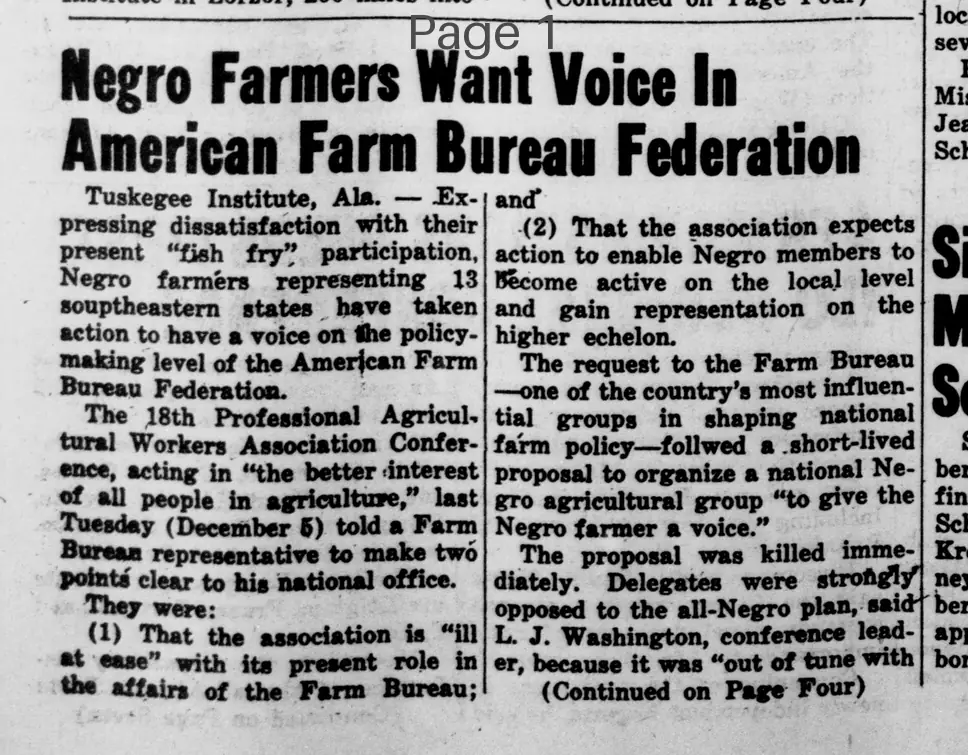
Tuskegee Institute, Ala. - Expressing dissatisfaction with their present "fish fry" participation, Negro farmers representing 13 southeastern states have taken action to have a voice on the policy-making level of the American Farm Bureau Federation.
The 18th Professional Agricultural Workers Association Conference, acting in "the better interest of all people in agriculture," last Tuesday (December 5) told a Farm Bureau representative to make two points clear to his national office.
They were:
That the association is ill at ease with its present role in the affairs of the Farm Bureau;
and (2) That the association expects action to enable Negro members to become active on the local level and gain representation on the higher echelon.
The request to the Farm Bureau -one of the country's most influential groups in shaping national farm policy-follwed a short-lived proposal to organize a national Negro agricultural group "to give the Negro farmer a voice."
The proposal was killed immediately. Delegates were strongly opposed to the all-Negro plan, said L. J. Washington, conference leader, because it was "out of tune with the times."
The Negro farmer is tired of being pampered with the "annual Farm Bureau fish fry by the river."
Dr. R. L. Hurst of South Carolina State College, a delegate, told Warren Newberry, Farm Bureau field director.
Supporting Dr. Hurst's stand, L. A. Potts, conference chairman, charges that Negro Farm Bureau members are being "distinctly discriminated" against on the local level. The policy of keeping Negroes out of local branches of the Bureau blocks colored participation on all levels, he said.
Although his organization is "ill at ease, it is not mad or bitter," said Mr. Potts, Dean of Tuskegee School of Agriculture. "We are acting to make the Farm Bureau stronger and better for all the people," he told Mr. Newberry.
Mr. Newberry, expressing his willingness to cooperate, promised he would convey the feelings and desires of the association to Charles B. Shuman, president of the Farm Bureau.
Said Mr. Newberry: "Whether we like it or not, we all-colored and white-- are in this farm business together and must cooperate in order to survive."
Attention of the conference was also focused on the need for breaking down racial barriers in the entire American economy; and the need for action to assure the Negro economic security.
Raymond D. Larson, assistant to the Secretary of the U. S. Department of Labor, called for the country to eliminate every tint of racial discrimination to use its economic manpower effectively.
"If we don't show economic progress in the '60's," he said, "Russia will certainly use this as a propaganda device against us."
He added that both Russia and the United States are vying for the favor of many countries which are "primitively" developed. These foreign countries will lean toward the ideology with the most economic strength - whether it be democratic or communistic, he concluded.
Norman L. McGhee, president of the McGhee Company, Cleveland, Ohio, presented a plan that would "lift blindness from the Negro's economic eyes."
He urged Negro families to become share owners of stock in each of America's 10 biggest corporations rather than possessors of "fine clothes and shiny cars."
Such an investment, said McGhee, would provide economic security and "assure equal citizenship." In addition to cash dividends, the Negro would also receive job dividends, which are now "crying need of the Negro," he said.
What sub-type of article is it?
What themes does it cover?
What keywords are associated?
What entities or persons were involved?
Where did it happen?
Story Details
Key Persons
Location
Tuskegee Institute, Ala.
Event Date
December 5
Story Details
Negro farmers from 13 southeastern states at the 18th Professional Agricultural Workers Association Conference express dissatisfaction with limited 'fish fry' participation in the American Farm Bureau Federation and demand active roles on local and higher levels. A proposal for a national Negro agricultural group is rejected. Conference also addresses breaking racial barriers in the economy for Negro economic security.