Thank you for visiting SNEWPapers!
Sign up free
Portland Gazette
Portland, Cumberland County, Maine
What is this article about?
James Elliot's Letter VI to his constituents critiques the Georgia legislature's 1796 rescission of the 1795 Yazoo land grants as improper and corrupt, defends the grantees' rights under public faith, discusses US claims to the territory, and opposes Mr. Randolph's congressional resolutions denying compensation to 1795 claimants from the 5 million acres ceded by Georgia.
Clipping
OCR Quality
Full Text
Mr. Elliot to his Constituents.
LETTER VI.
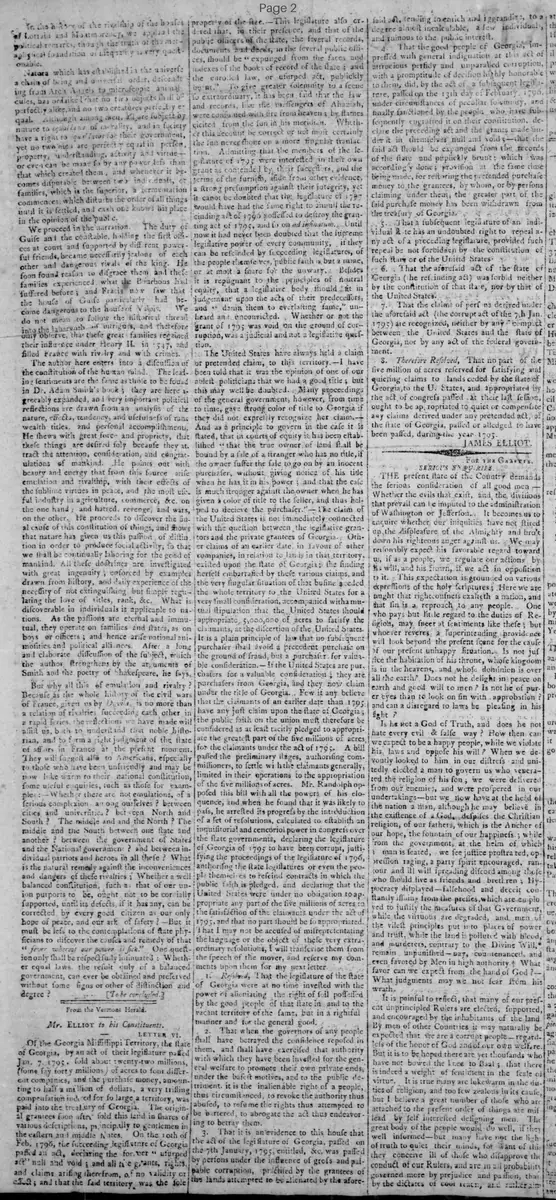
Of the Georgia Mississippi Territory, the state of Georgia, by an act of their legislature passed Jan. 7, 1795, sold about twenty-two millions, some say forty millions) of acres to four different companies, and the purchase money, amounting to half a million of dollars, a very trifling compensation indeed for so large a territory, was paid into the treasury of Georgia. The original grantees soon after sold this land in shares of various descriptions, principally to gentlemen in the eastern and middle States. On the 10th of Feb. 1796, the succeeding legislature of Georgia passed an act, declaring the former 'usurped act' null and void; and all the grants, rights, and claims arising therefrom, of no validity or effect; and that the said territory, was the sole proper ty of the state.-This legislature also ordered that, in their presence, and that of the public officers of the state, the several records, documents and deeds, in the several public offices, should be 'expunged from the faces and indexes of the books of record of the state: and the enrolled law, or usurped act, publicly burnt.' To give greater solemnity to a scene so extraordinary, it has been said that the law and records, like the messengers of Ahaziah, were consumed with fire from heaven; by flames elicited from the sun in his meridian. Whether this account be correct or not most certainly the sun never shone on a more singular transaction. Admitting that the members of the legislature of 1795 were interested in their own grant as contended by their successors, and the terms of the furnish, aside from all other evidence: a strong presumption against their integrity, yet it cannot be doubted that the legislature of 1797 would have had the same right to annul the rescinding act of 1796 passed to destroy the granting act of 1795, and so on ad infinitum. Until now it had never been doubted that the supreme legislative power of every community, if they can be rescinded by succeeding legislatures, or the people themselves, public faith is but a name, or at most a snare for the unwary. Besides it is repugnant to the principles of natural equity, that a legislative body should sit in judgment upon the acts of their predecessors, and 'damn them to everlasting fame,' unheard and unconvicted. Whether or not the grant of 1795 was void on the ground of corruption, was a judicial and not a legislative question.
The United States have always held a claim or pretended claim, to this territory.-I have been told that it was the opinion of one of our ablest politicians that we had a good title; but this may well be doubted. Many proceedings of the general government, however, from time to time, gave strong color of title to Georgia if they did not expressly recognize her claim.- And as a principle to govern in the case it is stated, that in courts of equity it has been established 'that the true owner of land shall be bound by a sale of a stranger who has no title, if the owner suffer the sale to go on by an innocent purchaser, without giving notice of his title when he has it in his power; and that the case is much stronger against the owner when he has given a color of title to the seller, and thus helped to deceive the purchaser.'- The claim of the United States is not immediately connected with the question between the legislative grantors and the private grantees of Georgia. Other claims of an earlier date, in favour of other companies, in relation to lands in that territory, existed upon the state of Georgia; she finding herself embarrassed by these various claims, and the very singular situation of that business ceded the whole territory to the United States for a very small consideration, accompanied with a mutual stipulation that the United States should appropriate, 5,000,000 of acres to satisfy the claimants, at the discretion of the United States. It is a plain principle of law that no subsequent purchaser shall avoid a precedent purchase on the ground of fraud, but a purchaser for valuable consideration.-If the United States are purchasers for a valuable consideration; they are purchasers from Georgia, and they now claim under the title of Georgia. Few if any believe that the claimants of an earlier date than 1795 have any just claim upon the state of Georgia; the public faith of the union must therefore be considered as at least tacitly pledged to appropriate the greatest part of the five millions of acres for the claimants under the act of 1795. A bill passed the preliminary stages, authorizing commissioners, to settle with the claimants generally, limited in their operations to the appropriation of the five millions of acres. Mr. Randolph opposed this bill with all the powers of his eloquence, and when he found that it was likely to pass, he arrested its progress by the introduction of a set of resolutions, calculated to establish an inquisitorial and censorial power in congress over the state governments, declaring the legislature of Georgia of 1795 to have been corrupt, justifying the proceedings of the legislature of 1796, authorizing the state legislatures or even the people themselves to rescind contracts in which the public faith is pledged, and declaring that the United States were under no obligation to appropriate any part of the five millions of acres to the satisfaction of the claimants under the act of 1795, and that no part should be so appropriated. That I may not be accused of misrepresenting the language or the object of these very extraordinary resolutions, I will transcribe them from the speech of the mover, and reserve my comments upon them for my next letter.
I. Resolved, That the legislature of the state of Georgia were at no time invested with the power of alienating the right of soil possessed by the good people of that state in and to the vacant territory of the same, but in a rightful manner and for the general good.
2. That when the governors of any people shall have betrayed the confidence reposed in them, and shall have exercised that authority with which they have been invested for the general welfare to promote their own private ends under the basest motives, and to the public detriment, it is the inalienable right of a people, thus circumstanced, to revoke the authority thus abused, to resume the rights thus attempted to be bartered, to abrogate the act thus endeavoring to betray them.
3. That it is an evidence to this house that the act of the legislature of Georgia, passed on the 7th January, 1795, entitled, &c. was passed by persons under the influence of gross and palpable corruption, practiced by the grantees of the lands attempted to be alienated by the aforesaid act, tending to enrich and aggrandize, to a degree almost incalculable, a few individuals and ruinous to the public interest.
4. That the good people of Georgia, impressed with general indignation at this act of atrocious perfidy and unparalleled corruption, with a promptitude of decision highly honorable to them, did, by the act of a subsequent legislature, passed on the 13th day of February, 1796, under circumstances of peculiar solemnity, and finally sanctioned by the people who have subsequently engrafted it on their constitution, declare the preceding act and the grants made under it in themselves null and void; that the said act should be expunged from the records of the state and publicly burnt: which was accordingly done; provision at the same time being made, for restoring the pretended purchase money to the grantees, by whom, or by persons claiming under them, the greater part of the said purchase money has been withdrawn from the treasury of Georgia.
5. That a subsequent legislature of an individual state has an undoubted right to repeal any act of a preceding legislature, provided such repeal be not forbidden by the constitution of such state or of the United States.
6. That the aforesaid act of the state of Georgia (the rescinding act) was forbid neither by the constitution of that state, nor by that of the United States.
7. That the claims of persons derived under the aforesaid act (the corrupt act of the 7th Jan. 1795) are recognized, neither by any compact between the United States and the state of Georgia, nor by any act of the federal government.
8. Therefore Resolved, That no part of the five million of acres reserved for satisfying and quieting claims to lands ceded by the state of Georgia, to the U. States, and appropriated by the act of congress passed at their last session, ought to be appropriated to quiet or compensate any claims derived under any pretended act, of the state of Georgia, passed or alleged to have been passed, during the year 1795.
JAMES ELLIOT
FOR The GAZETTE.
What sub-type of article is it?
What themes does it cover?
What keywords are associated?
What entities or persons were involved?
Letter to Editor Details
Author
James Elliot
Recipient
His Constituents
Main Argument
the georgia legislature's 1796 rescission of the 1795 land grants violated principles of public faith and natural equity, as succeeding legislatures cannot annul prior acts without judicial determination of corruption; the us is bound to compensate 1795 grantees from the ceded territory, and mr. randolph's resolutions unjustly deny this obligation.
Notable Details