Thank you for visiting SNEWPapers!
Sign up free
Story
February 7, 1870
The Evening Telegraph
Philadelphia, Philadelphia County, Pennsylvania
What is this article about?
Editorial in Wheeling Intelligencer refutes claims that Virginia's post-Civil War restoration invalidates West Virginia's statehood, citing 1862 consent by loyal legislature and U.S. recognition; dismisses reunion agitation as unfounded outside West Virginia. (214 characters)
Clipping
OCR Quality
98%
Excellent
Full Text
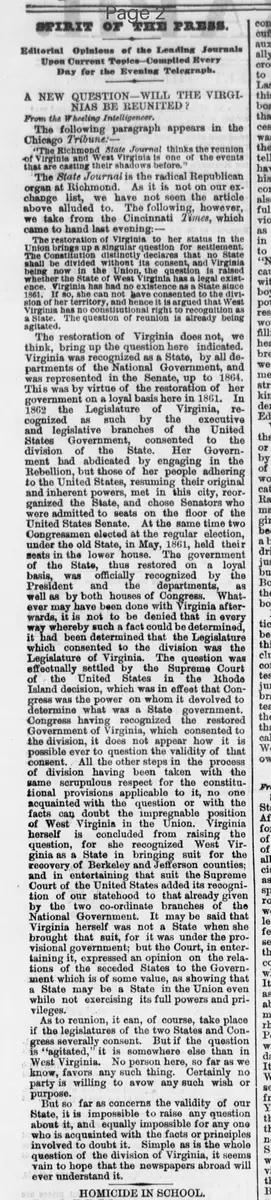
SPIRIT OF THE PRESS.
Editorial Opinions of the London Journals Upon Current Topics—Compiled Every Day for the Evening Telegraph.
A NEW QUESTION—WILL THE VIRGINIAs BE REUNITED?
From the Wheeling Intelligencer.
The following paragraph appears in the Chicago Tribune:
"The Richmond State Journal thinks the reunion of Virginia and West Virginia is one of the events that are casting their shadows before."
The State Journal is the radical Republican organ at Richmond. As it is not on our exchange list, we have not seen the article above alluded to. The following, however, we take from the Cincinnati Times, which came to hand last evening:-
The restoration of Virginia to her status in the Union brings up a singular question for settlement. The Constitution distinctly declares that no State shall be divided without its consent, and Virginia being now in the Union, the question is raised whether the State of West Virginia has a legal existence. Virginia has had no existence as a State since 1861. If so, she can not have consented to the division of her territory, and hence it is argued that West Virginia has no constitutional right to recognition as a State. The question of reunion is already being agitated.
The restoration of Virginia does not, we think, bring up the question here indicated. Virginia was recognized as a State, by all departments of the National Government, and was represented in the Senate, up to 1864. This was by virtue of the restoration of her government on a loyal basis here in 1861. In 1862 the Legislature of Virginia, recognized as such by the executive and legislative branches of the United States Government, consented to the division of the State. Her Government had abdicated by engaging in the Rebellion, but those of her people adhering to the United States, resuming their original and inherent powers, met in this city, reorganized the State, and chose Senators who were admitted to seats on the floor of the United States Senate. At the same time two Congressmen elected at the regular election, under the old State, in May, 1861, held their seats in the lower house. The government of the State, thus restored on a loyal basis, was officially recognized by the President and the departments, as well as by both houses of Congress. Whatever may have been done with Virginia afterwards, it is not to be denied that in every way whereby such a fact could be determined, it had been determined that the Legislature which consented to the division was the Legislature of Virginia. The question was effectually settled by the Supreme Court of the United States in the Rhode Island decision, which was in effect that Congress was the power on whom it devolved to determine what was a State government. Congress having recognized the restored Government of Virginia, which consented to the division, it does not appear how it is possible ever to question the validity of that consent. All the other steps in the process of division having been taken with the same scrupulous respect for the constitutional provisions applicable to it, no one acquainted with the question or with the facts can doubt the impregnable position of West Virginia in the Union. Virginia herself is concluded from raising the question, for she recognized West Virginia as a State in bringing suit for the recovery of Berkeley and Jefferson counties; and in entertaining that suit the Supreme Court of the United States added its recognition of our statehood to that already given by the two co-ordinate branches of the National Government. It may be said that Virginia herself was not a State when she brought that suit, for it was under the provisional government; but the Court, in entertaining it, expressed an opinion on the relations of the seceded States to the Government which is of some value, as showing that a State may be a State in the Union even while not exercising its full powers and privileges.
As to reunion, it can, of course, take place if the legislatures of the two States and Congress severally consent. But if the question is "agitated," it is somewhere else than in West Virginia. No person here, so far as we know, favors any such thing. Certainly no party is willing to avow any such wish or purpose.
But so far as concerns the validity of our State, it is impossible to raise any question about it, and equally impossible for any one who is acquainted with the facts or principles involved to doubt it. Simple as is the whole question of the division of Virginia, it seems vain to hope that the newspapers abroad will ever understand it.
Editorial Opinions of the London Journals Upon Current Topics—Compiled Every Day for the Evening Telegraph.
A NEW QUESTION—WILL THE VIRGINIAs BE REUNITED?
From the Wheeling Intelligencer.
The following paragraph appears in the Chicago Tribune:
"The Richmond State Journal thinks the reunion of Virginia and West Virginia is one of the events that are casting their shadows before."
The State Journal is the radical Republican organ at Richmond. As it is not on our exchange list, we have not seen the article above alluded to. The following, however, we take from the Cincinnati Times, which came to hand last evening:-
The restoration of Virginia to her status in the Union brings up a singular question for settlement. The Constitution distinctly declares that no State shall be divided without its consent, and Virginia being now in the Union, the question is raised whether the State of West Virginia has a legal existence. Virginia has had no existence as a State since 1861. If so, she can not have consented to the division of her territory, and hence it is argued that West Virginia has no constitutional right to recognition as a State. The question of reunion is already being agitated.
The restoration of Virginia does not, we think, bring up the question here indicated. Virginia was recognized as a State, by all departments of the National Government, and was represented in the Senate, up to 1864. This was by virtue of the restoration of her government on a loyal basis here in 1861. In 1862 the Legislature of Virginia, recognized as such by the executive and legislative branches of the United States Government, consented to the division of the State. Her Government had abdicated by engaging in the Rebellion, but those of her people adhering to the United States, resuming their original and inherent powers, met in this city, reorganized the State, and chose Senators who were admitted to seats on the floor of the United States Senate. At the same time two Congressmen elected at the regular election, under the old State, in May, 1861, held their seats in the lower house. The government of the State, thus restored on a loyal basis, was officially recognized by the President and the departments, as well as by both houses of Congress. Whatever may have been done with Virginia afterwards, it is not to be denied that in every way whereby such a fact could be determined, it had been determined that the Legislature which consented to the division was the Legislature of Virginia. The question was effectually settled by the Supreme Court of the United States in the Rhode Island decision, which was in effect that Congress was the power on whom it devolved to determine what was a State government. Congress having recognized the restored Government of Virginia, which consented to the division, it does not appear how it is possible ever to question the validity of that consent. All the other steps in the process of division having been taken with the same scrupulous respect for the constitutional provisions applicable to it, no one acquainted with the question or with the facts can doubt the impregnable position of West Virginia in the Union. Virginia herself is concluded from raising the question, for she recognized West Virginia as a State in bringing suit for the recovery of Berkeley and Jefferson counties; and in entertaining that suit the Supreme Court of the United States added its recognition of our statehood to that already given by the two co-ordinate branches of the National Government. It may be said that Virginia herself was not a State when she brought that suit, for it was under the provisional government; but the Court, in entertaining it, expressed an opinion on the relations of the seceded States to the Government which is of some value, as showing that a State may be a State in the Union even while not exercising its full powers and privileges.
As to reunion, it can, of course, take place if the legislatures of the two States and Congress severally consent. But if the question is "agitated," it is somewhere else than in West Virginia. No person here, so far as we know, favors any such thing. Certainly no party is willing to avow any such wish or purpose.
But so far as concerns the validity of our State, it is impossible to raise any question about it, and equally impossible for any one who is acquainted with the facts or principles involved to doubt it. Simple as is the whole question of the division of Virginia, it seems vain to hope that the newspapers abroad will ever understand it.
What sub-type of article is it?
Historical Event
What themes does it cover?
Justice
What keywords are associated?
West Virginia Statehood
Virginia Restoration
Constitutional Division
State Reunion
Civil War Aftermath
Where did it happen?
Virginia And West Virginia
Story Details
Location
Virginia And West Virginia
Event Date
Post 1865
Story Details
The Wheeling Intelligencer argues that West Virginia's statehood remains constitutionally valid despite Virginia's restoration to the Union, as the loyal Virginia government consented to the division in 1862, recognized by the U.S. government and Supreme Court; reunion is not favored in West Virginia.