Thank you for visiting SNEWPapers!
Sign up free
Story
October 6, 1955
Miami Labor Citizen
Miami, Dade County, Florida
What is this article about?
Article advises workers on personal hearing protection in noisy environments like aircraft maintenance, recommending ear plugs or muffs to prevent damage from noise above 85 decibels, with details on types, usage, and brands.
Merged-components note: Merging image that spatially overlaps with the ear protectors article.
Clipping
OCR Quality
75%
Good
Full Text
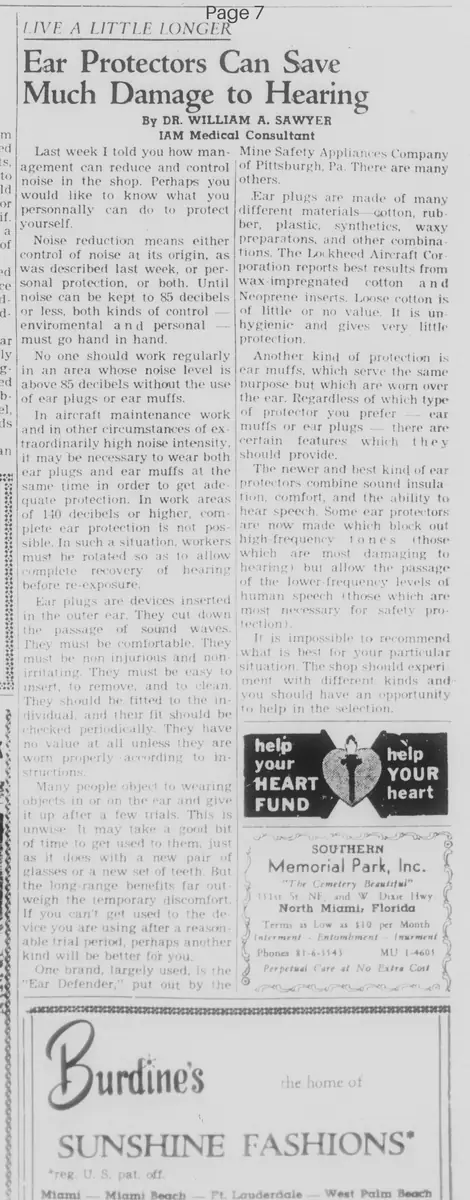
LIVE A LITTLE LONGER
Ear Protectors Can Save
Much Damage to Hearing
Last week I told you how management can reduce and control noise in the shop. Perhaps you would like to know what you personally can do to protect yourself.
Noise reduction means either control of noise at its origin, as was described last week, or personal protection, or both. Until noise can be kept to 85 decibels or less, both kinds of control environmental and personal must go hand in hand.
No one should work regularly in an area whose noise level is above 85 decibels without the use of ear plugs or ear muffs.
In aircraft maintenance work and in other circumstances of extraordinarily high noise intensity, it may be necessary to wear both ear plugs and ear muffs at the same time in order to get adequate protection. In work areas of 110 decibels or higher, complete ear protection is not possible. In such a situation, workers must be rotated so as to allow complete recovery of hearing before re-exposure.
Ear plugs are devices inserted in the outer ear. They cut down the passage of sound waves. They must be comfortable. They must be non-injurious and non-irritating. They must be easy to insert, to remove, and to clean. They should be fitted to the individual, and their fit should be checked periodically. They have no value at all unless they are worn properly according to instructions.
Many people object to wearing objects in or on the ear and give it up after a few trials. This is unwise. It may take a good bit of time to get used to them, just as it does with a new pair of glasses or a new set of teeth. But the long range benefits far out weigh the temporary discomfort.
If you can't get used to the device you are using after a reasonable trial period, perhaps another kind will be better for you.
One brand, largely used, is the "Ear Defender," put out by the
SUNSHINE
reg. U.S. pat.
off.
Mine Safety Appliances Company of Pittsburgh, Pa. There are many others.
Ear plugs are made of many different materials cotton, rubber, plastic, synthetics, waxy preparations, and other combinations. The Lockheed Aircraft Corporation reports best results from wax-impregnated cotton and Neoprene inserts. Loose cotton is of little or no value. It is unhygienic and gives very little protection.
Another kind of protection is ear muffs, which serve the same purpose but which are worn over the ear. Regardless of which type of protector you prefer ear muffs or ear plugs there are certain features which they should provide.
The newer and best kind of ear protectors combine sound insulation, comfort, and the ability to hear speech. Some ear protectors are now made which block out high-frequency tones (those which are most damaging to hearing) but allow the passage of the lower frequency levels of human speech (those which are most necessary for safety protection).
It is impossible to recommend what is best for your particular situation. The shop should experiment with different kinds and you should have an opportunity to help in the selection.
Ear Protectors Can Save
Much Damage to Hearing
Last week I told you how management can reduce and control noise in the shop. Perhaps you would like to know what you personally can do to protect yourself.
Noise reduction means either control of noise at its origin, as was described last week, or personal protection, or both. Until noise can be kept to 85 decibels or less, both kinds of control environmental and personal must go hand in hand.
No one should work regularly in an area whose noise level is above 85 decibels without the use of ear plugs or ear muffs.
In aircraft maintenance work and in other circumstances of extraordinarily high noise intensity, it may be necessary to wear both ear plugs and ear muffs at the same time in order to get adequate protection. In work areas of 110 decibels or higher, complete ear protection is not possible. In such a situation, workers must be rotated so as to allow complete recovery of hearing before re-exposure.
Ear plugs are devices inserted in the outer ear. They cut down the passage of sound waves. They must be comfortable. They must be non-injurious and non-irritating. They must be easy to insert, to remove, and to clean. They should be fitted to the individual, and their fit should be checked periodically. They have no value at all unless they are worn properly according to instructions.
Many people object to wearing objects in or on the ear and give it up after a few trials. This is unwise. It may take a good bit of time to get used to them, just as it does with a new pair of glasses or a new set of teeth. But the long range benefits far out weigh the temporary discomfort.
If you can't get used to the device you are using after a reasonable trial period, perhaps another kind will be better for you.
One brand, largely used, is the "Ear Defender," put out by the
SUNSHINE
reg. U.S. pat.
off.
Mine Safety Appliances Company of Pittsburgh, Pa. There are many others.
Ear plugs are made of many different materials cotton, rubber, plastic, synthetics, waxy preparations, and other combinations. The Lockheed Aircraft Corporation reports best results from wax-impregnated cotton and Neoprene inserts. Loose cotton is of little or no value. It is unhygienic and gives very little protection.
Another kind of protection is ear muffs, which serve the same purpose but which are worn over the ear. Regardless of which type of protector you prefer ear muffs or ear plugs there are certain features which they should provide.
The newer and best kind of ear protectors combine sound insulation, comfort, and the ability to hear speech. Some ear protectors are now made which block out high-frequency tones (those which are most damaging to hearing) but allow the passage of the lower frequency levels of human speech (those which are most necessary for safety protection).
It is impossible to recommend what is best for your particular situation. The shop should experiment with different kinds and you should have an opportunity to help in the selection.
What sub-type of article is it?
Medical Curiosity
What themes does it cover?
Moral Virtue
Recovery
What keywords are associated?
Ear Protectors
Noise Reduction
Hearing Damage
Ear Plugs
Ear Muffs
Workplace Safety
Decibels
What entities or persons were involved?
Mine Safety Appliances Company
Lockheed Aircraft Corporation
Where did it happen?
Aircraft Maintenance Work, Industrial Shops
Story Details
Key Persons
Mine Safety Appliances Company
Lockheed Aircraft Corporation
Location
Aircraft Maintenance Work, Industrial Shops
Story Details
Advises on using ear plugs and muffs to protect hearing from industrial noise, emphasizing proper fit, materials, and persistence despite discomfort for long-term benefits; recommends rotation in high-noise areas.