Thank you for visiting SNEWPapers!
Sign up free
Editorial
April 12, 1814
Daily National Intelligencer
Washington, District Of Columbia
What is this article about?
Editorial praises the repeal of U.S. trade restrictions during the War of 1812, arguing it benefits commerce and national interests despite wartime challenges. It defends government policy against accusations of anti-commercial bias, cites revolutionary precedents like non-importation acts, and anticipates positive trade with neutrals like Russia, referencing a 1801 Anglo-Russian convention on blockades.
Clipping
OCR Quality
98%
Excellent
Full Text
WASHINGTON CITY
TUESDAY, APRIL 12
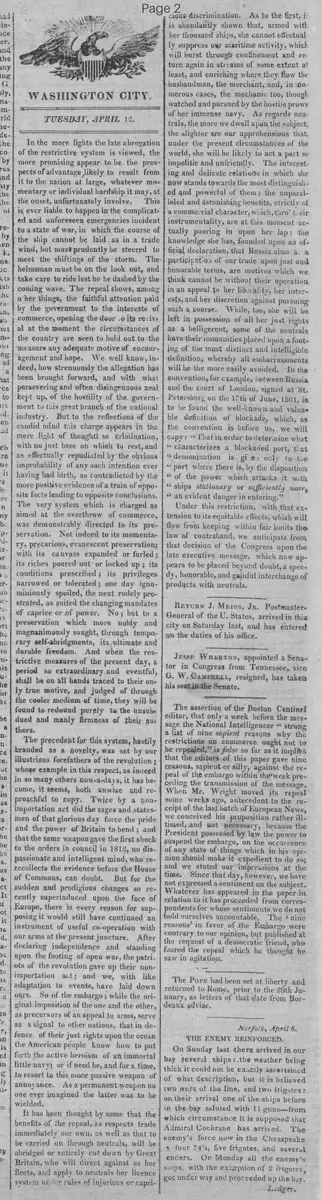
In the more lights the late abrogation of the restrictive system is viewed, the more promising appear to be the prospects of advantage likely to result from it to the nation at large, whatever momentary or individual hardship it may, at the onset, unfortunately involve. This is ever liable to happen in the complicated and unforeseen emergencies incident to a state of war, in which the course of the ship cannot be laid as in a trade wind, but must prudently be steered to meet the shiftings of the storm. The helmsman must be on the look out, and take care to ride lest he be dashed by the coming wave. The repeal shows, among other things, the faithful attention paid by the government to the interests of commerce, opening the door to its revival at the moment the circumstances of the country are seen to hold out to the measure any adequate motive of encouragement and hope. We well know, indeed, how strenuously the allegation has been brought forward, and with what persevering and often disingenuous zeal kept up, of the hostility of the government to this great branch of the national industry. But to the reflections of the candid mind this charge appears in the mere light of thoughtless crimination, with no just base on which to rest, and as effectually repudiated by the obvious improbability of any such intention ever having had birth, as contradicted by the more positive evidence of a train of opposite facts leading to opposite conclusions. The very system which is charged as aimed at the overthrow of commerce, was demonstrably directed to its preservation. Not indeed to its momentary, precarious, evanescent preservation; with its canvass expanded or furled; its riches poured out or locked up; its conditions prescribed; its privileges narrowed or tolerated; one day ignominiously spoiled, the next rudely prostrated, as suited the changing mandates of caprice or of power. No; but to a preservation which more nobly and magnanimously sought, through temporary self-abridgments, its ultimate and durable freedom. And when the restrictive measures of the present day, a period so extraordinary and eventful, shall be on all hands traced to their only true motive, and judged of through the cooler medium of time, they will be found to redound purely to the undaunted and manly firmness of their authors.
The precedent of this system, hastily branded as a novelty, was set by our illustrious forefathers of the revolution; whose example in this respect, as indeed in so many others now-a-days, it has become, it seems, both unwise and reproachful to copy. Twice by a non-importation act did the sages and statesmen of that glorious day force the pride and the power of Britain to bend; and that the same weapon gave the first shock to the orders in council in 1812, no dispassionate and intelligent mind, who recollects the evidence before the House of Commons, can doubt. But for the sudden and prodigious changes so recently superinduced upon the face of Europe, there is every reason for supposing it would still have continued an instrument of useful co-operation with our arms at the present juncture. After declaring independence and standing upon the footing of open war, the patriots of the revolution gave up their non-importation act; and we, with like adaptation to events, have laid down ours. So of the embargo; while the original imposition of the one and the other, as precursors of an appeal to arms, serve as a signal to other nations, that in defence of their just rights upon the ocean the American people know how to put forth the active heroism of an immortal little navy; or if need be, and for a time, to resort to this more passive weapon of annoyance. As a permanent weapon no one ever imagined the latter was to be wielded.
It has been thought by some that the benefits of the repeal, as respects trade immediately our own, as well as that to be carried on through neutrals, will be abridged or entirely cut down by Great Britain, who will direct against us her fleets, and apply to neutrals her licence system under rules of injurious or capricious-discrimination. As to the first, it is abundantly shown that, armed with her thousand ships, she cannot effectually suppress our maritime activity, which will burst through confinement and return again in streams of some extent at least, and enriching where they flow the husbandman, the merchant, and, in numerous cases, the mechanic too, though watched and pursued by the hostile prows of her immense navy. As regards neutrals, the more we dwell upon the subject the slighter are our apprehensions that, under the present circumstances of the world, she will be likely to act a part so impolitic and unfriendly. The interesting and delicate relations in which she now stands towards the most distinguished and powerful of them; the unparalleled and astonishing benefits, strictly of a commercial character, which, through their instrumentality, are at this moment actually pouring in upon her lap; the knowledge she has, founded upon an official declaration, that Russia aims at a participation of our trade upon just and honorable terms, are motives which we think cannot be without their operation in an appeal to her liberality, her interests, and her discretion against pursuing such a course. While, too, she will be left in possession of all her just rights as a belligerent, some of the neutrals have their immunities placed upon a footing of the most distinct and intelligible definition, whereby all embarrassments will be the more easily avoided. In the convention, for example, between Russia and the court of London, signed at St. Petersburg on the 17th of June, 1801, is to be found the well-known and valuable definition of blockade, which, as the convention is before us, we will copy: That in order to determine what characterizes a blockaded port, that denomination is given only to the port where there is, by the disposition of the power which attacks it with ships stationary or sufficiently near, an evident danger in entering.
Under this restriction, with that extension to its equitable effects, which will flow from keeping within fair limits the law of contraband, we anticipate from that decision of the Congress upon the late executive message, which now appears to be placed beyond doubt, a speedy, honorable, and gainful interchange of products with neutrals.
TUESDAY, APRIL 12
In the more lights the late abrogation of the restrictive system is viewed, the more promising appear to be the prospects of advantage likely to result from it to the nation at large, whatever momentary or individual hardship it may, at the onset, unfortunately involve. This is ever liable to happen in the complicated and unforeseen emergencies incident to a state of war, in which the course of the ship cannot be laid as in a trade wind, but must prudently be steered to meet the shiftings of the storm. The helmsman must be on the look out, and take care to ride lest he be dashed by the coming wave. The repeal shows, among other things, the faithful attention paid by the government to the interests of commerce, opening the door to its revival at the moment the circumstances of the country are seen to hold out to the measure any adequate motive of encouragement and hope. We well know, indeed, how strenuously the allegation has been brought forward, and with what persevering and often disingenuous zeal kept up, of the hostility of the government to this great branch of the national industry. But to the reflections of the candid mind this charge appears in the mere light of thoughtless crimination, with no just base on which to rest, and as effectually repudiated by the obvious improbability of any such intention ever having had birth, as contradicted by the more positive evidence of a train of opposite facts leading to opposite conclusions. The very system which is charged as aimed at the overthrow of commerce, was demonstrably directed to its preservation. Not indeed to its momentary, precarious, evanescent preservation; with its canvass expanded or furled; its riches poured out or locked up; its conditions prescribed; its privileges narrowed or tolerated; one day ignominiously spoiled, the next rudely prostrated, as suited the changing mandates of caprice or of power. No; but to a preservation which more nobly and magnanimously sought, through temporary self-abridgments, its ultimate and durable freedom. And when the restrictive measures of the present day, a period so extraordinary and eventful, shall be on all hands traced to their only true motive, and judged of through the cooler medium of time, they will be found to redound purely to the undaunted and manly firmness of their authors.
The precedent of this system, hastily branded as a novelty, was set by our illustrious forefathers of the revolution; whose example in this respect, as indeed in so many others now-a-days, it has become, it seems, both unwise and reproachful to copy. Twice by a non-importation act did the sages and statesmen of that glorious day force the pride and the power of Britain to bend; and that the same weapon gave the first shock to the orders in council in 1812, no dispassionate and intelligent mind, who recollects the evidence before the House of Commons, can doubt. But for the sudden and prodigious changes so recently superinduced upon the face of Europe, there is every reason for supposing it would still have continued an instrument of useful co-operation with our arms at the present juncture. After declaring independence and standing upon the footing of open war, the patriots of the revolution gave up their non-importation act; and we, with like adaptation to events, have laid down ours. So of the embargo; while the original imposition of the one and the other, as precursors of an appeal to arms, serve as a signal to other nations, that in defence of their just rights upon the ocean the American people know how to put forth the active heroism of an immortal little navy; or if need be, and for a time, to resort to this more passive weapon of annoyance. As a permanent weapon no one ever imagined the latter was to be wielded.
It has been thought by some that the benefits of the repeal, as respects trade immediately our own, as well as that to be carried on through neutrals, will be abridged or entirely cut down by Great Britain, who will direct against us her fleets, and apply to neutrals her licence system under rules of injurious or capricious-discrimination. As to the first, it is abundantly shown that, armed with her thousand ships, she cannot effectually suppress our maritime activity, which will burst through confinement and return again in streams of some extent at least, and enriching where they flow the husbandman, the merchant, and, in numerous cases, the mechanic too, though watched and pursued by the hostile prows of her immense navy. As regards neutrals, the more we dwell upon the subject the slighter are our apprehensions that, under the present circumstances of the world, she will be likely to act a part so impolitic and unfriendly. The interesting and delicate relations in which she now stands towards the most distinguished and powerful of them; the unparalleled and astonishing benefits, strictly of a commercial character, which, through their instrumentality, are at this moment actually pouring in upon her lap; the knowledge she has, founded upon an official declaration, that Russia aims at a participation of our trade upon just and honorable terms, are motives which we think cannot be without their operation in an appeal to her liberality, her interests, and her discretion against pursuing such a course. While, too, she will be left in possession of all her just rights as a belligerent, some of the neutrals have their immunities placed upon a footing of the most distinct and intelligible definition, whereby all embarrassments will be the more easily avoided. In the convention, for example, between Russia and the court of London, signed at St. Petersburg on the 17th of June, 1801, is to be found the well-known and valuable definition of blockade, which, as the convention is before us, we will copy: That in order to determine what characterizes a blockaded port, that denomination is given only to the port where there is, by the disposition of the power which attacks it with ships stationary or sufficiently near, an evident danger in entering.
Under this restriction, with that extension to its equitable effects, which will flow from keeping within fair limits the law of contraband, we anticipate from that decision of the Congress upon the late executive message, which now appears to be placed beyond doubt, a speedy, honorable, and gainful interchange of products with neutrals.
What sub-type of article is it?
Economic Policy
Foreign Affairs
War Or Peace
What keywords are associated?
Trade Restrictions
Non Importation Act
Embargo Repeal
Commerce Revival
War Of 1812
Neutral Trade
Blockade Definition
What entities or persons were involved?
Government
Britain
Russia
Congress
Forefathers Of The Revolution
Editorial Details
Primary Topic
Repeal Of Trade Restrictions During War
Stance / Tone
Supportive Of Government Repeal And Optimistic For Commerce
Key Figures
Government
Britain
Russia
Congress
Forefathers Of The Revolution
Key Arguments
Repeal Of Restrictions Promises National Advantages Despite Initial Hardships
Government Attentive To Commerce, Not Hostile As Alleged
Restrictive System Aimed At Durable Preservation Of Trade
Historical Precedents From Revolution's Non Importation Acts
Britain Cannot Fully Suppress U.S. Maritime Activity
Anticipate Favorable Trade With Neutrals Like Russia
Reference To 1801 Anglo Russian Convention On Blockades