Thank you for visiting SNEWPapers!
Sign up free
The Liberator
Boston, Suffolk County, Massachusetts
What is this article about?
At the American Colonization Society's annual meeting, speakers including Rev. Bacon, Hon. Frelinghuysen, Rev. Breckinridge, and Gerrit Smith decry a $46,000 debt, colony mismanagement, and neglect of free people of color. Gen. Jones defends focusing on colonization without emancipation ties.
Merged-components note: These two components are a direct continuation of reports and quotes from the Colonization Society meeting, flowing sequentially in reading order and topic.
Clipping
OCR Quality
Full Text
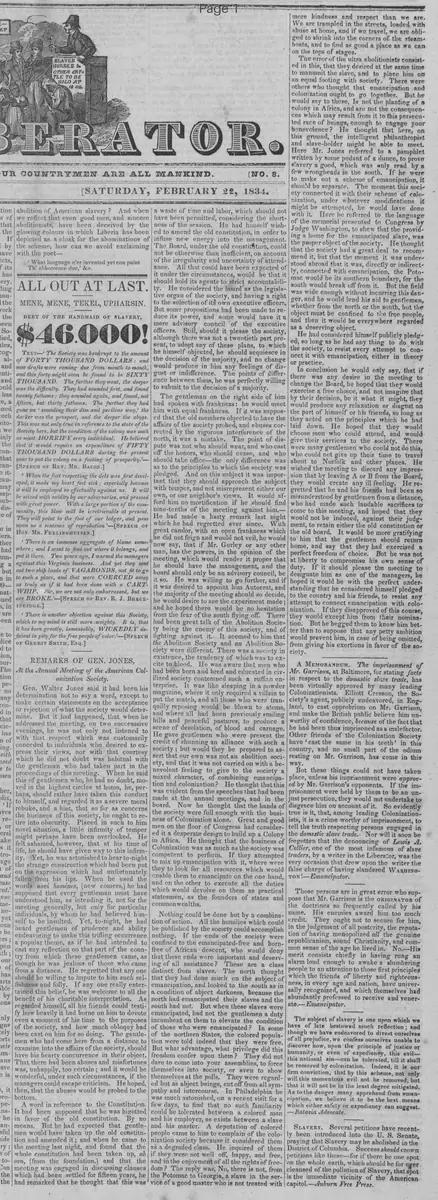
MENE, MENE, TEKEL, UPHARSIN.
DEBT OF THE HANDMAID OF SLAVERY, $46,000!
'The Society was bankrupt to the amount of FORTY THOUSAND DOLLARS: and new drafts were coming due from month to month, and this forty might soon be found to be SIXTY THOUSAND. The further they went, the deeper was the difficulty. They had sounded first, and found twenty fathoms; they sounded again, and found, not fifteen, but thirty fathoms. The further they had gone on 'sounding their dim and perilous way,' the darker was the prospect, and the deeper the abyss. This was not only true in reference to the state of the Society here, but the condition of the colony was such as must HORRIFY every individual. He believed that it would require an expenditure of FIFTY THOUSAND DOLLARS during the present year to put the colony on a footing of prosperity.'—[Speech of Rev. Mr. Bacon.]
When the fact respecting the debt was first developed, it made my heart feel sick; especially because it will be employed so effectually against us. It will be seized with avidity by our adversaries, and pressed with great power. With a large portion of the community, this blow will be irretrievable at present. They will point to the foot of our ledger, and pass upon us a sentence of reprobation'—[Speech of Hon. Mr. Frelinghuysen.]
There is an immense aggregate of blame somewhere; and I want to find out where it belongs, and put it there. Two years ago, I warned the managers against this Virginia business. And yet they sent out two ship loads of VAGABONDS, not fit to go to such a place, and that were COERCED away as truly as if it had been done with a CART WHIP. Sir, we are not only embarrassed, but we are BROKE.'—[Speech of Rev. R. J. Breckinridge.]
There is another objection against this Society, which to my mind is still more weighty. It is, that it has been greatly, lamentably, WICKEDLY deficient in pity for the free people of color.'—[Speech of Gerrit Smith, Esq.]
REMARKS OF GEN. JONES, At the Annual Meeting of the American Colonization Society.
Gen. Walter Jones said it had been his determination not to say a word, except to make certain statements on the acceptance or rejection of—what the society would determine. But it had happened, that when he addressed the meeting, on two successive evenings, he was not only not listened to with that respect which was customarily conceded to individuals who desired to express their views, nor with that courtesy which he did not doubt was habitual with the gentleman who had taken part in the proceedings of this meeting. When he said this of gentlemen who, he had no doubt, moved in the highest circles at home, he, perhaps, should rather have taken this conduct to himself, and regarded it as a severe moral rebuke, and a hint, that so far as concerns the business of this society, he ought to retire into obscurity. Placed in such to him novel situation, a little infirmity of temper might perhaps have been overlooked. He felt ashamed, however, that at his time of life, he should have given way to this infirmity. Yet, he was astonished to hear to-night the strange construction which had been put on the expression which had unfortunately fallen from his lips. When he used the words novi homines, (new comers,) he had supposed that every gentleman must have understood him, as intending it, not for the meeting generally, but only for particular individuals, by whom he had believed himself to be insulted. Yet, to-night, he had heard gentlemen of prudence and ability endeavoring to make this trifling occurrence a popular theme, as if he had intended to cast any reflection on that part of the country from which these gentlemen came, as though he was jealous of those who came from a distance. He regretted that any one should be willing to impute to him such selfishness and folly. If any one really entertained this belief, he was welcome to all the benefit of his charitable interpretation. As regarded himself, all his friends could testify how heavily it had borne on him to devote even a moment of his time to the purposes of the society, and how much obloquy had been cast on him for so doing. The gentlemen who had come here from a distance to examine into the affairs of the society, should have his hearty concurrence in their object. That there had been abuses and misfortunes was, unhappily, too certain; and it would be wonderful, under such circumstances, if the managers could escape criticism. He hoped, then, that the abuses would be probed to the bottom.
A word in reference to the Constitution. It had been supposed that he was bigotted in favor of the old constitution. By no means. But he had expected that gentlemen would have taken up the old constitution and amended it: and when he came to the meeting last night, and found that the whole constitution had been taken up, ab ovo, (from the foundation,) and that the meeting was engaged in discussing clauses which had been settled for fifteen years, he had remarked that he thought that this was a waste of time and labor, which should not have been permitted, considering the shortness of the session. He had himself wished to amend the old constitution, in order to infuse new energy into the management. The Board, under the old constitution, could not be otherwise than inefficient, on account of the irregularity and uncertainty of attendance. All that could have been expected of it under the circumstances, would be that it should hold its agents to strict accountability. He considered the board as the legislative organ of the society, and having a right to the selection of its own executive officers. But some propositions had been made to reduce its power, and some would have it a mere advisory council of the executive officers. Still, should it please the society, although there was not a twentieth part present, to adopt any of these plans, to which he himself objected, he should acquiesce in the decision of the majority, and no change would produce in him any feelings of disgust or indifference. The points of difference between them, he was perfectly willing to submit to the decision of a majority.
The gentleman on the right side of him had spoken with frankness: he would meet him with equal frankness. If it was supposed that the old members objected to have the affairs of the society probed, and abuses corrected by the vigorous interference of the north, it was a mistake. The point of dispute was not who should wear, and who cast off the honors, who should cease, and who should take office—the only difference was as to the principles to which the society was pledged. And on this subject it was important that they should approach the subject with temper, and not misrepresent either our own, or our neighbor's views. It would afford him no mortification if he should find nine-tenths of the meeting against him.— He had made a hasty remark last night which he had regretted ever since. With great candor, with an open frankness which he did not feign and would not veil, he would now say, that if Mr. Gurley or any other man, has the powers, in the opinion of the meeting, which would render it proper that he should have the management, and the board should only be an advisory council, be it so. He was willing to go further, and if it was desired to appoint him Autocrat, and the majority of the meeting should so decide, he would desire to see the experiment made; and he hoped there would be no hesitation from the fear of the south flying off. There had been great talk of the Abolition Society being the enemy of this society, and of fighting against it. It seemed to him that the Abolition Society and an Abolition Society were different. There was a society in existence, the tendency of which was to excite to blood. He was aware that men who had been born and bred and educated in civilized society contemned such a ruffian enterprise. It was like sleeping in a powder magazine, where it only required a villain to put the match, and all those who were tranquilly reposing would be blown to atoms, and where all had been previously smiling hills and peaceful pastures, to produce a scene of desolation, of blood and carnage. He gave gentlemen who were present the credit of shunning an alliance with such a society; but would they be prepared to assert that our own was not an abolition society, and that it was not carried on with a benevolent feeling to give to the society a mixed character, of combining emancipation and colonization? He thought that this was evident from the speeches that had been made at the annual meetings, and in the board. Now he thought that the hands of the society were full enough with the business of Colonization alone. Great and good men on the floor of Congress had considered it a desperate design to build up a Colony in Africa. He thought that the business of Colonization was as much as the society was competent to perform. If they attempted to mix up emancipation with it, where were they to look for all resources which would enable them to emancipate on the one hand, and on the other to execute all the duties which would devolve on them as practical statesmen, as the founders of states and commonwealths.
Nothing could be done but by a combination of action. All the homilies which could be published by the society could accomplish nothing. If the ends of the society were confined to the emancipated—free and born-free of African descent, who would deny that those ends were important and deserving of all assistance? These are a class distinct from slaves. The north thought that they had done much on the subject of emancipation, and looked to the south as in a condition of abject darkness, because the north had emancipated their slaves and the south had not. But when these slaves were emancipated, had not the gentlemen a duty incumbent on them to elevate the condition of those who were emancipated? In some of the northern States, the colored population were told indeed that they were free. But what advantage, what privilege did this freedom confer upon them? They did not dare to come into your assemblies, to force themselves into society, or even to show themselves at the polls. They were regarded but as abject beings, cut off from all sympathy and intercourse. In Philadelphia he was much astonished, on a recent visit for a few days, to find that no such familiarity could be tolerated between a colored man and his employer, as exists between a slave and his master. A deputation of colored people came to him to complain of the colonization society because it considered them as a degraded class. He inquired of them if they were not well off, happy, and free, and in the enjoyment of all the rights of freedom? The reply was, No, there is not, from the Potomac to Georgia, a slave in the service of a good master who is not treated with
more kindness and respect than we are. We are trampled in the streets, loaded with abuse at home, and if we travel, we are obliged to shrink into the corners of the steamboats, and to find as good a place as we can on the tops of stages.
The error of the ultra abolitionists consisted in this, that they desired at the same time to manumit the slave, and to place him on an equal footing with society. There were others who thought that emancipation and colonization ought to go together. But he would say to these, Is not the planting of a colony in Africa, and are not the consequences which may result from it to this persecuted race of beings, enough to engage your benevolence? He thought that here, on this ground, the intelligent philanthropist and slave-holder might be able to meet.
Here Mr. Jones referred to a pamphlet written by some pedant of a dunce, to prove slavery a good, which was only read by a few wrongheads in the south. If he were to make out a scheme of emancipation, it should be separate. The moment this society connected it with their scheme of colonization, under whatever modifications it might be attempted, he would have done with it. Here he referred to the language of the memorial presented to Congress by Judge Washington, to shew that the providing a home for the emancipated slave, was the proper object of the society. He thought that the society had a great deal to recommend it, but that the moment it was understood abroad that it was, directly or indirectly, connected with emancipation, the Potomac would be its southern boundary, for the south would break off from it. But the field was wide enough without incurring this danger, and he would lend his aid to gentlemen, whether from the north or the south, but the object must be confined to the free people. and then it would be everywhere regarded as a deserving object.
He had considered himself publicly pledged, so long as he had any thing to do with the society, to resist every attempt to connect it with emancipation, either in theory or practice.
In conclusion he would only say, that if there was any desire in the meeting to change the Board, he hoped that they would exercise a free choice, and not imagine that by their decision, be it what it might, they would produce any relaxation or disgust on the part of himself or his friends, so long as they acted on the principles which he had laid down. He hoped that they would choose men who could attend, and would give their services to the society. There were many gentlemen who could not do this, who could not give up their time to travel about to Norfolk and other places. He wished the meeting to discard any impression that by leaving A or B from the Board, they would create any ill feeling. He regretted that he and his friends had been so misunderstood by gentlemen from a distance, who had made such laudable sacrifices to come to this meeting, and hoped that they would not be induced, against their judgment, to retain either the old constitution or the old board. It would be more gratifying to him that the gentlemen should return home, and say that they had exercised a perfect freedom of choice. But he was not at liberty to compromise his own sense of duty. If it should please the meeting to designate him as one of the managers, he hoped it would be with the perfect understanding that he considered himself pledged to the country and his friends, to resist any attempt to connect emancipation with colonization. If they disapproved of this course, they would except him from their nomination. But he begged them to know him better than to suppose that any petty ambition would prevent him, in case of being omitted, from giving his exertions in favor of the society.
What sub-type of article is it?
What themes does it cover?
What keywords are associated?
What entities or persons were involved?
Where did it happen?
Story Details
Key Persons
Location
Annual Meeting Of The American Colonization Society
Story Details
Speeches at the American Colonization Society's annual meeting highlight a $46,000 debt, deepening financial woes, mismanagement in the Virginia colony, criticisms of neglecting free people of color, and Gen. Walter Jones's remarks defending the society's focus on colonization for free blacks while opposing links to emancipation.