Thank you for visiting SNEWPapers!
Sign up free
Editorial
March 25, 1910
The Hawaiian Gazette
Honolulu, Honolulu County, Hawaii
What is this article about?
Editorial endorses President Dearborn's proposal for American-Hawaiian Steamship Company to co-build a modern tourist liner with Honolulu investors to boost Hawaii tourism. Urges investment in hotels and amusements, temporary suspension of emigrant laws for foreign ships, and criticizes existing lines' focus on freight.
Clipping
OCR Quality
92%
Excellent
Full Text
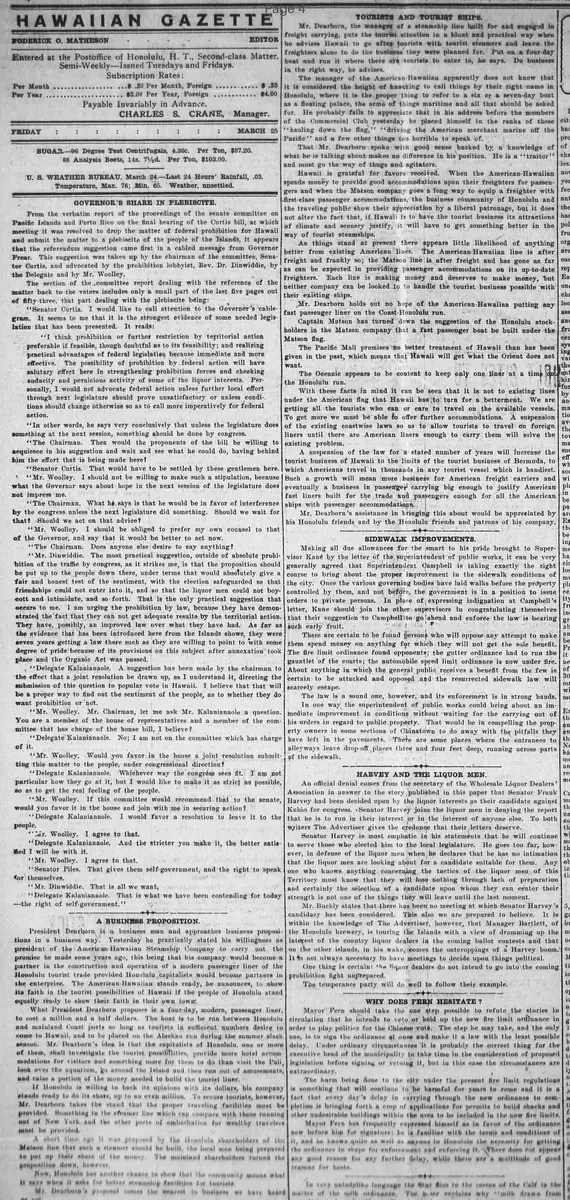
TOURISTS AND TOURIST
SHIPS.
A
BUSINESS PROPOSITION.
President Dearborn is a business man and approaches business proposi-
tions in a business way. Yesterday he practically stated his willingness as
president of the American-Hawaiian Steamship Company to carry out the
promise he made some years ago, this being that his company would become a
partner in the construction and operation of a modern passenger liner of the
Honolulu tourist trade provided Honolulu capitalists would become partners in
the enterprise. The American-Hawaiian stands ready, he announces, to show
its faith in the tourist possibilities of Hawaii if the people of Honolulu stand
equally ready to show their faith in their own town.
What President Dearborn proposes is a four-day, modern, passenger liner,
to cost a million and a half dollars. The boat is to be run between Honolulu
and mainland Coast ports so long as tourists in sufficient numbers desire to
come to Hawaii, and to be placed on the Alaskan run during the summer slack
season, Mr. Dearborn's idea is that the capitalists of Honolulu, one or more
of them, shall investigate the tourist possibilities, provide more hotel accom
modations for visitors and something more for them to do than visit the Pali
look over the aquarium, go around the Island and then run out of amusements,
and raise a portion of the money needed to build the tourist liner.
If Honolulu is willing to back its opinions with its dollars, his company
stands ready to do its share, up to an even million. To secure tourists, however,
Mr. Dearborn takes the stand that the proper traveling facilities must be
provided. Something in the steamer line which can compare with those running
out of New York and the other ports of embarkation for wealthy travelers
must be provided.
A short time ago it was proposed by the Honolulu shareholders of the
Matson Line that such a steamer should be built, the local men being prepared
to put up their share of the money. The mainland shareholders turned the
proposition down, however.
Now, Honolulu has another chance to show that the community means what
it says when it asks for better steamship facilities for tourists.
Mr. Dearborn's proposal comes the nearest to business we have heard
as yet.
In the meantime, pending the building of such a steamer, the temporary
passage of the suspending resolution of the emigrant law will sort a stream
of tourists this way in which the boats cannot see advantage what
Mr. Dearborn, the manager of a steamship line built for and engaged in
freight carrying, puts the tourist situation in a blunt and practical way when
he advises Hawaii to go after tourists with tourist steamers and leave the
freighters alone to do the business they were planned for. Put on a four-day
boat and run it where there are tourists to cater to, he says. Do business
in the right way, he advises.
The manager of the American-Hawaiian apparently does not know that
it is considered the height of knocking to call things by their right name in
Honolulu, where it is the proper thing to refer to a six or a seven-day boat
as a floating palace, the acme of things maritime and all that should be asked
for. He probably fails to appreciate that in his address before the members
of the Commercial Club yesterday he placed himself in the ranks of those
"hauling down the flag," "driving the American merchant marine off the
Pacific" and a few other things too horrible to speak of.
That Mr. Dearborn spoke with good sense backed by a knowledge of
what he is talking about makes no difference in his position. He is a "traitor"
and must go the way of thugs and agitators.
Hawaii is grateful for favors received. When the American-Hawaiian
spends money to provide good accommodations upon their freighters for passen-
gers and when the Matson company goes a long way to equip a freighter with
first-class passenger accommodations, the business community of Honolulu and
the traveling public show their appreciation by a liberal patronage, but it does
not alter the fact that, if Hawaii is to have the tourist business its attractions
of climate and scenery justify, it will have to get something better in the
way of tourist steamships.
As things stand at present there appears little likelihood of anything
better from existing American lines. The American-Hawaiian line is after
freight and frankly so; the Matson line is after freight and has gone as far
as can be expected in providing passenger accommodations on its up-to-date
freighters. Each line is making money and deserves to make money, but
neither company can be looked to to handle the tourist business possible with
their existing ships.
Mr. Dearborn holds out no hope of the American-Hawaiian putting any
fast passenger liner on the Coast-Honolulu run.
Captain Matson has turned down the suggestion of the Honolulu stock-
holders in the Matson company that a fast passenger boat be built under the
Matson flag.
The Pacific Mail promises no better treatment of Hawaii than has been
given in the past, which means that Hawaii will get what the Orient does not
want.
The Oceanic appears to be content to keep only one liner at a time on
the Honolulu run.
With these facts in mind it can be seen that it is not to existing lines
under the American flag that Hawaii has to turn for a betterment. We are
getting all the tourists who can or care to travel on the available vessels.
To get more we must be able to offer further accommodations. A suspension
of the existing coastwise laws so as to allow tourists to travel on foreign
liners until there are American liners enough to carry them will solve the
existing problem.
A suspension of the law for a stated number of years will increase the
tourist business of Hawaii to the limits of the tourist business of Bermuda, to
which Americans travel in thousands in any tourist vessel which is handiest.
Such a growth will mean more business for American freight carriers and
eventually a business in passenger carrying big enough to justify American
fast liners built for the trade and passengers enough for all the American
ships with passenger accommodations.
Mr. Dearborn's assistance in bringing this about would be appreciated by
his Honolulu friends and by the Honolulu friends and patrons of his company.
SHIPS.
A
BUSINESS PROPOSITION.
President Dearborn is a business man and approaches business proposi-
tions in a business way. Yesterday he practically stated his willingness as
president of the American-Hawaiian Steamship Company to carry out the
promise he made some years ago, this being that his company would become a
partner in the construction and operation of a modern passenger liner of the
Honolulu tourist trade provided Honolulu capitalists would become partners in
the enterprise. The American-Hawaiian stands ready, he announces, to show
its faith in the tourist possibilities of Hawaii if the people of Honolulu stand
equally ready to show their faith in their own town.
What President Dearborn proposes is a four-day, modern, passenger liner,
to cost a million and a half dollars. The boat is to be run between Honolulu
and mainland Coast ports so long as tourists in sufficient numbers desire to
come to Hawaii, and to be placed on the Alaskan run during the summer slack
season, Mr. Dearborn's idea is that the capitalists of Honolulu, one or more
of them, shall investigate the tourist possibilities, provide more hotel accom
modations for visitors and something more for them to do than visit the Pali
look over the aquarium, go around the Island and then run out of amusements,
and raise a portion of the money needed to build the tourist liner.
If Honolulu is willing to back its opinions with its dollars, his company
stands ready to do its share, up to an even million. To secure tourists, however,
Mr. Dearborn takes the stand that the proper traveling facilities must be
provided. Something in the steamer line which can compare with those running
out of New York and the other ports of embarkation for wealthy travelers
must be provided.
A short time ago it was proposed by the Honolulu shareholders of the
Matson Line that such a steamer should be built, the local men being prepared
to put up their share of the money. The mainland shareholders turned the
proposition down, however.
Now, Honolulu has another chance to show that the community means what
it says when it asks for better steamship facilities for tourists.
Mr. Dearborn's proposal comes the nearest to business we have heard
as yet.
In the meantime, pending the building of such a steamer, the temporary
passage of the suspending resolution of the emigrant law will sort a stream
of tourists this way in which the boats cannot see advantage what
Mr. Dearborn, the manager of a steamship line built for and engaged in
freight carrying, puts the tourist situation in a blunt and practical way when
he advises Hawaii to go after tourists with tourist steamers and leave the
freighters alone to do the business they were planned for. Put on a four-day
boat and run it where there are tourists to cater to, he says. Do business
in the right way, he advises.
The manager of the American-Hawaiian apparently does not know that
it is considered the height of knocking to call things by their right name in
Honolulu, where it is the proper thing to refer to a six or a seven-day boat
as a floating palace, the acme of things maritime and all that should be asked
for. He probably fails to appreciate that in his address before the members
of the Commercial Club yesterday he placed himself in the ranks of those
"hauling down the flag," "driving the American merchant marine off the
Pacific" and a few other things too horrible to speak of.
That Mr. Dearborn spoke with good sense backed by a knowledge of
what he is talking about makes no difference in his position. He is a "traitor"
and must go the way of thugs and agitators.
Hawaii is grateful for favors received. When the American-Hawaiian
spends money to provide good accommodations upon their freighters for passen-
gers and when the Matson company goes a long way to equip a freighter with
first-class passenger accommodations, the business community of Honolulu and
the traveling public show their appreciation by a liberal patronage, but it does
not alter the fact that, if Hawaii is to have the tourist business its attractions
of climate and scenery justify, it will have to get something better in the
way of tourist steamships.
As things stand at present there appears little likelihood of anything
better from existing American lines. The American-Hawaiian line is after
freight and frankly so; the Matson line is after freight and has gone as far
as can be expected in providing passenger accommodations on its up-to-date
freighters. Each line is making money and deserves to make money, but
neither company can be looked to to handle the tourist business possible with
their existing ships.
Mr. Dearborn holds out no hope of the American-Hawaiian putting any
fast passenger liner on the Coast-Honolulu run.
Captain Matson has turned down the suggestion of the Honolulu stock-
holders in the Matson company that a fast passenger boat be built under the
Matson flag.
The Pacific Mail promises no better treatment of Hawaii than has been
given in the past, which means that Hawaii will get what the Orient does not
want.
The Oceanic appears to be content to keep only one liner at a time on
the Honolulu run.
With these facts in mind it can be seen that it is not to existing lines
under the American flag that Hawaii has to turn for a betterment. We are
getting all the tourists who can or care to travel on the available vessels.
To get more we must be able to offer further accommodations. A suspension
of the existing coastwise laws so as to allow tourists to travel on foreign
liners until there are American liners enough to carry them will solve the
existing problem.
A suspension of the law for a stated number of years will increase the
tourist business of Hawaii to the limits of the tourist business of Bermuda, to
which Americans travel in thousands in any tourist vessel which is handiest.
Such a growth will mean more business for American freight carriers and
eventually a business in passenger carrying big enough to justify American
fast liners built for the trade and passengers enough for all the American
ships with passenger accommodations.
Mr. Dearborn's assistance in bringing this about would be appreciated by
his Honolulu friends and by the Honolulu friends and patrons of his company.
What sub-type of article is it?
Trade Or Commerce
Economic Policy
What keywords are associated?
Tourist Ships
Hawaii Tourism
Steamship Lines
Passenger Liners
American Hawaiian
Matson Line
Emigrant Law Suspension
What entities or persons were involved?
President Dearborn
American Hawaiian Steamship Company
Honolulu Capitalists
Matson Line
Captain Matson
Pacific Mail
Oceanic
Editorial Details
Primary Topic
Proposal For Modern Tourist Passenger Liner In Hawaii
Stance / Tone
Supportive Of Business Proposition For Better Tourist Shipping
Key Figures
President Dearborn
American Hawaiian Steamship Company
Honolulu Capitalists
Matson Line
Captain Matson
Pacific Mail
Oceanic
Key Arguments
American Hawaiian Willing To Partner In Building $1.5m Four Day Passenger Liner If Honolulu Invests
Honolulu Needs More Hotels And Amusements To Attract Tourists
Existing Lines Focus On Freight, Not Suitable For Growing Tourist Trade
Temporarily Suspend Emigrant Laws To Allow Foreign Liners For Tourists
Such Measures Will Boost Tourism Like Bermuda's And Justify American Passenger Ships