Thank you for visiting SNEWPapers!
Sign up free
The National Intelligencer And Washington Advertiser
Washington, District Of Columbia
What is this article about?
In the U.S. House on Feb. 12, 1803, debate on repealing discriminating and countervailing duties with Britain led to discharging the committee without decision, due to late session and unprepared public opinion.
Clipping
OCR Quality
Full Text
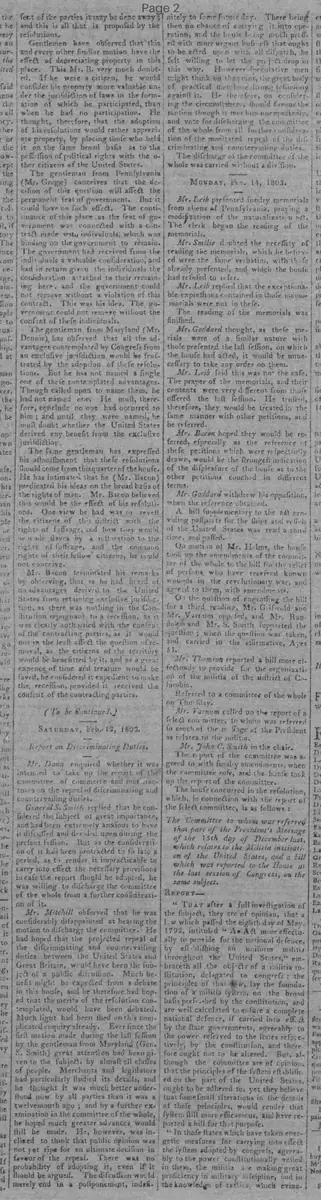
Report on Discriminating Duties.
Mr. Dana enquired whether it was intended to take up the report of the committee of Commerce and manufactures on the repeal of discriminating and countervailing duties.
General S. Smith replied that he considered the subject of great importance, and had been extremely anxious to have it discussed and decided upon during the present session. But as the consideration of it had been protracted to so late a period, as to render it impracticable to carry into effect the necessary provisions in case the report should be adopted, he was willing to discharge the Committee of the whole from a further consideration of it.
Mr. Mitchill observed that he was considerably disappointed at hearing the motion to discharge the committee. He had hoped that the projected repeal of the discriminating and countervailing duties between the United States and Great Britain, would have been the subject of a public discussion. Much benefit might be expected from a debate in this house, and he therefore had hoped that the merits of the resolution contemplated, would have been debated.
Much light had been shed on this complicated enquiry already. Ever since the first motion made during the last session by the gentleman from Maryland (Gen. S. Smith) great attention had been given to the subject, by almost all classes of people. Merchants and legislators had particularly studied its details, and he thought it was much better understood now by all parties than it was a twelvemonth ago; and by a further examination in the committee of the whole, he hoped much greater advances would still be made. He, however, was inclined to think that public opinion was not yet ripe for an ultimate decision in favour of the repeal. There was no probability of adopting it, even if it should be argued. The discussion would merely end in a postponement, indeed indefinitely to some future day. There being then no chance of carrying it into operation, and the house being much pressed with more urgent business that ought to be acted upon with all dispatch, he felt willing to let the project drop in this way. However speculative men might think on the point, the great body of practical men bore strong testimony against it. He therefore, on considering the circumstance, should favour the motion though it met him unexpectedly, and vote for discharging the committee of the whole from all further consideration of the meditated repeal of the discriminating and countervailing duties.
The discharge of the committee of the whole was carried without a division.
What sub-type of article is it?
What keywords are associated?
What entities or persons were involved?
Where did it happen?
Domestic News Details
Primary Location
United States House Of Representatives
Event Date
1803 02 12
Key Persons
Outcome
the committee of the whole was discharged from further consideration without a division.
Event Details
Mr. Dana inquired about taking up the report on repealing discriminating and countervailing duties. General S. Smith, considering the late session timing, moved to discharge the committee. Mr. Mitchill expressed disappointment but agreed due to lack of readiness for repeal and urgent business, favoring the motion.