Thank you for visiting SNEWPapers!
Sign up free
Editorial
April 16, 1840
Watchman Of The South
Richmond, Virginia
What is this article about?
A religious editorial explaining the biblical basis, occasions, nature, and proper observance of fasting, distinguishing it from Jewish practices and emphasizing personal and communal aspects for spiritual benefit.
Merged-components note: Single continuous editorial on the subject of fasting spanning components across pages 2 and 3.
Clippings
1 of 2
OCR Quality
95%
Excellent
Full Text
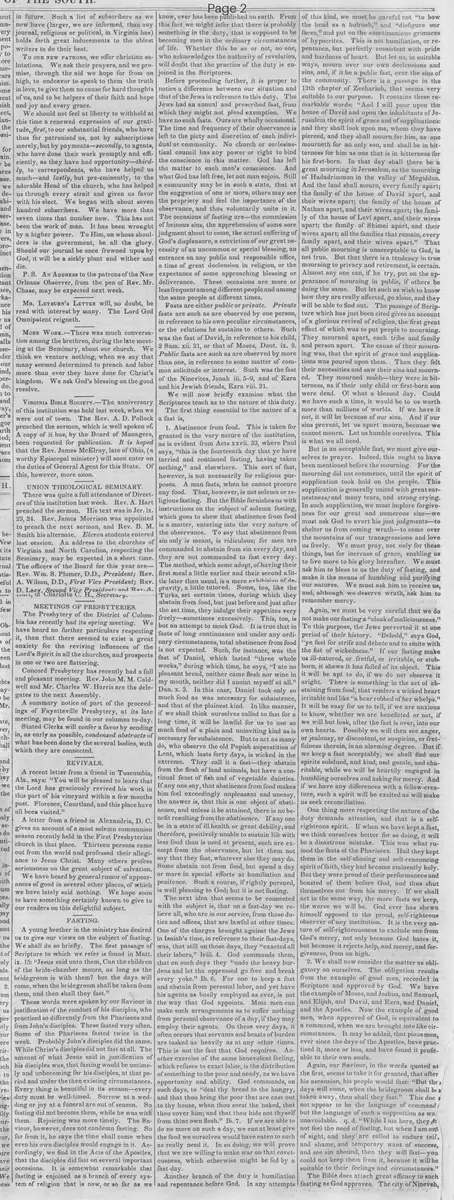
FASTING.
A young brother in the ministry has desired
us to give our views on the subject of fasting.
We shall do so briefly. The first passage of
Scripture to which we refer is found in Matt.
ix. 15: "Jesus said unto them, Can the children
of the bride-chamber mourn, as long as the
bridegroom is with them? but the days will
come, when the bridegroom shall be taken from
them, and then shall they fast."
These words were spoken by our Saviour in
justification of the conduct of his disciples, who
practised so differently from the Pharisees and
from John's disciples. These fasted very often.
Some of the Pharisees fasted twice in the
week. Probably John's disciples did the same.
While Christ's disciples did not fast at all. The
amount of what Jesus said in justification of
his disciples was, that fasting would be untime-
ly and unbecoming for his disciples, at that pe-
riod and under the then existing circumstances.
Every thing is beautiful in its season—every
duty must be well-timed. Sorrow at a wed-
ding or joy at a funeral are out of season. So
fasting did not become them, while he was with
them. Rejoicing was more timely. The Sa-
viour, however, does not condemn fasting. So
far from it, he says the time shall come when
even his own disciples would engage in it. Ac-
cordingly, we find in the Acts of the Apostles,
that the disciples did fast on several important
occasions. It is somewhat remarkable that
fasting is enjoined as a branch of every sys-
tem of religion that is now, or so far as we
know, ever has been published on earth. From
this fact we might infer that there is probably
something in the duty, that is supposed to be
becoming men in the ordinary circumstances
of life. Whether this be so or not, no one,
who acknowledges the authority of revelation,
will doubt that the practice of the duty is en-
joined in the Scriptures.
Before proceeding further, it is proper to
notice a difference between our situation and
that of the Jews in reference to this duty. The
Jews had an annual and prescribed fast, from
which they might not plead exemption. We
have no such fasts. Ours are wholly occasional.
The time and frequency of their observance is
left to the piety and discretion of each indivi-
dual or community. No church or ecclesias-
tical council has any power or right to bind
the conscience in this matter. God has left
the matter to each man's conscience. And
what God has left free, let not man enjoin. Still
a community may be in such a state, that at
the suggestion of one or more, others may see
the propriety and feel the importance of the
observance, and thus voluntarily unite in it.
The occasions of fasting are—the commission
of heinous sins, the apprehension of some sore
judgment about to come, the actual suffering of
God's displeasure, a conviction of our great ne-
cessity of an uncommon or special blessing, an
entrance on any public and responsible office
a time of great declension in religion, or the
expectance of some approaching blessing or
deliverance.
These occasions are more or
less frequent among different people and among
the same people at different times.
Fasts are either public or private. Private
fasts are such as are observed by one person,
in reference to his own peculiar circumstances,
or the relations he sustains to others. Such
was the fast of David, in reference to his child,
2 Sam. xii. 21, or that of Moses, Deut. ix. 9.
Public fasts are such as are observed by more
than one, in reference to some matter of com-
mon solicitude or interest. Such was the fast
of the Ninevites, Jonah iii. 5-9, and of Ezra
and his Jewish friends, Ezra viii. 21.
We will now briefly examine what the
Scriptures teach as to the nature of this duty.
The first thing essential to the nature of a
fast is,
1. Abstinence from food. This is taken for
granted in the very nature of the institution,
as is evident from Acts xxvii. 33, where Paul
says, "this is the fourteenth day that ye have
tarried and continued fasting, having taken
nothing," and elsewhere. This sort of fast,
however, is not necessarily for religious pur-
poses. A man fasts, when he cannot procure
any food. That, however, is not solemn or re-
ligious fasting. But the Bible furnishes us with
instructions on the subject of solemn fasting,
which goes to shew that abstinence from food
is a matter, entering into the very nature of
the observance. To say that abstinence from
sin only is meant, is ridiculous; for men are
commanded to abstain from sin every day, and
they are not commanded to fast every day.
The method, which some adopt, of having their
first meal a little earlier and their second a lit-
tle later than usual, is a mere exhibition of de-
pravity, a little tutored. Some, too, like the
Turks, set certain times, during which they
abstain from food, but just before and just after
the set time, they indulge their appetites very
freely—sometimes excessively. This, too, is
but an attempt to mock God. It is true that in
fasts of long continuance and under any ordi-
nary circumstances, total abstinence from food
is not expected. Such, for instance, was the
fast of Daniel, which lasted "three whole
weeks," during which time, he says, "I ate no
pleasant bread, neither came flesh nor wine in
my mouth, neither did I anoint myself at all,"
Dan. x. 3. In this case, Daniel took only so
much food as was necessary for subsistence,
and that of the plainest kind. In like manner,
if we shall think ourselves called to fast for a
long time, it will be lawful for us to use so
much food of a plain and uninviting kind as is
necessary for subsistence. But to act as many
do, who observe the old Popish superstition of
Lent, which lasts forty days, is wicked in the
extreme. They call it a fast—they abstain
from the flesh of land animals, but have a con-
tinual feast of fish and of vegetable dainties.
If any one say, that abstinence from food makes
him feel exceedingly unpleasant and uneasy,
the answer is, that this is one object of absti-
nence, and unless it be attained, there is no be-
nefit resulting from the abstinence. If any one
be in a state of ill health or great debility, and
therefore, positively unable to sustain life with
less food than is used at present, such are ex-
empt from the observance, but let them not
say that they fast, whatever else they may do.
Some abstain not from food, but spend a day
or more in special efforts at humiliation and
penitence. Such a course, if rightly pursued
is well pleasing to God; but it is not fasting.
The next idea that seems to be connected
with the subject is, that on a fast-day we re-
lieve all, who are in our service, from those du-
ties and offices, that are lawful at other times.
One of the charges brought against the Jews
in Isaiah's time, in reference to their fast-days,
was, that still on those days, they "exacted all
their labors," lviii. 4. God commands them,
that on such days they "undo the heavy bur-
dens and let the oppressed go free and break
every yoke." Ib. 6. For one to keep a fast
and abstain from personal labor, and yet have
his agents as busily employed as ever, is not
the way that God appoints. Most men can
make such arrangements as to suffer nothing
from personal observance of a day, if they may
employ their agents. On these very days, it
often occurs that servants and beasts of burden
are tasked as heavily as at any other times.
This is not the fast that God requires. An-
other exercise of the same benevolent feeling,
which refuses to exact labor, is the distribution
of something to the poor and needy, as we have
opportunity and ability. God commands, on
such days, to "deal thy bread to the hungry,
and that thou bring the poor that are cast out
to thy house, when thou seest the naked, that
thou cover him; and that thou hide not thyself
from thine own flesh." Ib. 7. If we are able to
do no more on such a day, we can at least give
the food we ourselves would have eaten to such
as really need it. In so doing, we will prove
that we are willing to make war on that covet-
ousness, which otherwise might be fed by a
fast-day.
Another branch of the duty is humiliation
and repentance before God. In any attempts
of this kind, we must be careful not "to bow
the head as a bulrush," and "disfigure our
faces," and put on the sanctimonious grimaces
of hypocrites. This is not humiliation, or re-
pentence, but perfectly consistent with pride
and hardness of heart. But let us, in suitable
ways, mourn over our own declensions and
sins, and, if it be a public fast, over the sins of
the community. There is a passage in the
12th chapter of Zechariah, that seems very
suitable to our purpose. It contains these re-
markable words: "And I will pour upon the
house of David and upon the inhabitants of Je-
rusalem the spirit of grace and of supplications:
and they shall look upon me, whom they have
pierced, and they shall mourn for him, as one
mourneth for an only son, and shall be in bit-
terness for him as one that is in bitterness for
his first-born. In that day shall there be a
great mourning in Jerusalem, as the mourning
of Hadadrimmon in the valley of Megiddon.
And the land shall mourn, every family apart;
the family of the house of David apart, and
their wives apart; the family of the house of
Nathan apart, and their wives apart; the fami-
ly of the house of Levi apart, and their wives
apart; the family of Shimei apart, and their
wives apart; all the families that remain, every
family apart, and their wives apart." That
all public mourning is unacceptable to God, is
not true. But that there is a tendency in true
mourning to privacy and retirement, is certain.
Almost any one can, if he try, put on the ap-
pearance of mourning in public; if others be
doing the same. But let such as wish to know
how they are really affected, go alone, and they
will be able to find out. The passage of Scrip-
ture which has just been cited gives an account
of a glorious revival of religion, the first great
effect of which was to put people to mourning.
They mourned apart, each tribe and family
and person apart. The cause of their mourn-
ing was, that the spirit of grace and supplica-
tions was poured upon them. Then they felt
their necessities and saw their sins and mourn-
ed. They mourned much—they were in bit-
terness, as if their only child or first-born son
were dead. O! what a blessed day. Could
we have such a time, it would be to us worth
more than millions of worlds. If we have it
not, it will be because of our sins. And if our
sins prevent, let us apart mourn, because we
cannot mourn. Let us humble ourselves. This
is what we all need.
But in an acceptable fast, we must give our-
selves to prayer. Indeed, this ought to have
been mentioned before the mourning. For the
mourning did not commence, until the spirit of
supplication took hold on the people. This
supplication is generally united with great ear-
estness, and many tears, and strong crying.
In such supplication, we must implore forgive-
ness for our great and numerous sins—we
must ask God to avert his just judgments—to
shelter us from coming wrath—to come over
the mountains of our transgressions and love
us freely. We must pray, not only for these
things, but for increase of grace, enabling us
to live more to his glory hereafter. We must
ask him to bless to us the duty of fasting, and
make it the means of humbling and purifying
our natures. We must ask him to receive us,
and, although we deserve wrath, ask him to
remember mercy.
Again, we must be very careful that we do
not make our fasting a "cloak of maliciousness."
To this purpose, the Jews perverted it at one
period of their history. "Behold," says God,
"ye fast for strife and debate and to smite with
the fist of wickedness." If our fasting make
us ill-natured, or fretful, or irritable, or stub-
born, it shews it has failed of its object. This
it will be apt to do, if we do not observe it
aright. There is something in the act of ab-
staining from food, that renders a wicked heart
irritable and like "a bear robbed of her whelps."
It will be easy for us to tell, if we are anxious
to know, whether we are benefitted or not, if
we will but look, after the fast is over, into our
own hearts. Possibly we will then see anger,
or jealousy, or discontent, or suspicion, or fret-
fulness therein, in an alarming degree. But if
we keep a fast acceptably, we shall find our
spirits subdued, and kind, and gentle, and cha-
ritable, while we will be heartily engaged in
humbling ourselves and asking for mercy. And
if we have any differences with a fellow-crea-
ture, such a spirit will be excited as will make
us seek reconciliation.
One thing more respecting the nature of the
duty demands attention, and that is a self
righteous spirit. If when we have kept a fast,
we think ourselves better for so doing, it will
be a disastrous mistake. This was what ru-
ined the fasts of the Pharisees. Had they kept
them in the self-abasing and self-renouncing
spirit of faith, they had become eminently holy.
But they were proud of their performances and
boasted of them before God, and thus shut
themselves out from his mercy. If we shall
act in the same way, the more fasts we keep,
the worse we will be. God ever has shewn
himself opposed to the proud, self-righteous
observer of any institution. It is the very na-
ture of self-righteousness to exclude one from
God's mercy, not only because God hates it,
but because it rejects help, and mercy, and for-
giveness, from on high.
2. We shall now consider the matter as obli-
gatory on ourselves. The obligation results
from the example of good men, recorded in
Scripture and approved by God. We have
the example of Moses, and Joshua, and Samuel,
and Elijah, and David, and Ezra, and Daniel,
and the Apostles. Now the example of good
men, when approved of God, is equivalent to
a command, when we are brought into like cir-
cumstances. It may be added, that pious men,
ever since the days of the Apostles, have prac-
tised it, more or less, and have found it profit-
able to their own souls.
Again, our Saviour, in the words quoted at
the first, seems to take it for granted, that after
his ascension, his people would fast: "But the
days will come, when the bridegroom shall be
taken away, then shall they fast." This does
not appear to be the language of command
but the language of such a supposition as was
unavoidable. q. d. "While I am here, they
not feel the need of fasting, but when I am out
of sight, and they are called to endure toil,
and shame, and temporary want of success,
and see sin abound, then they will fast—you
could not keep them from it, because it will be
suitable to their feelings and circumstances."
The Bible does attach great efficacy to such
fasting as God approves. The city of Nineveh.
with its thousands, was saved by it. And our Saviour said that there were peculiarly stubborn and distressing cases of possessions of the devil, which no instrumentality could affect but fasting and prayer, teaching us that these could affect them. So there may be sins and states of feeling in the church, which no other means would reach. This may be our own case now.
Our Saviour certainly expected his people to fast, or he would not have given directions as to the method of performing the duty. "When ye fast," said he, "be not as the hypocrites," &c. Now if we have such a spirit that we will not perform a duty, because there are no set times pointed out in Scripture for its performance, will it not argue a great amount of coldness and indifference to Christ's commands? Nay, will it not go far to prove us destitute of his spirit? and if "any have not the spirit of Christ he is none of his."
A young brother in the ministry has desired
us to give our views on the subject of fasting.
We shall do so briefly. The first passage of
Scripture to which we refer is found in Matt.
ix. 15: "Jesus said unto them, Can the children
of the bride-chamber mourn, as long as the
bridegroom is with them? but the days will
come, when the bridegroom shall be taken from
them, and then shall they fast."
These words were spoken by our Saviour in
justification of the conduct of his disciples, who
practised so differently from the Pharisees and
from John's disciples. These fasted very often.
Some of the Pharisees fasted twice in the
week. Probably John's disciples did the same.
While Christ's disciples did not fast at all. The
amount of what Jesus said in justification of
his disciples was, that fasting would be untime-
ly and unbecoming for his disciples, at that pe-
riod and under the then existing circumstances.
Every thing is beautiful in its season—every
duty must be well-timed. Sorrow at a wed-
ding or joy at a funeral are out of season. So
fasting did not become them, while he was with
them. Rejoicing was more timely. The Sa-
viour, however, does not condemn fasting. So
far from it, he says the time shall come when
even his own disciples would engage in it. Ac-
cordingly, we find in the Acts of the Apostles,
that the disciples did fast on several important
occasions. It is somewhat remarkable that
fasting is enjoined as a branch of every sys-
tem of religion that is now, or so far as we
know, ever has been published on earth. From
this fact we might infer that there is probably
something in the duty, that is supposed to be
becoming men in the ordinary circumstances
of life. Whether this be so or not, no one,
who acknowledges the authority of revelation,
will doubt that the practice of the duty is en-
joined in the Scriptures.
Before proceeding further, it is proper to
notice a difference between our situation and
that of the Jews in reference to this duty. The
Jews had an annual and prescribed fast, from
which they might not plead exemption. We
have no such fasts. Ours are wholly occasional.
The time and frequency of their observance is
left to the piety and discretion of each indivi-
dual or community. No church or ecclesias-
tical council has any power or right to bind
the conscience in this matter. God has left
the matter to each man's conscience. And
what God has left free, let not man enjoin. Still
a community may be in such a state, that at
the suggestion of one or more, others may see
the propriety and feel the importance of the
observance, and thus voluntarily unite in it.
The occasions of fasting are—the commission
of heinous sins, the apprehension of some sore
judgment about to come, the actual suffering of
God's displeasure, a conviction of our great ne-
cessity of an uncommon or special blessing, an
entrance on any public and responsible office
a time of great declension in religion, or the
expectance of some approaching blessing or
deliverance.
These occasions are more or
less frequent among different people and among
the same people at different times.
Fasts are either public or private. Private
fasts are such as are observed by one person,
in reference to his own peculiar circumstances,
or the relations he sustains to others. Such
was the fast of David, in reference to his child,
2 Sam. xii. 21, or that of Moses, Deut. ix. 9.
Public fasts are such as are observed by more
than one, in reference to some matter of com-
mon solicitude or interest. Such was the fast
of the Ninevites, Jonah iii. 5-9, and of Ezra
and his Jewish friends, Ezra viii. 21.
We will now briefly examine what the
Scriptures teach as to the nature of this duty.
The first thing essential to the nature of a
fast is,
1. Abstinence from food. This is taken for
granted in the very nature of the institution,
as is evident from Acts xxvii. 33, where Paul
says, "this is the fourteenth day that ye have
tarried and continued fasting, having taken
nothing," and elsewhere. This sort of fast,
however, is not necessarily for religious pur-
poses. A man fasts, when he cannot procure
any food. That, however, is not solemn or re-
ligious fasting. But the Bible furnishes us with
instructions on the subject of solemn fasting,
which goes to shew that abstinence from food
is a matter, entering into the very nature of
the observance. To say that abstinence from
sin only is meant, is ridiculous; for men are
commanded to abstain from sin every day, and
they are not commanded to fast every day.
The method, which some adopt, of having their
first meal a little earlier and their second a lit-
tle later than usual, is a mere exhibition of de-
pravity, a little tutored. Some, too, like the
Turks, set certain times, during which they
abstain from food, but just before and just after
the set time, they indulge their appetites very
freely—sometimes excessively. This, too, is
but an attempt to mock God. It is true that in
fasts of long continuance and under any ordi-
nary circumstances, total abstinence from food
is not expected. Such, for instance, was the
fast of Daniel, which lasted "three whole
weeks," during which time, he says, "I ate no
pleasant bread, neither came flesh nor wine in
my mouth, neither did I anoint myself at all,"
Dan. x. 3. In this case, Daniel took only so
much food as was necessary for subsistence,
and that of the plainest kind. In like manner,
if we shall think ourselves called to fast for a
long time, it will be lawful for us to use so
much food of a plain and uninviting kind as is
necessary for subsistence. But to act as many
do, who observe the old Popish superstition of
Lent, which lasts forty days, is wicked in the
extreme. They call it a fast—they abstain
from the flesh of land animals, but have a con-
tinual feast of fish and of vegetable dainties.
If any one say, that abstinence from food makes
him feel exceedingly unpleasant and uneasy,
the answer is, that this is one object of absti-
nence, and unless it be attained, there is no be-
nefit resulting from the abstinence. If any one
be in a state of ill health or great debility, and
therefore, positively unable to sustain life with
less food than is used at present, such are ex-
empt from the observance, but let them not
say that they fast, whatever else they may do.
Some abstain not from food, but spend a day
or more in special efforts at humiliation and
penitence. Such a course, if rightly pursued
is well pleasing to God; but it is not fasting.
The next idea that seems to be connected
with the subject is, that on a fast-day we re-
lieve all, who are in our service, from those du-
ties and offices, that are lawful at other times.
One of the charges brought against the Jews
in Isaiah's time, in reference to their fast-days,
was, that still on those days, they "exacted all
their labors," lviii. 4. God commands them,
that on such days they "undo the heavy bur-
dens and let the oppressed go free and break
every yoke." Ib. 6. For one to keep a fast
and abstain from personal labor, and yet have
his agents as busily employed as ever, is not
the way that God appoints. Most men can
make such arrangements as to suffer nothing
from personal observance of a day, if they may
employ their agents. On these very days, it
often occurs that servants and beasts of burden
are tasked as heavily as at any other times.
This is not the fast that God requires. An-
other exercise of the same benevolent feeling,
which refuses to exact labor, is the distribution
of something to the poor and needy, as we have
opportunity and ability. God commands, on
such days, to "deal thy bread to the hungry,
and that thou bring the poor that are cast out
to thy house, when thou seest the naked, that
thou cover him; and that thou hide not thyself
from thine own flesh." Ib. 7. If we are able to
do no more on such a day, we can at least give
the food we ourselves would have eaten to such
as really need it. In so doing, we will prove
that we are willing to make war on that covet-
ousness, which otherwise might be fed by a
fast-day.
Another branch of the duty is humiliation
and repentance before God. In any attempts
of this kind, we must be careful not "to bow
the head as a bulrush," and "disfigure our
faces," and put on the sanctimonious grimaces
of hypocrites. This is not humiliation, or re-
pentence, but perfectly consistent with pride
and hardness of heart. But let us, in suitable
ways, mourn over our own declensions and
sins, and, if it be a public fast, over the sins of
the community. There is a passage in the
12th chapter of Zechariah, that seems very
suitable to our purpose. It contains these re-
markable words: "And I will pour upon the
house of David and upon the inhabitants of Je-
rusalem the spirit of grace and of supplications:
and they shall look upon me, whom they have
pierced, and they shall mourn for him, as one
mourneth for an only son, and shall be in bit-
terness for him as one that is in bitterness for
his first-born. In that day shall there be a
great mourning in Jerusalem, as the mourning
of Hadadrimmon in the valley of Megiddon.
And the land shall mourn, every family apart;
the family of the house of David apart, and
their wives apart; the family of the house of
Nathan apart, and their wives apart; the fami-
ly of the house of Levi apart, and their wives
apart; the family of Shimei apart, and their
wives apart; all the families that remain, every
family apart, and their wives apart." That
all public mourning is unacceptable to God, is
not true. But that there is a tendency in true
mourning to privacy and retirement, is certain.
Almost any one can, if he try, put on the ap-
pearance of mourning in public; if others be
doing the same. But let such as wish to know
how they are really affected, go alone, and they
will be able to find out. The passage of Scrip-
ture which has just been cited gives an account
of a glorious revival of religion, the first great
effect of which was to put people to mourning.
They mourned apart, each tribe and family
and person apart. The cause of their mourn-
ing was, that the spirit of grace and supplica-
tions was poured upon them. Then they felt
their necessities and saw their sins and mourn-
ed. They mourned much—they were in bit-
terness, as if their only child or first-born son
were dead. O! what a blessed day. Could
we have such a time, it would be to us worth
more than millions of worlds. If we have it
not, it will be because of our sins. And if our
sins prevent, let us apart mourn, because we
cannot mourn. Let us humble ourselves. This
is what we all need.
But in an acceptable fast, we must give our-
selves to prayer. Indeed, this ought to have
been mentioned before the mourning. For the
mourning did not commence, until the spirit of
supplication took hold on the people. This
supplication is generally united with great ear-
estness, and many tears, and strong crying.
In such supplication, we must implore forgive-
ness for our great and numerous sins—we
must ask God to avert his just judgments—to
shelter us from coming wrath—to come over
the mountains of our transgressions and love
us freely. We must pray, not only for these
things, but for increase of grace, enabling us
to live more to his glory hereafter. We must
ask him to bless to us the duty of fasting, and
make it the means of humbling and purifying
our natures. We must ask him to receive us,
and, although we deserve wrath, ask him to
remember mercy.
Again, we must be very careful that we do
not make our fasting a "cloak of maliciousness."
To this purpose, the Jews perverted it at one
period of their history. "Behold," says God,
"ye fast for strife and debate and to smite with
the fist of wickedness." If our fasting make
us ill-natured, or fretful, or irritable, or stub-
born, it shews it has failed of its object. This
it will be apt to do, if we do not observe it
aright. There is something in the act of ab-
staining from food, that renders a wicked heart
irritable and like "a bear robbed of her whelps."
It will be easy for us to tell, if we are anxious
to know, whether we are benefitted or not, if
we will but look, after the fast is over, into our
own hearts. Possibly we will then see anger,
or jealousy, or discontent, or suspicion, or fret-
fulness therein, in an alarming degree. But if
we keep a fast acceptably, we shall find our
spirits subdued, and kind, and gentle, and cha-
ritable, while we will be heartily engaged in
humbling ourselves and asking for mercy. And
if we have any differences with a fellow-crea-
ture, such a spirit will be excited as will make
us seek reconciliation.
One thing more respecting the nature of the
duty demands attention, and that is a self
righteous spirit. If when we have kept a fast,
we think ourselves better for so doing, it will
be a disastrous mistake. This was what ru-
ined the fasts of the Pharisees. Had they kept
them in the self-abasing and self-renouncing
spirit of faith, they had become eminently holy.
But they were proud of their performances and
boasted of them before God, and thus shut
themselves out from his mercy. If we shall
act in the same way, the more fasts we keep,
the worse we will be. God ever has shewn
himself opposed to the proud, self-righteous
observer of any institution. It is the very na-
ture of self-righteousness to exclude one from
God's mercy, not only because God hates it,
but because it rejects help, and mercy, and for-
giveness, from on high.
2. We shall now consider the matter as obli-
gatory on ourselves. The obligation results
from the example of good men, recorded in
Scripture and approved by God. We have
the example of Moses, and Joshua, and Samuel,
and Elijah, and David, and Ezra, and Daniel,
and the Apostles. Now the example of good
men, when approved of God, is equivalent to
a command, when we are brought into like cir-
cumstances. It may be added, that pious men,
ever since the days of the Apostles, have prac-
tised it, more or less, and have found it profit-
able to their own souls.
Again, our Saviour, in the words quoted at
the first, seems to take it for granted, that after
his ascension, his people would fast: "But the
days will come, when the bridegroom shall be
taken away, then shall they fast." This does
not appear to be the language of command
but the language of such a supposition as was
unavoidable. q. d. "While I am here, they
not feel the need of fasting, but when I am out
of sight, and they are called to endure toil,
and shame, and temporary want of success,
and see sin abound, then they will fast—you
could not keep them from it, because it will be
suitable to their feelings and circumstances."
The Bible does attach great efficacy to such
fasting as God approves. The city of Nineveh.
with its thousands, was saved by it. And our Saviour said that there were peculiarly stubborn and distressing cases of possessions of the devil, which no instrumentality could affect but fasting and prayer, teaching us that these could affect them. So there may be sins and states of feeling in the church, which no other means would reach. This may be our own case now.
Our Saviour certainly expected his people to fast, or he would not have given directions as to the method of performing the duty. "When ye fast," said he, "be not as the hypocrites," &c. Now if we have such a spirit that we will not perform a duty, because there are no set times pointed out in Scripture for its performance, will it not argue a great amount of coldness and indifference to Christ's commands? Nay, will it not go far to prove us destitute of his spirit? and if "any have not the spirit of Christ he is none of his."
What sub-type of article is it?
Moral Or Religious
What keywords are associated?
Fasting
Religious Duty
Biblical Examples
Humiliation
Prayer
Repentance
Abstinence
Spiritual Benefit
What entities or persons were involved?
Jesus
Pharisees
John's Disciples
Apostles
Moses
David
Ezra
Daniel
Ninevites
Editorial Details
Primary Topic
Biblical Instructions On Fasting
Stance / Tone
Instructional And Supportive Of Appropriate Fasting
Key Figures
Jesus
Pharisees
John's Disciples
Apostles
Moses
David
Ezra
Daniel
Ninevites
Key Arguments
Fasting Is Untimely While Jesus Is Present But Expected After His Departure
Fasting Is Enjoined In Scriptures And Common Across Religions
Christian Fasts Are Occasional, Not Prescribed Like Jewish Ones
Occasions Include Sin, Judgment, Need For Blessing, Religious Declension
Essential Elements: Abstinence From Food, Relief From Labor For Others, Charity To Poor, Humiliation And Repentance, Prayer
Avoid Hypocrisy, Self Righteousness, Or Using Fasting For Strife
Obligatory Based On Biblical Examples And Christ's Expectation
Fasting With Prayer Effective For Stubborn Spiritual Issues