Thank you for visiting SNEWPapers!
Sign up free
Story
March 27, 1883
Semi Weekly Interior Journal
Stanford, Lincoln County, Kentucky
What is this article about?
Satirical sketch of the 'patronizing subscriber' who subscribes to newspapers without paying, expects special favors from the editor, and complains when not accommodated, highlighting ingratitude and false philanthropy in journalism.
Clipping
OCR Quality
98%
Excellent
Full Text
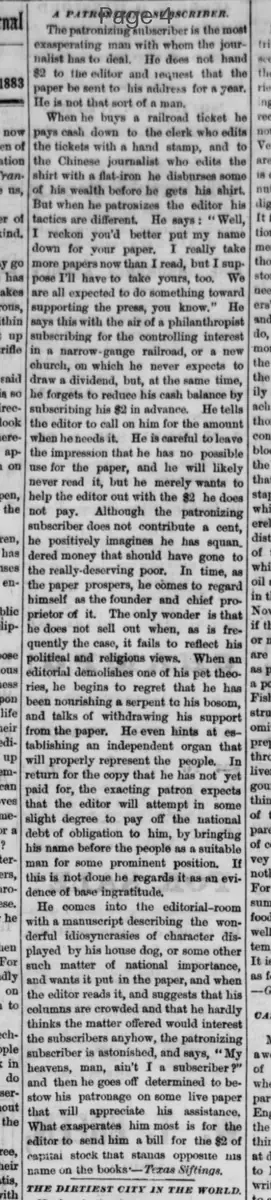
The patronizing subscriber is the most exasperating man with whom the journalist has to deal. He does not hand $2 to the editor and request that the paper be sent to his address for a year. He is not that sort of a man. When he buys a railroad ticket he pays cash down to the clerk who edits the tickets with a hand stamp, and to the Chinese journalist who edits the shirt with a flat-iron he disburses some of his wealth before he gets his shirt. But when he patronizes the editor his tactics are different. He says: "Well, I reckon you'd better put my name down for your paper. I really take more papers now than I read, but I suppose I'll have to take yours, too. We are all expected to do something toward supporting the press, you know." He says this with the air of a philanthropist subscribing for the controlling interest in a narrow-gauge railroad, or a new church, on which he never expects to draw a dividend, but, at the same time, he forgets to reduce his cash balance by subscribing his $2 in advance. He tells the editor to call on him for the amount when he needs it. He is careful to leave the impression that he has no possible use for the paper, and he will likely never read it, but he merely wants to help the editor out with the $2 he does not pay. Although the patronizing subscriber does not contribute a cent, he positively imagines he has squandered money that should have gone to the really-deserving poor. In time, as the paper prospers, he comes to regard himself as the founder and chief proprietor of it. The only wonder is that he does not sell out when, as is frequently the case, it fails to reflect his political and religious views. When an editorial demolishes one of his pet theories, he begins to regret that he has been nourishing a serpent to his bosom, and talks of withdrawing his support from the paper. He even hints at establishing an independent organ that will properly represent the people. In return for the copy that he has not yet paid for, the exacting patron expects that the editor will attempt in some slight degree to pay off the national debt of obligation to him, by bringing his name before the people as a suitable man for some prominent position. If this is not done he regards it as an evidence of base ingratitude.
He comes into the editorial-room with a manuscript describing the wonderful idiosyncrasies of character displayed by his house dog, or some other such matter of national importance, and wants it put in the paper, and when the editor reads it, and suggests that his columns are crowded and that he hardly thinks the matter offered would interest the subscribers anyhow, the patronizing subscriber is astonished, and says, "My heavens, man, ain't I a subscriber?" and then he goes off determined to bestow his patronage on some live paper that will appreciate his assistance.
What exasperates him most is for the editor to send him a bill for the $2 of capital stock that stands opposite his name on the books.-Texas Siftings.
He comes into the editorial-room with a manuscript describing the wonderful idiosyncrasies of character displayed by his house dog, or some other such matter of national importance, and wants it put in the paper, and when the editor reads it, and suggests that his columns are crowded and that he hardly thinks the matter offered would interest the subscribers anyhow, the patronizing subscriber is astonished, and says, "My heavens, man, ain't I a subscriber?" and then he goes off determined to bestow his patronage on some live paper that will appreciate his assistance.
What exasperates him most is for the editor to send him a bill for the $2 of capital stock that stands opposite his name on the books.-Texas Siftings.
What sub-type of article is it?
Curiosity
Deception Fraud
What themes does it cover?
Social Manners
Deception
What keywords are associated?
Patronizing Subscriber
Newspaper Subscription
Editorial Patronage
Non Paying Subscriber
Journalism Satire
What entities or persons were involved?
Patronizing Subscriber
Editor
Story Details
Key Persons
Patronizing Subscriber
Editor
Story Details
The patronizing subscriber verbally subscribes to the newspaper without paying the $2 fee, acts philanthropically, expects the editor to publish his trivial manuscripts and promote him for positions, and reacts with indignation when billed or rejected.